Crommunist
  • Blog
  • Music
    • Video
    • Audio
  • Media
    • Audio
    • Video
  • Events
  • Twitter
  • Ian Cromwell Music
  • Soundcloud

Category: health

4 Alternative therapies aren’t ALWAYS full of shit… but this one is

  • February 1, 2011
  • by Crommunist
  • · blog · Canada · health · medicine · science · skepticism

It seems that once again I am donning my ‘scientist’ cap and wading knee-deep into the shit…

Literally:

A hospital physician from a major B.C. facility says several patients died in the last year from C. difficile — unnecessarily — after the health authority stopped her and her colleagues from giving an experimental, simple and highly effective treatment… The treatment, called a fecal transplant, involves introducing stool from a healthy donor — usually a relative — into an infected patient’s bowel, usually through an enema.

Yes, you read that correctly. Dr. Jeanne Keegan-Henry is proposing transplanting somebody’s poo into the bowels of someone with a Clostridium difficile infection in order to cure them.

Poo.

Transplant.

Poo Transplant.

It sounds like the name of a doomed-to-obscurity high school punk rock band. And yet, Dr. Keegan-Henry, who is by all accounts an able and qualified physician, is recommending it. Skeptical smackdown time, right?

Here’s the crazy thing about skepticism. Detractors would characterize it as being resolutely opposed to anything that doesn’t sound like Big Pharma drugs, or is too experimental or outside the realm of conventional medicine. While it is often worthwhile to listen to the criticisms that come from one’s enemies, it is important to resist the temptation to allow them to define your position. More often than not, they are all too happy to succumb to the temptation of straw-manning you into oblivion rather than give a dispassionate description of what it is you actually think (cue the peanut gallery coming out of the woodwork to point out the many times I’ve done it to them).

Skepticism is about evaluating claims, all claims, according to their plausibility and the evidence supporting their truth. When I first caught wind of poo transplants (reader’s note: this article will be stuffed full of poop jokes – you have been warned) my skeptic hackles immediately went up. It’s really the prototypical case – we have a brave maverick doctor who is standing up to the medical establishment and recommending a completely natural remedy to a condition that is usually treated with drugs. For bonus points, it involves enemas. Seems like this ripe stinker was dumped right on our plate as another crazy whackaloon looking for attention (and possibly a book deal).

So, what does a skeptic do? She goes to the evidence! A quick search on PubMed (the U.S. National Library of Medicine National Institutes of Health centralized research database) for “fecal transplant clostridium difficile” reveals 30 hits – not exactly a stellar start; usually it’s in the neighbourhood of a few hundred to a few thousand results. The majority of these hits were commentaries and letters rather than full-blown research articles – also not a good start; what we’re looking for is systematic reviews of clinical trials, or at least trials themselves. We don’t have that – what we have is a handful of case series reports, each representing a tiny number of patients.

So I took a look at the largest case series, that of a 12-patient sample. And the results? Well… would you forgive me if I say “holy shit”?
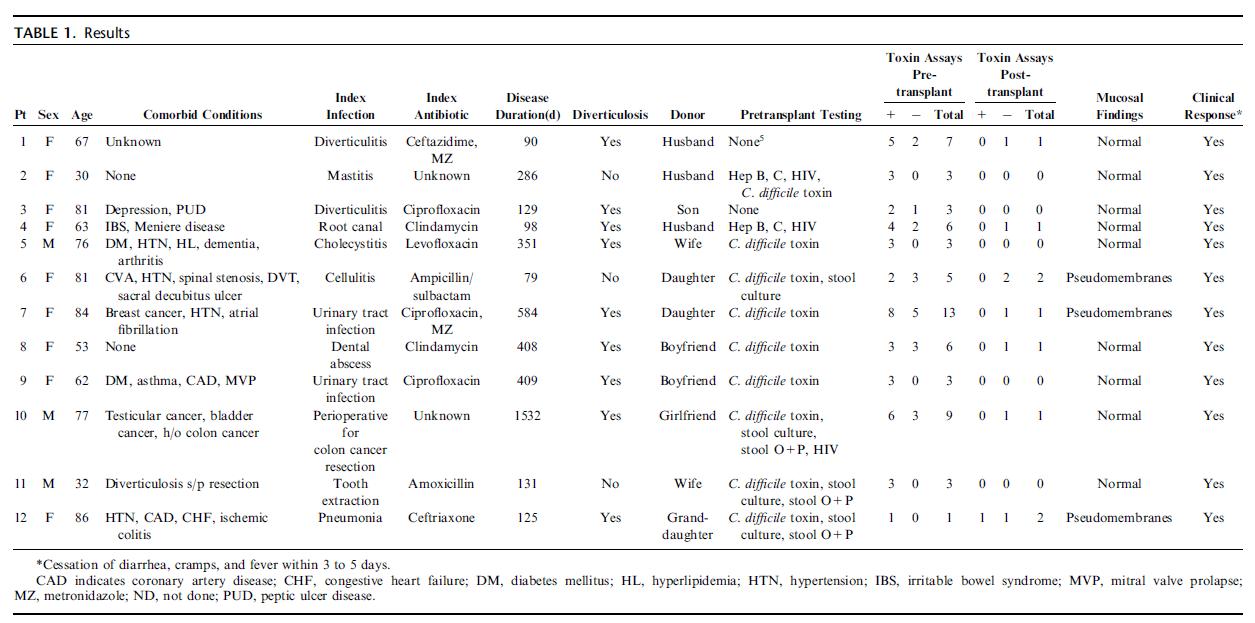
Click to enlarge

Of 12 patients with infections ranging from 79 to 1532 days (mean length = 352 days), 100% of the patients in this sample experienced a clinical response, defined as “cessation of diarrhea, cramps, and fever within 3 to 5 days”. The authors describe their inclusion and exclusion criteria clearly, as well as the treatment protocol. Patient followup ranged from 3 weeks to many years after the intervention (which is a necessary evil of a case series – it’s not a prospective trial where follow-up can be standardized).

So, cut and dry answer right? Obviously it worked for these patients! No need for further study – let’s approve the shit!

Not so fast…

The reason for putting on the brakes (and possibly leaving skid marks) is that this is one sample of patients. These results are certainly dramatic, but there were no enterobacteriology cultures done – the gut was not examined to see if it was truly the poop that did the trick. The patients from whom the samples were taken had taken doses of antibiotics before donating their sample – was it the poo or the drugs that done it? Even the authors of the paper admit that they don’t have a certain mechanism by which fecal transplantation works. There are certainly some plausible attempts at explanation, but they still don’t know.There was also no control group for comparison (although in a time-series design it is permissible to use the patients as their own controls, comparing them to their pre-trial state – I am channeling that degree in epidemiology!), meaning that we cannot rule out the placebo effect or some other event as explanatory.

Is Dr. Keegan-Henry right? Should we be allowing fecal transplanation? Maybe – the preliminary results are certainly compelling (to go from years of suffering to resolved in 3-5 days is really remarkable). We should be enrolling people in small-scale clinical trials to test for efficacy. Given that there are no observed adverse effects of the transplantation, there’s certainly no reason to block the investigation:

Dr. George Sing, a gastroenterologist at Burnaby Hospital, also wants to provide the treatment to patients. “We did table [a proposal], but it fell into the cracks,” said Sing. “We have been through all the channels … but when it goes through committees it gets bogged down.”

Heh… he said “fell into the cracks”.

This is the hallmark of skepticism – even if something looks totally batshit insane, we test claims against evidence, not against what we think should work. I’ll be interested to see if this story develops.
Like this article? Follow me on Twitter!

6 “Cultural Sensitivity” meets clear stupidity

  • January 27, 2011
  • by Crommunist
  • · blog · Canada · crapitalism · cultural tolerance · forces of stupid · health

It’s been a while since I talked about one of my first pet topics, the burqa bans going on in various places in the world. The point I laboured to make in those early articles was that there may be some specific circumstances under which it is better for society to brook some contravention of its rules in the name of being tolerant of practices imported from other cultures. This is particularly true of Canada, with its wide variety of cultural groups. If we want Canada to remain a place where groups from all over the world can feel at home, then we have to occasionally put aside our discomfiture toward “the other”.

But other times, “the other” is stupid and there needn’t be any accommodation:

Plans for a hospice on the University of British Columbia campus have been put on hold after some neighbourhood residents said the proposed facility offended their cultural sensitivities around death and dying.

“It is all about cultural sensitivity,” said Ms. Fan, a Chinese-born immigrant who lives in a high-rise near the proposed hospice site. “We came here as new immigrants with our own belief system. And in our beliefs, it is impossible for us to have dying people in our backyard.”

The main gist of this argument is that many Chinese-born immigrants share a cultural taboo about death, feeling that it brings bad luck and will spoil marriages and businesses and all sorts of other pursuits. Building a hospice in a neighbourhood with many immigrants from this area lacks cultural sensitivity for such beliefs.

My response: fuck your superstition.

This proposed building is on the campus of the University of British Columbia. UBC has a right to build whatever legal structure they like on their grounds. UBC also has a hospital on its grounds. News flash: people die in hospitals every day. People also die in car accidents, stabbings, from heart attacks… the list goes on ad infinitum. Death is a part of life – in fact, death is the thing that makes life precious. If your beliefs are in conflict with biological fact, it is not the responsibility of the rest of the world to move in line with your beliefs; it’s your responsibility to figure out a way to deal with it.

I feel passionately about this issue, as someone who works in cancer research. The majority of people who pursue hospice care suffer from terminal cancer. At the end of the course of this disease, patients are often in near-constant pain that gets limited (or no) relief through the use of drugs and radiation. The idea behind hospice care is to allow the dying person to maintain a bit of dignity and comfort. It is the sign of a compassionate and caring people when the sick and dying are cared for. Adequate hospice care means that people are not languishing in long-term care facilities, at home, or worst of all in a hospital, unable to access sufficient relief from their symptoms as their bodies shut down.

A very good friend of mine worked in a hospice on a co-op term. She would be able to speak much more eloquently and passionately than I can about what a great job hospice care does of improving the quality of life of people who are lucky enough to have the opportunity to die there. I say ‘lucky’ in full awareness of the fact that it’s not exactly ‘lucky’ to get cancer, but since there are far fewer spaces than there is demand for those spaces, getting in is indeed a stroke of luck.

I hope nobody would accuse me of being a person who is not sensitive to the fact that not everyone sees the world the same way. I am aware that different groups have different ideas about life, and that some issues hit people more viscerally than others. However, in this case we’re talking about conflating superstition with the real suffering of real people. The proximity of death has zero effect on whether or not your business is lucky – the flourishing funeral home business is perhaps a counter-example. People who work in hospitals around dying people can maintain happy relationships, and in some cases the death of a close family member can bring people closer together. To suggest that dying people should put relief of their suffering on hold because you’re afraid of the dark is the height of childish arrogance.

We should make our decisions based on what is real, not what spares the delicate feelings of stupid people.

Like this article? Follow me on Twitter!

13 This is horrible

  • January 26, 2011
  • by Crommunist
  • · blog · feminism · health · medicine · news · sex

I am in favour of a woman’s right to make her own sexual choices. This encapsulates her right to choose her sexual partner, her right to use contraception, and her right to choose whether or not she has a child. I am unmoved by the “logic” of the anti-choicers, which conflates the life of a developing embryo with the life of a fully-grown human person. I am similarly unmoved by their constant appeals to emotion, thrusting pictures of aborted fetuses in the faces of people who already have a difficult decision to make.

I am not, however, unmoved by this:

West Philadelphia abortion doctor Kermit Gosnell routinely delivered live babies in the third trimester of pregnancy, then murdered them by “sticking scissors into the back of the baby’s neck and cutting the spinal cord,” according to the Philadelphia district attorney. One newborn who weighed almost 6 pounds was so big “the doctor joked . . . this baby ‘could walk me to the bus stop.'”

Those are among the jaw-dropping details — complete with photographs — in a 260-page grand jury report released Wednesday that charges Gosnell, 69, with the murder of a patient and seven infants.

The article goes on to detail some of the abject depravity with which this “doctor” treated his victims patients. He hired unqualified people to perform medical procedures, gave inadequate care, and operated under nightmarish conditions:

What they found, according to the report, was “filthy, deplorable, and disgusting”: blood on the floor; the stench of urine; cat feces on the stairs; semiconscious women moaning in the waiting or recovery rooms, covered with bloodstained blankets; broken equipment; blocked or locked exits.

Whatever your feelings on abortion, you can’t help but be disgusted by not only the way in which this man conducted himself, but at the utter lack of humanity at his core. People pursuing medical care are at a fundamental disadvantage – they’re in severe need and are afraid for their safety. This is precisely the reason why all health care practitioners must undergo extensive medical ethics training (I myself have been the recipient of such training at least 7 times over the course of my short career). When someone provides medical care to another, they enter a position of both authority and trust. Those types of relationships are far too easy to abuse – one person is willing to sacrifice a great deal of their autonomy for the chance at relief from suffering. When you’re the person to whom autonomy is being given, you have a moral obligation to work for the best interests of that person, since that person would (under different circumstances) be operating for their own best interest.

Once again I find myself flummoxed by my inability to express sufficiently my utter horror and disgust at anyone who would systematically abuse this kind of trust. Most health care professionals I have had the pleasure of working with take the oaths and ethics of the caregiver-patient dynamic extremely seriously. I know that I do, even though I rarely have any contact with patients in my day-to-day work. To imagine that someone would not only dismiss that ethical responsibility, but outright contravene it in such an egregious and deleterious way for years shocks me. That this happened under the noses of the people who had a responsibility to regulate and inspect it depresses me beyond all belief.

PZ Myers says that this isn’t an argument about the morality of the practice of abortion, and for the most part I agree with him. He hits it squarely on the head when he says this:

Gosnell is precisely the kind of butcher the pro-choice movement opposes. No one endorses bad medicine and unrestricted, unregulated, cowboy surgery like Gosnell practiced — what he represents is the kind of back-alley deadly hackery that the anti-choice movement would have as the only possible recourse, if they had their way. If anything, the Gosnell case is an argument for legal abortion.

Outlawing abortion, as we have seen from international cases like Romania, and even within the United States, does not stop it from happening. All it does is reduce access to safe abortions, allowing monsters like Gosnell to maim more women who have no other options. Criminalizing abortion disproportionately affects the poor, particularly people of colour and immigrants who do not have the same access to resources and illicit medical services that their wealthier counterparts do.

I am deeply aggrieved and horrified that a remorseless killer like Kermit Gosnell exists and was allowed to continue hurting women for so long. I don’t know what the answer to this problem is, but I am confident that putting more women in the tender merciful hands of amoral ghouls like Kermit Gosnell is a step in the wrong direction.

Like this article? Follow me on Twitter!

6 No refund policy? No, refund policy!

  • January 10, 2011
  • by Crommunist
  • · blog · medicine · science · skepticism · skeptivism

This is the second part of this morning’s story of my homeopathic overdose.

After the “overdose” failed to accomplish anything, I went back to Finlandia and told the person behind the till that I was dissatisfied with the insomnia homeopathic preparation I had purchased, because it didn’t do anything. I told her that it had not changed my sleeping pattern whatsoever, and that as far as I could tell it didn’t work. She went and got the manager, who informed me that there was no refund policy on homeopathy. Peeved, I started to walk out. She stopped me and said that she might be able to do an exchange, although that was against policy too.

The reason for the policy, she told me, was that homeopathy doesn’t work right away. If I was looking for a “quick fix” I should try something else, but that homeopathy supposedly “regulates” my sleeping cycle. I pointed out that it hadn’t done anything like that, even after taking an entire bottle. She suggested that I needed to give it more time and keep going. I said that I was warned about that, and that I wasn’t interested in buying more of a product that didn’t work the first time.

As she ushered me over to the counter of sleeping stuff, she introduced me to the devil herself – the Heel Homeopathy rep. I described my issue to her and she gave me a bunch of the same nonsense about how it was working to ‘balance my energy’ and that I would need to wait for at least a week to see any effect. There was a guy behind the counter who said “it takes time, and homeopathy doesn’t work for everyone” (that old gem). I pointed out that when I came in, I told them I was having a sleeping problem, they gave me something they told me would help – at no point did anyone say “this will help in a week’s time” or “this might not work for you”. I was just told to follow the instructions. There is a difference here between things like antidepressants that actually do take a while to take effect – this information is disclosed to you when they are prescribed. These scam artists had told me no such thing at the point of purchase, and were then trying to evade having to pay me back when their snake oil didn’t work.

The assistant manager quickly swept me away from my debunking, and back to the sleeping pill counter. She then tried to up-sell me a bunch of stuff. The one she pushed the hardest was $44 a bottle! I put on my best skeptical face and said “look, I’m a scientist. I know a thing or two about how the body works, and none of what you’ve said so far addresses my problem.” Sensing defeat, she then buckled and refunded my money in full. Of course, on my way out she tried to sell me a bunch of other stuff, and told me to “do my own research”. Silly manager, I’ve done LOTS of research – you’re full of crap.

I do kind of feel bad about taking the refund under false pretenses, after buying the product under OTHER false pretenses. However, since it was PRESCRIBED under false pretenses, and the people who provide this stuff really ought to know better than to make false health claims, I will sleep just fine tonight (*rimshot*). I will donate the $18 to the James Randi Educational Foundation.

Like this article? Follow me on Twitter!

11 My homeopathic overdose

  • January 10, 2011
  • by Crommunist
  • · blog · critical thinking · medicine · science · skeptivism

If you’re reading this, then I survived a deadly overdose on sleeping pills. It wasn’t my iron constitution, survival instincts or even the quick work of trained medical professionals that saved my life; no, it was the fact that I used homeopathic sleeping pills.

Many of you have probably heard of homeopathy, but don’t really know much about it – this is how they make money. Like Scientology, the explanation is so stupid that once you know about it you can’t believe anyone buys into it. Basically, homeopathy operates on the principle that “like cures like” – for example, an herb that causes fever symptoms is a good cure for fever. The secret is that the substance must be super dilute, and the more diluted it is, the stronger it becomes. Avogadro’s constant (6.02 x 10^23) describes the number of molecules present in a mole of the substance in question – there are, for example 6.02 x 10^23 molecules of O2 in 38 grams of oxygen gas. What this means is that if you dilute something past 23C (C is a number which denotes the number of 100X dilutions a substance has undergone), there is essentially zero chance of even one molecule of active substance being present in the “remedy”.

Many homeopathic drugs are diluted to 30, 100, even 1000C – a sphere of water the size of the entire universe wouldn’t even contain one molecule of the substance. Homeopaths counter this by saying that water has “memory”, and can “remember” what was diluted in it. How it distinguishes between the herbs you want and the thousands of animals that have peed in it, the rocks it has passed over, and the other homeopathic remedies that have been in the same water (more dilute, therefore much stronger) is a question for which an answer has never even been attempted.

For a better explanation of how homeopathy works, go to this website: http://www.howdoeshomeopathywork.com/

It’s no exaggeration to say that homeopathy is completely useless. It couldn’t possibly work without re-writing the entire understanding of chemistry and physics, developed over hundreds of years. Even still, it has been tested – it doesn’t work. While a handful of “studies” (no control group, no proper blinding, small sample size) have shown a small effect for homeopathy – an effect that is much smaller than the claims that are made by homeopaths – every single rigorously-controlled study has shown it to be no different than a placebo. You could give someone a glass of water, tell them it’s homeopathic, and get the exact same result as if you put a drop of onion juice in it then diluted it a billion times.

However, despite the fact that it can’t work, and that it doesn’t work, people still buy into homeopathy in a big way. Walking the streets of Vancouver, it’s easy to stumble across a “natural” pharmacy that sells herbs, vitamins, and of course homeopathic preparations. Homeopathy is a multi-billion dollar industry – essentially the largest legal scam ever perpetrated (aside from, perhaps, religion) – separating desperate people from their money one vial of water or bottle of sugar pills at a time.

What did I do?

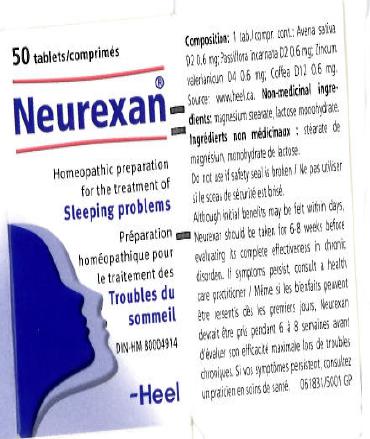
On Wednesday, October 27th, I participated in a mass suicide bid along with a handful of other Vancouver skeptics, organized through CFI Vancouver. I went to Finlandia, a naturopathic pharmacy on Broadway, to procure myself some homeopathic sleeping pills. I presented myself to the person behind the counter as a person suffering from insomnia, and curious about homeopathy (which, I would imagine, is a fairly reasonable case study). Without hesitating, the naturopath behind the counter pulled down a bottle of Neurexan, described on the bottle as a “Homeopathic preparation for the treatment of sleeping problems”.

Neurexan - homeopathic sugar pills

You’ll notice that the non-medicinal ingredients are sugar. Nothing else, just sugar. The suggested dose is 3 pills, so consuming the whole bottle would be about 16 doses of sleep meds.

As I would do with any new medication, I asked a few questions:

  1. As a larger person, sometimes I need a higher dosage. Response: It doesn’t matter if you’re 10 lbs or 1000 lbs, use the same dose.
  2. What happens if I miss the directions, or otherwise misuse the product? Response: If you miss a dose, just take a bunch extra.
  3. I’ve used sleeping pills before, and I woke up groggy. Response: Won’t happen with these.
  4. Is it possible to overdose? Response: You can’t overdose on homeopathy because it’s just energy.

If you go to a pharmacy and they tell you that the dose doesn’t matter, that you should just take a bunch extra if you miss the protocol, that there will be no adverse effects at all regardless of your previous medical experience, and that it’s impossible to overdose, make sure you haven’t stumbled into Bizarro world. Such advice from a real pharmacist would be recklessly irresponsible, which is why you get specific instructions when you buy medications.

I honestly don’t think that Jane (not her real name) was out to defraud me. I’m certain she believes that homeopathy works, as do her bosses. However, personal belief is not enough when you have someone coming in with a real medical problem. I might believe that punching you in the uterus will fix your infertility problem, but would you let me? Should you let me? Should you let your sister or wife or mother come to my uterus-punching clinic because she believes it too? No, what you’d likely do is demand some proof from me that it works – proof that you’d examine closely because of how implausible my “treatment” is.

While not the same as an uppercut to the babymaker, the bottle of pills cost me $18 – that’s some expensive sugar! On my way out of the pharmacy, I grabbed myself a copy of this little gem:

Pharma Fiction magazine

You saucy little minx – tell me how it’s the pharmaceutical companies that are defrauding me by selling me stuff that’s been shown to actually work. I’ll believe anything that you and your smoking bottle of pills tells me.

I met up with a group of CFI Vancouver skeptics in front of Vancouver General Hospital. They had all brought their own homeopathic concoctions, including a popular homeopathic flu medication, sleeping pills, arsenic pills and belladonna (the latter two being highly toxic when undiluted). All of these were available from places like Choices and Whole Foods – none of them were particularly cheap. At the appointed hour, we opened our bottles of pills and tossed back the entire thing.

To be clear, if you did this with sleeping pills that you could get as a prescription, or even over-the-counter things like Tylenol, cough medicine, antihistamines, pretty much anything you could get in a real pharmacy, you’d probably die. Even if you didn’t die, you’d be sick as a dog as the pharmaceuticals do what they do inside your body. Even if you didn’t get sick, you’d most assuredly feel something – high, woozy, drowsy, hyper, something. The most likely outcome of downing a whole bottle of sleeping pills is death.

What happened?

Nothing. Nothing happened at all. We stood around for an hour, waiting to feel something. Nothing happened.

What did we learn?

We are not the first group to perform this stunt – a group out of the UK called the 10:23 Campaign first did this on January 23, 2010 as a massive protest against Boots, a naturopathic pharmacy. Since then, the National Health Service (NHS) has called for the stoppage of funding for homeopathy with public money, doctors have petitioned the government to stop licensing homeopaths, and a great deal of light has been shone on this shadiest of practices.

Here in Vancouver, naturopaths are being given diagnostic and prescription privileges. People are flocking to places like Finlandia on the mistaken assumption that the stuff in the bottle does what it says. Homeopaths are banking on a combination of the scientific ignorance of the populace and the veneer of respectibility that accompanies being called a “doctor” to push placebo medicine to desperate people. They compound this by railing against the pharmaceutical companies and the government health regulators, stirring up hostility against the scientific community at large. In fact as a skeptic, it is almost inevitable that you will be accused of being a “Big Pharma Shill” when you bring up the fact that most “alternative medicines” don’t actually do anything (or at least they don’t do what they claim).

The predictable response from those who endorse “alternative” or “natural” medicines is to say “what is the harm? If people think it makes them feel better, why tell them otherwise?” I’ve dealt with this question before, which is to say that the truth is important if we are going to live in a society with other people and make decisions that affect each other. In this particular case though, there is a more tangible cost. This website lists cases of people who died or were seriously injured by belief in quack medicine. Obviously no treatment is perfect, but to convince people to forgo treatment that has a chance of working because you want to sell them something that doesn’t work is tantamount to abetting involuntary suicide.

Another tired trope is that homeopathy only works on some people. It’s quite the coincidence that none of the people who have tried the overdose or who have been observed in carefully designed clinical trials are the ones who it “works” for. The whole point of a study is to control for random differences between people, so that the only difference is the treatment you’re giving them. It would have to be the mother of all coincidences that nobody in these rigorous studies, nobody in our group, and nobody in the 400+ skeptics in the 10:23 campaign felt any effect in the slightest. It would have to be coincidence if it worked – but it doesn’t. The easiest explanation is that homeopathy is just water, with no more “medicine” in it than what comes out of the tap.

We were lucky as well to have the entire thing videotaped by CBC Marketplace as part of their exposé on Boiron, the largest manufacturer of homeopathy in Canada. The episode is due to air this Friday at 8 pm, so you should check it out. I’m not sure if I got on TV or not. Hopefully our merry band of skeptics can help convince people that spending any money on homeopathy is a complete and total waste, because it doesn’t do anything.

Incidentally, I slept pretty much the exact same as I always do that night. I woke up around 3:00 in the morning, rolled over and went back to sleep.

TL/DR: Homeopathy doesn’t work either in theory or in practice. Taking an entire bottle of pills doesn’t have any effect. Homeopaths are defrauding people and giving them sugar pills instead of real medicine.

Make sure you read part two of this saga.

Like this article? Follow me on Twitter!

8 “Alternative Medicine” isn’t

  • January 4, 2011
  • by Crommunist
  • · blog · critical thinking · medicine · science · skepticism

I am not Orac (though at times I wish I had his flair and his work ethic). My involvement in medicine can be accurately described as “tangential”, at least insofar as it comes to my career. That being said, I’m interested in the decisions we make when the stakes are high, and they don’t get much higher than the life and death circumstances we find ourselves in when talking about our health. As a result, I am acutely interested in the discussion around “alternative” medicines.

Alternative medicine, of course, is a propaganda phrase used to describe “treatments” that lie outside of the accepted norms for medicine. It is applied with equal gusto to completely sensible and useful things like modifying diet and exercise; things that seem like they might work but are a little out there like acupuncture and chiropractic; and to things that don’t make any sense and are completely batshit insane like homeopathy or energy healing (although, to be sure, there are way crazier things out there). The problem with such a… shall we say… flexibile definition of “alternative”, is that when someone points out that acupuncture doesn’t work, or that “energy healing” is the same fakery that faith healers exploit, people jump on them and say that they’re against anything that is “natural”.

That’s a distortion of the skeptical position that is so outrageous that it borders on being a lie. Large mainstream science-based organizations like Health Canada and the World Health Organization whole-heartedly endorse the use of diet and exercise modification to reduce the risk of heart disease, diabetes, stroke, and any number of other chronic and acute conditions. Herbal remedies are refined and turned into powerful pharmaceuticals (Aspirin is a commonly-invoked example of such a refinement). Things like yoga, massage, and other types of relaxation therapy are often recommended to reduce stress which can underly a number of health problems. Skeptics are happy to accept something so long as it works. We don’t care if it’s “alternative” or not.

These “alternative medicines” are not alternative in any way – if they work, then they aren’t alternative, they’re just medicine. The other side of the problem is the ones that are truly “alternative” aren’t medicine! They don’t work any better than voodoo or augury or invoking ancestor’s spirits. This wouldn’t be so problematic, except that they still do cause side-effects:

Giving alternative treatments such as homeopathic remedies instead of conventional medicines to children may have deadly side-effects in rare instances, a new analysis says. Australian researchers monitored reports from pediatricians in Australia from 2001 to 2003 looking for suspected side-effects from alternative medicines like herbal treatments, vitamin supplements or naturopathic pills. They found 39 reports of side-effects including four deaths.

Real medicine is regulated, monitored for safety, and must pass through a strict certification process to reach market. Nobody would claim that the process is perfect – some real stinkers get through – but they get caught. All some quack has to do is slap the label “alternative” on her product, and she gets off scot free. This poses a real threat – herbs and supplements are biochemically active substances that have real effects in the body. The liver doesn’t care if something is “natural” or not – it still breaks it down. The metabolites of any substance that enters the body can exert real effects, particularly if they are used in conjunction with pharmaceuticals.

But what about things like reiki or homeopathy? Surely these things that exert no actual effect on the body (above the often-misunderstood placebo effect) don’t cause the liver to do anything. What possible side-effects could they cause?

The answer is that people will often forego real treatments in favour of these so-called “alternative” approaches:

In 30 cases, the issues were “probably or definitely” related to complementary medicine, and in 17 the patient was regarded as being harmed by a failure to use conventional medicine. The report says that all four deaths resulted from a failure to use conventional medicine.

One death involved an eight-month-old baby admitted to hospital “with malnutrition and septic shock following naturopathic treatment with a rice milk diet from the age of three months for ‘congestion'”. “Another death involved a 10-month-old infant who presented with septic shock following treatment with homeopathic medicines and dietary restriction for chronic eczema,” the authors say.

One child had multiple seizures after complementary and alternative medicines (CAMs) were used instead of anti-seizure drugs due to concerns about potential side effects. The fourth death was of a child who needed blood-clotting drugs but was given complementary medicine instead.

These people proceeded in defiance of medical advice to give useless products to children with real health problems. Adults do this to themselves too. It’s not because they didn’t know or weren’t told, it’s because they believed in the lie that is the phrase “alternative medicine”. I can’t put too strong a point on this: “alternative medicine” isn’t alternative, and it isn’t medicine. The stuff that works is just medicine, and the stuff that doesn’t work is nothing other than voodoo.

I have friends who are voodoo practitioners. A woman I did my undergraduate with is training to be a chiropractor (much to the face-palming chagrin of the rest of our class); two of my close companions here in Vancouver use acupuncture as part of their otherwise science-based rehabilitative toolkit; another friend is into “energy work”, whatever that means. This is not an abstract concept to me, nor should it be to you. If you buy into the idea that there is such a thing as “alternative medicine”, you’re helping contribute to the climate that puts completely decent things like healthy lifestyle factors in the same category as crystals and “psychic surgery”.

There is no “alternative medicine” – there’s just medicine and bullshit.

Like this article? Follow me on Twitter!

6 ‘Tis the season… to shove it in their faces!

  • December 13, 2010
  • by Crommunist
  • · blog · medicine · religion · secularism · skeptivism

Cross-posted from Canadian Atheist, in direct (and repeated) violation of the unofficial policy prohibiting such things.

This one will brief, since Hemant over at Friendly Atheist has already given us all the relevant information:

The Atheism subReddit has taken up the cause to raise $42,000 for Doctors without Borders — the amount is an homage to Douglas Adams.

This is a friendly competition with the members of the Christianity subReddit, who are donating to the World Vision Clean Water Fund. Much like with Kiva, we’re crushing them with our generosity :) (I should’ve pointed out that this is hardly a fair fight because the Atheism subReddit outnumbers the Christian subReddit by a longshot. There’s waaaaay more of us. So the “competition” is all in good fun. Still, Christians are more than welcome to try to beat us :) )

As I write this, the atheists have already raised $30,000. The Christians have raised a little over $10,000.

Let’s help the atheists reach their goal (and, as a bonus, give more than the Christians).

If you’re in the U.K., you can give here.

If you’re in America (or elsewhere), you can give here.

I just gave $10. What are you donating?

Personally I think this is an awesome idea. Despite being at odds with a large segment of the atheist community with my stance toward religion, I think this is the kind of collaboration and friendly rivalry that the “accommodationists” are talking about most of the time. I’m happy to channel some of my vitriol (and one night out’s worth of cash – I donated $50) into a cause that sees real and positive results for someone else on the planet.

So atheists, put down your deep-fried baby sandwiches, click on the link, and cough up whatever dough you can spare to finally destroy Christianity once and for all! Or, get a poor kid some medicine. Whatever lifts your luggage. Christians, you can donate here.

Like this article? Follow me on Twitter!

8 Whoops, spoke too soon

  • December 8, 2010
  • by Crommunist
  • · blog · Catholic church · ethics · health · politics · religion · retractions · sex

Sometimes I overextend myself and make statements preemptively before I have all the facts. It can happen to any of us, and from time to time I have to walk back something I’ve said in a post here.

This is one of those times.

Yesterday, I made a statement in a post that could be interpreted as me saying that the Pope wasn’t evil:

Apparently the world is quite willing to hand an abundance of cookies over to the Pope for finally saying something that pretty much everyone else had figured out already.

But hey, at least he figured it out, right?

I’m sad to say that I have to walk back even this grudging attempt to paint the Pope in anything other than a completely negative light:

Pope Benedict XVI praised efforts of the Filipino bishops in blocking any attempts to promote contraception in the Philippines. The pontiff said the Philippine Catholic leadership has reaffirmed its commitment to confronting any attack on the sanctity of life.

“I commend the Church in the Philippines for seeking to play its part in support of human life from conception until natural death, and in defense of the integrity of marriage and the family,” said Benedict XVI.

Hmm, perhaps I should translate:

Pope Benedict XVI praised the corrupting influence in the Filipino bishops in ensuring that poor people are doomed to sexually transmitted diseases and unwanted pregnancy in the Philippines. The ancient decrepit virgin said that the religiotic busybodies in the Philippines have reaffirmed their commitment to preventing any attempt to improve the quality of life.

“I commend the assholes in the Philippines for seeking to dictate its beliefs to other people in defiance of human rights from conception until natural death, and in defense of bigoted and outdated definitions of marriage and the family,” said Benedict XVI.

So it is to my great chagrin that I must apologize for misleading you fine readers. The Pope is completely evil and has no redeeming qualities. He is happy to whine and cry about the “oppression” of religion in rich countries, and then cackle with Palpatine-like glee as his Church dooms entire countries to a cycle of abuse and unwanted pregnancy in the poor countries.

Tim Minchin, play us out…

Like this article? Follow me on Twitter!

10 Do me a favour?

  • December 7, 2010
  • by Crommunist
  • · blog · critical thinking · health · medicine · skepticism

I have heard that Ms. Tinkham has died of her cancer as of 3:30 pm PST. I am deeply saddened by this, more so because this death was, in all probability, preventable.

I enjoy blogging, I really do. However, sometimes it’s a struggle to find the inspirado to write. Since I started this for serious back in March, I’ve posted at least one new story every morning at 6 am (Vancouver time). Mondays I have reached deep into my psyche and pulled out a completely organic essay (what I’ve taken to privately referring to as my “think pieces”), and Fridays I have scoured the interwebs to find you a pithy or humorous video to entertain you.

I have yet to miss an update (I came perilously close this past Friday, but I still got it out).

I love blogging, but on those days when I just don’t feel like writing, I am spurred on by the thought that somewhere out there in the world, there is someone (maybe even a few someones) who read these things and get something from them. Maybe it’s just mindless entertainment as part of your morning routine, maybe it means something more than that; regardless, the thought of you going “where the fuck is today’s article?” is what chains my ass to the desk and gets my fingers a-typin’.

I say all this because the time has come for me to ask a favour from you. Over at Respectful Insolence, Orac has put out this plea:

I’m still perturbed that a cancer quack was able to convince a woman who had everything to live for that he could cure her of her breast cancer without surgery, chemotherapy, or radiation. I’m still perturbed at this particular cancer quack’s attitude, where he tried to claim that he didn’t know the woman who is dying, Kim Tinkham, and imply that her cancer recurred because didn’t follow his regimen carefully enough, that she had stopped living the quack’s “alkaline diet.” I thought of my mother-in-law, who died in 2009 of metastatic breast cancer, and watching her decline.

And then I thought of Oprah Winfrey and her role in what ultimately happened to Kim Tinkham.

…

Oprah needs to know what can happen when people choose quackery and woo instead of effective science-based medicine.

Because I know how hard Orac works to get his lengthy and in-depth analyses of science-based medicine and medical skepticism out there, I was happy to contribute my voice to what I hope is a chorus of people saying the same thing: people who give bad advice about medicine have to live with the consequences of their words. This Kim Tinkham woman was told that cancer was an “acid” that was caused by feelings of resentment – a steamier pile of bullshit there has never been. Based on this faulty premise, the exposure and publicity that she got on the Oprah show, and Oprah’s whole-hearted endorsement of nonsense like The Secret, Ms. Tinkham eschewed conventional treatment and attempted to “alkalize” her body to get rid of cancer.

To be sure, with a stage III cancer she had roughly 50% odds of succumbing to the disease even with conventional treatment. However, that is a full 50% better chance than if she just slowly lets the cancer kill her. If we found some other treatment that improved your odds of surviving cancer by 50%, we’d be trumpeting it from the skies. Ms. Tinkham, with encouragement from Oprah, decided to opt instead for witch-doctor treatment from a quack who thinks that cancer is made up of acid. I have, with my own two eyes, seen a cancerous tumour – it looks nothing at all like acid. Furthermore, I have seen positive, happy, well-balanced people die of cancer – to suggest that it’s their own fault for having too much “resentment” is a disgusting insult to anyone who has seen a loved one die of cancer.

And so I am asking you, my dear readers, for whom I work so hard to provide regular (and hopefully interesting) content 5 days a week, to do me this favour: please write in to the Oprah show and tell them that it’s not okay to encourage vulnerable sick people to slowly commit suicide under the “care” of people who would exploit them first, then blame them later when their voodoo “cures” don’t work.

Please also feel free to copy and paste your submission to Oprah in the comments section.

Like this article? Write in to the Oprah Show then, dammit!

P.S. WordPress helpfully tracks the number of clicks the links that I post yield, so if you read this and don’t write the show, I’ll know.

2 MS procedure claims its first(?) victim

  • November 30, 2010
  • by Crommunist
  • · blog · Canada · health · science · skepticism

I like lots of things. I like dogs, I like children, I like rainstorms, I like canoeing (although I haven’t gotten my act together to go in a long time). Another thing I like is being right. I am unashamed to say that I get a giddy little thrill when I can clarify a position and bring someone around to my way of thinking. It’s not particularly humble or diplomatic of me, but I figure as long as I don’t throw it in anyone’s face I am okay.

There are some times I wish I wasn’t right:

An Ontario man with multiple sclerosis died of complications after a controversial treatment in Costa Rica to open up his neck veins, CBC News has learned. Mahir Mostic, 35, of St. Catharines died on Oct. 19, one day after doctors in the Central American country tried to dissolve a blood-clot complication.

Let’s back up for a second. Back in April, I wrote a post about a new proposed therapy for the treatment of Multiple Sclerosis. This therapy involves inserting an angioplastic balloon into a neck vein and inflating it. The proposed mechanism violates the current scientific understanding of MS, but patients have reported dramatic symptom improvement after receiving the procedure, so it was worth investigating. However, the rules of skepticism must be particularly adhered to when a new “miracle” procedure appears that completely changes the current understanding of any phenomenon. If someone, for instance, claimed that they had invented a ‘gravity beam’ that could attract objects by firing gravity at them, we’d probably be more skeptical than if someone had said they’d invented a ‘sound beam’ that could fire sound over long distances – the latter requires a slight tweaking of current understanding, whereas the former requires a complete re-imagining of how gravity works.

So, by the same token, I was concerned at the flood of patients demanding access to this procedure without adequate testing beforehand. Even the doctor who invented the procedure cautioned people to wait until it had been evaluated. However, out of their (totally understandable) desperation to alleviate their symptoms, patients demanded that the approval for the surgery be fast-tracked. When the various health authorities said that they needed to have actual testing before they would approve it, the predictable happened: a private company began shipping people to countries that don’t care about health regulations.

The problem with failing to regulate health care is that it allows quackery to go on unmonitored. These patients who circumvent the system do not receive adequate follow-up:

Suddenly, after nine weeks, [patient Brandon] Layh began to deteriorate. His neurologist said he had two blood clots near the stent, and he was prescribed more blood thinners. The couple fears what could happen if the clot moves. “If it lets go, we were informed that he could have the clot move into his brain, which would cause a stroke,” said his wife, Sindy Layh. “I know they can fix it. He shouldn’t have to wait to get into a dire situation where he is on death’s door to be treated.”

The couple is now exploring whether to seek treatment in the U.S. to dissolve the clot at a cost of $20,000.

Stents increase blood turbulence, which promotes the formation of clots. The problem with clots is that there is a “damned if you do, damned if you don’t” scenario: a clot can become dislodged and cause a stroke, but prescribing clot-busting drugs when the clot itself is that far advanced makes such an event more likely. Blood thinners are prescribed to prevent the clot from growing and reducing turbulence, but at any point the clot could break off. Proper follow-up and monitoring may have been able to prevent this from happening, but so would not having the procedure in the first place.

And now, thanks to patient zeal and the happy willingness of the private sector to exploit that zeal, a man has died. Apparently his isn’t an isolated case either:

[Vascular surgeon Barry] Rubin said Mostic isn’t the first case of a serious complication in an MS patient who has sought treatment outside Canada. Last week, he treated a woman who had the vein procedure in Mexico.

“We found extensive clotting in the left arm reaching into the chest veins, and some of the clots had broken off and travelled to her lungs, which is called a pulmonary embolus, which is life threatening, potentially life-threatening complication.”

This is what happens when you skip steps and jump right into a risky procedure. This is why science works in small, incremental steps. This is why it’s a good thing that such studies take time. None of this means that the procedure doesn’t work, it just means that there are significant risks to the patients, and we don’t know if the benefits are worth it.

I have friends whose careers tip-toe into the realm of woo-woo, who often chastise me for my skeptic approach. “If it gives people hope and makes them feel better, what’s the harm?”

This is the harm.

Like this article? Follow me on Twitter!

Page 6 of 7
  • 1
  • …
  • 4
  • 5
  • 6
  • 7

  • SoundCloud
  • Twitter
  • Facebook
  • YouTube
  • Subscribe Subscribed
    • Crommunist
    • Join 82 other subscribers
    • Already have a WordPress.com account? Log in now.
    • Crommunist
    • Subscribe Subscribed
    • Sign up
    • Log in
    • Report this content
    • View site in Reader
    • Manage subscriptions
    • Collapse this bar
 

Loading Comments...