Crommunist
  • Blog
  • Music
    • Video
    • Audio
  • Media
    • Audio
    • Video
  • Events
  • Twitter
  • Ian Cromwell Music
  • Soundcloud

Category: skepticism

3 Intelligent vs. smart: reflections on ‘racial realism’

  • September 19, 2011
  • by Crommunist
  • · blog · critical thinking · crommunism · forces of stupid · race · racism · science · skepticism

As a member of the skeptic/freethinker community, I tend to associate with many people that share my views on things. I am somewhat spoiled by the fact that most people my age in Canada read from the same playbook, and have many of the same fundamental assumptions/conclusions about the world. It is therefore usually a pretty big shock when I meet someone who is a 9/11 truther or a climate change denialist or a hardcore libertarian making themselves known at a skeptic’s pub night or related event.

Many people use the term ‘skeptic’ to denote anyone who ‘opposes the status quo’ – saying that their conspiracy mongering over who really took down the World Trade Center towers is just them being ‘skeptical’. When organized skeptics talk about ‘skepticism’, they generally refer to methodological skepticism – a philosophy wherein all beliefs and truth claims are subjected to scrutiny and apportioned to the available evidence. While superficially those do seem to overlap, the problem with the positions I mention above is that they fail to doubt their own truth claims, instead relying on a combination of ideological rigidity and back-filling to “prove” their validity. As I’ve spelled out before, it is no good to decide something is true and then look for evidence – the human mind is capable of thus “proving” pretty much anything it likes.

Enter “racial realism”.

Regular readers may recall a number of months ago when I had a white supremacist show up in the comments section. It triggered a somewhat unusual and surprising reaction in me – one that I myself wasn’t really prepared for. That aside, while I stand by my characterization of that person as a de facto white supremacist, he would probably prefer the term “race realist”. Race realism is, generally, the position that observable racial groupings are biologically valid, and are so beyond simply superficial cosmetic traits. The video linked above was created by someone who describes herself in such terms.

It may surprise you (it certainly surprised me) to learn that there are many points of agreement between myself and the author. Insofar as race has a biological component, I am certainly happy to admit that genetic differences account for phenotypic differences. I will also agree with her assertion that many people (most often those on the political left) misuse the term ‘racist’, often in an attempt to introduce emotional weight to an argument, sometimes in lieu of actually refuting the claims made. I will finally agree with her closing statement that noticing racial differences is not, in and of itself, racist.

That is probably the beginning and the end of the places where the author and I would agree with each other. The rest of the video is (despite the catchy musical accompaniment) is utter nonsense. Her basic position is that because races are inherently different, that “noticing” racial differences is only natural. The problem with her position specifically, and racial realism generally, is twofold. First, the statement that racial differences account for the type and magnitude of differences in access/achievement seen between racial groups is unsupported by the scientific evidence, and fails to take into account the multitude of other demonstrated, observed factors.

Second, the video uses the word “noticing” in a profoundly different way than we would colloquially. When the author uses the word ‘noticing’, she means semantically what most of us would use the word ‘explaining’ for. Noticing that there are disparities between racial groups is, indeed, not a racist action. Explaining differences between groups by attributing them to something as demonstrably superficial as race certainly qualifies as racism – almost by definition.

I’m not going to spend too much longer on the myriad of reasons why I disagree with the author. Friend of the blog Will has done an unbelievably thorough job of skewering the specific claims about race that the author makes:

Ruka also demonstrates a complete lack of understanding of social constructivism. The fact that race is socially constructed does not mean it is not real. It means that it is not reducible to biological traits. Race is a very real idea and has real, tangible implications on peoples’ lives. So, of course racial hate crimes exist, but they are based on the way people define race (e.g., skin color), not based on biology. I will close with a typically anthropological discussion. The definition of “race” varies cross-culturally, across time, and across space. This fact is evidence for a social construction of race. An excellent example of this can be seen in the changes of the race category of the United States national census over the last two centuries and in comparing the American categories of race options to the race options on other countries’ censuses.

Tim Wise has similarly taken his quill to the position of racial realism, saying that even if it was true it would be morally inarguable:

 In other words, in order to uphold the notion that people should be treated like the individuals they are — not merely as individuals in the abstract — considering the way that racial identity may have limited opportunities for job or college applicants (and thus, taking affirmative action to look more deeply at what goes into an applicant’s presumed and visible “merit”) would be morally requisite. And yet, making assumptions about individual IQ based on group averages, and then doling out the goodies accordingly would be morally repugnant. Both look at group identity, but for very different reasons, with very different levels of ethical justification, and with very different practical results.

I don’t think I could do a better job than they have of taking on this absurd position. My utter contempt for it is such that I am loath to run the risk of elevating it above the adolescent brain-fart it is. What I would like to do is offer some perspective on why I think the author, and those like her, should be particularly addressed by the skeptical community.

Smart vs. intelligent

Back in early 2009, I re-posted a brief essay I had written delineating the concepts of “smart”, “wise”, “intellectual” and “intelligent”. I have a tendency to redefine terms for my own purposes, and I wanted that page to serve as a reference in case I ran into someone who objected to my describing of something as ‘stupid’. Simply put, “intelligent” refers to one’s ability to adapt to novel situations, “wise” includes the application of previously-held knowledge, and “intellectual” refers to one’s willingness to process things cognitively and through the application of logical processes. “Smart” is the confluence of all three of these attributes, whereas ‘stupid’ is its polar opposite.

I have no doubt that Ruka, the author of the video above, is intelligent. I am sure that, in her own way, she is “intellectual”, except insofar as she ignores contradictory evidence and refuses to address the flaws in her position, preferring instead to bloviate about how mean everyone is to her when she’s ‘just asking questions’. None of her intelligence, however, protects her from being profoundly stupid. I cannot really speculate about whether she is intentionally introducing straw man arguments and red herrings into her position, but I can conclude that, intentional or not, her arguments are sloppy and borne of an unbelievably arrogant reliance on her own perception of her cognitive abilities.

This kind of unwarranted self-assurance is also what is at play in 9/11 truthers, climate skeptics, Holocaust deniers, and other non-methodological ‘skeptics’. While it is most often an unfair straw man characterization foisted upon us by our opponents, it is also occasionally true of those who call ourselves ‘freethinkers’. Skepticism, as I’ve mentioned variously in previous posts, is an ideal to be pursued; not a goal to be reached. The only reliable path to truth is to test our beliefs against observed evidence, and (more importantly) to change them when necessary. While this can be done without ridiculous hang-wringing and false modesty, one must always keep in the back of their mind the statement “what if I’m wrong? How could that be demonstrated?”

Failing to do this, or only pretending to do it, as Ruka does (she apparently blocks comments unless they agree with her or  insult her – presumably so she can paint her opponents as lunatics as she does in the video I link above), will inevitably lead us into positions like hers, where our inherent beliefs about the world are ‘justified’ through a convoluted process of back-filling and denial.

Like this article? Follow me on Twitter!
5 Exploring the alternative

  • August 10, 2011
  • by Crommunist
  • · blog · crapitalism · critical thinking · forces of stupid · health · medicine · skepticism

I live in Vancouver. Vancouver is home to quite a bit of what is wildly-inaccurately called “alternative medicine”. What people think they mean by this term is medical treatments that fall outside of the conventional combination of surgery, pharmaceuticals, and other forms of medicine that one expects to find in a hospital. Some even fancy these treatments as operating in a different medical paradigm – an entirely new way of looking at the human body and human health.

The truth is that “alternative” medicine has been around forever – it’s how we treated illness before we understood anything about immunology, biology, biochemistry, physics… basically it’s what we did while we were all idiots. Apparently some of us are still wedded to our historical idiocy, and are promoting this prescientific bafflegab under the label of “alternative”. However, there’s nothing alternative about it – it’s just the stuff that doesn’t qualify as real medicine.

People here in North America don’t seem to appreciate this line of reasoning. They accuse people who recognize the importance of basing our health care decisions on scientific evidence of being “closed-minded” and “reductionist”. This is an inaccurate characterization, since the whole principle of the scientific method requires open-mindedness and evaluation of truth based solely on observed phenomena. However, cloaked in a certainty borne of smug arrogance (“science doesn’t know everything – there are other ways to know things”), people readily flock to nonsense ‘treatments’ like reiki, homeopathy, acupuncture, reflexology, and a whole host of others.

However, there are millions of people who turn to these ‘alternative’ therapies because they can’t get actual medicine:

Ignoring the red-and-white danger sign, Sri Mulyati walks slowly to the train tracks outside Indonesia’s bustling capital, lies down and stretches her body across the rails to seek electric therapy. Like the nearly dozen others lined up along the track, the 50-year-old diabetes patient has all but given up on doctors and can’t afford the expensive medicines they prescribe. In her mind, it is only option left. “I’ll keep doing this until I’m completely cured,” said Mulyati, twitching visibly as an oncoming passenger train sends an extra rush of current racing through her body.

Side effects may include headaches, nausea, cramps, and being crushed by a motherfucking train. It is sad to see that a complete lack of a social safety net has resulted in conditions being this bad (are you paying attention Americans? Republican North Party?). It’s stuff like this that lights the fire under me to keep defending a well-run and publicly-funded health care system.

Back to my original point though. I challenge anyone who promotes ‘alternative medicines’ to explain why this particular therapy is stupid, but your treatment of choice isn’t. For those promoting science-based medicine, this task is easy: rigorous examination of patients reveals that those that lie on train tracks to cure their diabetes experience the same rate of cure as those that pursue homeopathy, reiki, crystals, ‘distance healing’, and whatever other nonsense term you’d like to throw out there.

If you’re not of a mind to call this therapy stupid and think that there’s something to it, then I really have to question your sanity. These are people risking their lives for a cure that not only doesn’t work, but can’t possibly work. Diabetes is not a condition of the nervous system. Electrical shocks would have no effect on the ability of the pancreas to produce its own insulin. The only thing that repeated and prolonged shocks might do is the same kind of effect you see in electroconvulsive therapy – massive release of endorphins and neurotransmitters, causing temporary feelings of euphoria. It would certainly explain the types of testimonials available in the article:

But Mulyati insists it provides more relief for her symptoms — high-blood pressure, sleeplessness and high cholesterol — than any doctor has since she was first diagnosed with diabetes 13 years ago.

Illness is a complex and multifaceted concept. I am entirely willing (and so is the medical community) to grant that there is a psychological role to all disease. This doesn’t mean anything quite so Chopra-riffic as being able to think yourself well from cancer, but it does suggest that management of any kind of illness requires an understanding of patient psychology. Anyone who can tap into a patient psychologically can provide “relief” of a certain kind, but that doesn’t do anything to treat the underlying biophysical problem.

Then again, some problems are not exactly biophysical:

The Philippine government has warned against using geckos to treat various diseases, including Aids and cancer, saying the traditional and common practice across southeast Asia could put the ill at greater risk. A Philippine health department statement said on Friday that the use of geckos as treatments had no scientific basis and could be dangerous because patients might not seek proper treatment for their diseases. “This is likely to aggravate their overall health and put them at greater risk,” it said. Treatments for asthma are easily available and affordable, while there are antiviral drugs to control the progress of HIV, the statement added.

Sometimes the problems are more deeply entrenched than even an adequately-funded health care system can address. Proponents of ‘alternative medicine’ often point to the age and popularity of their nonsense as evidence that it must work. After all, the reasoning goes, why would people stick with something that doesn’t make you better? Surely people are inherently rational and will abandon bogus medical intervention once they have been shown not to work. As difficult a time as alt-med types have with evidence, it seems to point in the opposite direction of this hypothesis.

And sure enough, just like in the Phillippines, there are always those who are hovering around the crowd of desperate sick people, circling like vultures and waiting for an opportunity to make a quick buck. The problem is that there will always be hucksters and charlatans who are more interested in making money than making people feel better. Worse, there are those that honestly believe they are helping, but who don’t bother to follow up or investigate their ‘patients’ longer than it takes to pocket their fee and hear a testimonial.

This is a problem that can be addressed only in part by legislation – we can’t really legislate people into rationality. It is for this reason that I am a partisan skeptic: we need to be actively promoting the ideals of basing our decision-making on scientific evidence, rather than simply saying “well people are going to do what they want.” This kind of arch-liberal hands-off cowardice is laying out the path for more abuse, fraud, and ultimately preventable deaths.

Like this article? Follow me on Twitter!

A warning about increasing diversity

  • July 18, 2011
  • by Crommunist
  • · blog · crommunism · skepticism

Regular readers will probably have noticed that my post this morning was a bit more verbose than they’re used to seeing. In the interest of not making these things too ponderous (and also in the interest of serving my own short attention span) I try to cap blog posts around 1,000 words. Sometimes the ‘Monday Think Pieces’ go a bit over, but today’s post was knocking down the door of 2,000 words. In my defense, there was a lot of ground to cover and I wanted to make sure I didn’t leave any ideas unexplored.

That being said, there is still one thing that I didn’t say in this morning’s piece. Part of it was sheer post length, and part of it was that inclusion would have severely interrupted the flow of the piece by introducing a topic that is only tangentially related to what I was trying to convey. If you’ll forgive the indulgence, I’ll raise it here (if you won’t forgive the indulgence, then fuck you; this is my site :P).

I met Jen McCreight once when she came to Vancouver to discuss women in the atheist movement. Since then I have seen her write several blog posts about the importance of women in the atheist movement, sit on ‘diversity panels’, and give presentations at meetings all around the continent on pretty much the same set of topics. Given the frequency with which she is asked to give these presentations, it is fairly easy to forget that Jen is a biologist. Her life is devoted (at least in part) to discussing gene expression and mapping and all kinds of neat biology stuff; all of which seemingly tends to take a back seat to the fact that she owns a uterus.

This phenomenon seems to be fairly typical – women are invited to speak about “women’s issues” rather than skepticism at large. Greta Christina is perhaps my favourite atheist blogger, and it has almost nothing to do with the fact that she’s a woman. Her writing is what does it for me, and while she does offer her insights when it comes to gender diversity in the freethinking community, she writes some really great stuff about atheism in general that isn’t a “women’s issue” in any sense.

So here’s my point: while diversity is an important topic, and while many people (myself included) are happy to talk your ear off about it, it may in fact be the case that not every member of a minority group wants to spend all of their time focussed on being a member of a minority group. We have interests that go beyond our sex/gender or ethnic background, and insofar as we are good at discussing those interests it might be nice to be invited to speak on them, rather than offering our alternative perspective.

I am not not not suggesting that this is a recurrent and exhaustive phenomenon – Neil Degrasse Tyson, for example, is a black freethinker that spends hardly any time talking about race. He brings it up when he chooses to, and when he feels it’s relevant. Hemant Mehta spends more time talking about education and youth activism than he does about being brown. It is not always the case that minority members are pigeon-holed as I describe above. I want to make that clear.

That being said, as we begin to embrace diversity and come to a better understanding of what it means and why it’s important, I just want to raise general caution at how easy it is to embrace tokenism and type-casting at the same time.

Like this article? Follow me on Twitter!

7 Why do we want diversity?

  • July 18, 2011
  • by Crommunist
  • · blog · critical thinking · crommunism · gender · race · secularism · skepticism

A copy of this post appears at Phil Ferguson’s Skeptic Money blog.

The skeptic/atheist movement is an interesting case study in group dynamics. It is a group that is subject to all the same vices and cognitive blindnesses that plague all human beings: self-centredness, arrogance, in-group bias, lack of self-awareness, hostility and stubbornness in the face of dissenting ideas. However, it is simultaneously a group that is acutely aware of human failings and constantly looks for ways to overcome them. As a result, we see pretty regular blow-ups, scandals, and strings of self-righteous blog posts that take opposing sides of pretty much every minor issue that crops up.

I, for one, wouldn’t change that for the world. Political movements thrive on passion, and provided we don’t start splitting ourselves into irreconcilable camps that are too busy tearing each other down to work together, occasional (read: incessant) spats are a small price to pay. Debate is good, debate is important.

One of my favourite aspects of the group is that, despite the diversity of beliefs, we tend to be a fairly liberal bunch. This is, to my mind, the natural result of being a critical thinker – when you replace “obviously” with “evidently” as the sufficiently persuasive criterion, your beliefs become more fluid and nuanced. Things that are “obvious” are seldom so to everyone, and usually coloured with a whole host of assumptions, many of which are unwarranted. Freethinkers have been quick to adopt the cause of the LGBT movement, and are currently struggling through the task of embracing feminism. Freethinkers like Debbie Goddard, Sikivu Hutchinson, and myself (if I can flatter myself and place my name in such august company) are pushing to introduce anti-racist ideas into the freethinkers toolbox.

At the same time, I also recognize that there is a great deal of normative pressure involved in the group dynamic – even among a group of freethinkers, a fair amount of ‘group think’ tends to go on that we try and sweep under the carpet. Some ideas are adopted as slogans without really being vetted by the cerebral cortex. We’re only human and not every idea can be fully chewed over – we’d cease getting anything else done.

I’ve said all the above to say the following. The freethinking community has, of late, embraced the word “diversity” with both arms. Panels are popping up at major meetings to discuss the need for multiple voices, groups are starting to look less monocultural/monosexual, and discussants nod their heads sagely when ‘the D word’ comes up in conversation. We are, as a group, beginning to talk more and more about the importance of including women and visible minorities in the conversation.

Of course, I couldn’t call myself a skeptic if I wasn’t just a little bit cynical about what is fueling this fairly rapid adoption. Maybe ‘rapid’ is a mischaracterization borne of my own recent arrival to the movement, but it seems as though a few people started talking about diversity and then within a span of a year or so, everyone was talking about it. It may in fact be the case that people were flogging this issue for years before I started paying attention, and I just noticed at the last minute. If this is so, then I apologize. However, the salient point is that diversity went from being “not a big deal” to “central to the freethinking movement” very quickly.

The most optimistic explanation of this fact is simple: because the freethinking movement is open to new ideas and stocked with humanists, we are of course going to work to address inequities when they happen within our own ranks. It is no strange feat, therefore, for this particular group to make rapid wholesale changes in how they (we) talk and think about important issues. Diversity of thought is embraced because it is important, and we have recognized that.

A slightly more nuanced explanation is that a small number of opinion leaders started listening to those who had been speaking about the need for diversity, and the audiences of those opinion leaders adopted the new position. When speakers and media figures and bloggers began talking about the need for diversity in the movement, people who watch read and listen incorporated the subject into their lexicon without really needing the kind of understanding that is borne of a full explanation.

The most cynical of the potential explanations is that because the movement is chock-a-block with white liberals, the popularity of diversity is due to a strong desire to avoid appearing sexist/racist/anti-gay. Anyone familiar with the term ‘white guilt’ will immediately understand what I’m driving at – oftentimes being a member of the majority leaves you with a feeling of obligation and the overwhelming drive to ensure that nothing you do can be construed as bigoted. While this is a useful way of getting white people to do what you want (as a minority), it’s an incredibly limited and shallow solution that eventually breeds resentment.

My reason for suspecting the presence of this third motive comes from a few sources, but there is one instance that sticks out in my mind. I shared a link to a blog post I had written on Reddit’s r/atheism subgroup. In the comments section, someone disagreed with my general thrust along a predictable line (“why do people need to identify as black atheists? Why can’t we all just be atheists?”) When I tried to explain my position, the conversation ended with the commenter saying “well you should post an AMA [ask me anything – a common type of post on Reddit] about what it’s like to be a black atheist.” My response was “I have an entire blog about that. You should read it – it’s good.”

My interlocutor seemed to think that his involvement in the conversation was over by telling me that it was my responsibility to explain myself – despite the fact that I had already explained myself to him, and despite the fact that I have an entire website explaining myself. His interest was in shutting down the conversation because the topic was making him uncomfortable. The onus wasn’t on him to learn something, it was on me to make him feel better. This is typically symptomatic of white guilt – I am interested in feeling better, not in learning how to contribute.

I am inclined to think that there is a bit of all three of the above motives going on. As I said earlier, while we are freethinkers and skeptics, we are also human beings, and human beings are full of frailties and flaws. As much as we’d like to believe our thoughts are pure, true skepticism is an ideal only – not achievable in a complete sense. Also insofar as we are talking about a group of people, there are going to be a variety of factors that compel us to act. Given that fact, I am going to take a moment to speak to those who understand that diversity is good, but may not really understand why.

Why do we want diversity?

Most everyone is familiar with the parable of the blind men and the elephant – a group of men who cannot see encounter an elephant and each describes it differently, based on which part they are feeling. The resolution to that story, depending on the cultural context, is that a wiser man (or one who has encountered an elephant before) tells them that they are all right, despite their wildly disparate descriptions.

The truth is rarely accessible from a single perspective – there are often a wide variety of interpretations that bring us a fuller understanding of a phenomenon, particularly when we are talking about topics related to personal interaction. This is not to say that “all perspectives are equally valid” – that’s a load of post-modernist bullcrap. What it is to say is that when it comes to perception, it is rare that any one narrative captures the full experience, and that multiple overlapping points of view brings us a much better picture.

Given that one’s experiences as, say, a black woman or a gay man or a person with physical disability colours one’s perception in ways that someone outside of that group might have difficulty understanding, it is expedient to include members of those groups. Doing so grants us a wider and richer set of experiences that we might not otherwise be able to access. It opens us up to avenues and sensitivities and nuances that we’d overlook unless we were particularly attuned to them.

The typical rejoinder often comes back: “so are you saying it’s impossible for a white person to understand issues facing black people?” No, I am not saying that. If I believed that, then I’d have given up on writing long ago. There are certainly many white people that are scholars of the black experience that probably know the issues better than most black people themselves. What I am saying is that it is far more difficult to find people like that, and far easier instead to include people who have had those experiences personally, rather than by proxy.

Beyond this simple issue of expediency of wisdom, however, there is another reason why diversity is a good thing. I alluded to it last week, and while the example I gave was perhaps not the ‘smoking gun’ type of evidence for me to draw this conclusion, I hope that I may be granted a bit of leeway. It is entirely possible that diversity makes us smarter – that bringing a variety of experiences and types of communication to a group may, counter-intuitively, collectively make us better at solving problems. Failing to foster a diverse environment may be hurting our cause needlessly – surely the monocultural environment reported by minority skeptics isn’t intentional – more likely simply a product of ordinary inattention.

Concluding thoughts

While the freethinking movement has gained a great deal of momentum in the past few years, it is important to reflect and ‘take stock’ of where we are going. We have a number of tools at our disposal, and I think we are doing ourselves a disservice if we don’t begin to see diversity of experience as an asset rather than an obligation. Whatever our reasons for ‘talking the talk’ when it comes to diversity, the sooner we come to realize that it is a boon for us to ‘walk the walk’, the faster this process will take place.

TL/DR: There has been a lot of talk about ‘diversity’ in the skeptic/atheist movement of late, and I am a tad suspicious as to why it has gained such rapid acceptance. There are a number of reasons why this may be so, some more noble than others. Regardless of our motives, diversity is a benefit to the movement, and this should be a good enough reason on its own to work to encourage it.

Like this article? Follow me on Twitter!

2 Normalizing belief (pt. III) – who are we talking to?

  • June 27, 2011
  • by Crommunist
  • · blog · crommunism · skepticism

When I initially started this line of argumentation 4 weeks ago, I hadn’t planned on making it a 3-parter, but such is life I suppose.

In the first part of this series, I asked you to engage in a thought experiment in which a population with a distribution of strength/types of belief in a god/gods are exposed to a strong argument against belief. My assertion was that a strong dissonant position would push the overall population away from belief and toward disbelief, even if there were no ‘strong’ believers convinced to change their position:

In the follow-up, I refuted 3 general objections to using confrontation in argument. The first is that people who cling more tightly to their belief if you aren’t nice to them aren’t in the market for a persuasive approach grounded in logic anyway, so trying to convince them is a wasted effort. Second, to postulate that confrontation is “counter-productive” assumes that more people move away from nonbelief when confronted than toward it, when it is more likely that people will simply remain where they are on the continuum of belief if they hear an argument they don’t like. Third, people seldom change their minds on a position in one stroke – it usually happens over time, and confrontation helps plant seeds of dissonance that can blossom into full-blown doubt.

There is a 4th refutation that I want to discuss, and because it is the most important (in my opinion), I would like to dedicate an entire post to it. The accommodationist position neglects an important segment of the audience – those who are de facto atheists but who do not see themselves that way, or who think it is better to “live and let live” rather than oppose religious ideas. I have my own private suspicions as to why that might be the case (mostly revolving around the fact that the “Diplomats” tend to be the “live and let live” types themselves), but regardless of the reasons why, this camp is largely ignored by the “Diplomat” approach.

I’ve spent a considerable amount of time on why I am not content to just let people believe whatever nonsense they want, and to illustrate how differences in understanding can lead to disastrous consequences. To summarize for those of you that haven’t been here that long, it is important to vigorously oppose bad ideas (of which religion is one), especially when following those ideas can lead individuals and societies into dangerous territory, and especially when there are those people zealously promoting those bad ideas. Having a shared way of understanding the universe and being willing to toss aside bad ideas can allow us to live harmoniously alongside our fellow human beings, whereas a “live and let live” approach simply silos people into tolerant but disagreeing camps.

I can remember the point at which I was pushed from being a “live and let live” type into a “we have to do something” type – it was when I watched the closing monologue of Bill Maher’s Religulous. Bill lays out a cogent argument for why it is not sufficient simply to leave well enough alone – religion is fueling destruction and widespread suffering among millions (if not billions) of our fellow creatures – it is no virtue to stand aside in the name of “tolerance” in the face of such suffering. That was the deciding factor for me, and I haven’t looked back since.

It is precisely for this reason that confrontational and assertive argument is necessary. While playing nice with the believers is all well and good if you want to make friends, if you are in the business of reducing the harm that religion causes then not only must we convince people to move away from belief, but to press those who merely do not believe to begin to voice their objections. Fence-sitters can be moved off their perch by showing them “look, not only is it absurd but it’s harmful”. “Diplomacy” fails to address this argument, stopping short of calling a spade a spade, and landing in the morass of “religion is okay, but fundamentalism is dangerous”.

There is also something to be said for the reinforcement and encouragement of those that are already in your camp. Insult and mockery can be a “pep talk” for other atheists that are perhaps too shy to speak up on their own. It can be incredibly comforting to those that are surrounded by believers to hear their innermost thoughts expressed in a way that vindicates their own godlessness. “Diplomats” don’t speak to this group, but it is important to do just that.

This also overlaps with the idea of being “counterproductive”, and touches deeply on why I hate that word so much. If we can use our rhetoric to motivate more people to speak openly, this can have a cumulative effect. A chorus of voices are created that are articulating an anti-religious position, which creates strong normative pressure on the status quo. This is where our argument begins to take on the strength of non-rational forms of argumentation, because we add a component of popularity to the underlying core of rationality. As religious belief is no longer seen as the norm, but rather simply one alternative to no belief, faith loses its status as an idea that is above criticism.

It is for this reason that I am incredibly irritated when atheists begin telling each other that they’re “doing it wrong”. It is crucial to the advancement of any position that a variety of approaches are available. Some people feel most comfortable finding common ground with their opponents, then exploring where the differences are. That is a useful and valid approach, but it is not the only one, nor should it be considered the “best”. Others find it easiest to express themselves in strong language, reveling in conflict and clever mockery. This too is a valid way of articulating a position, and can have an audience outside of simply those who oppose us. Why would we undercut ourselves and take away a valid form of debate?

There are no good reasons.

Like this article? Follow me on Twitter!

1 Normalizing belief (pt. II) – in defense of aggression

  • June 20, 2011
  • by Crommunist
  • · blog · crommunism · skepticism

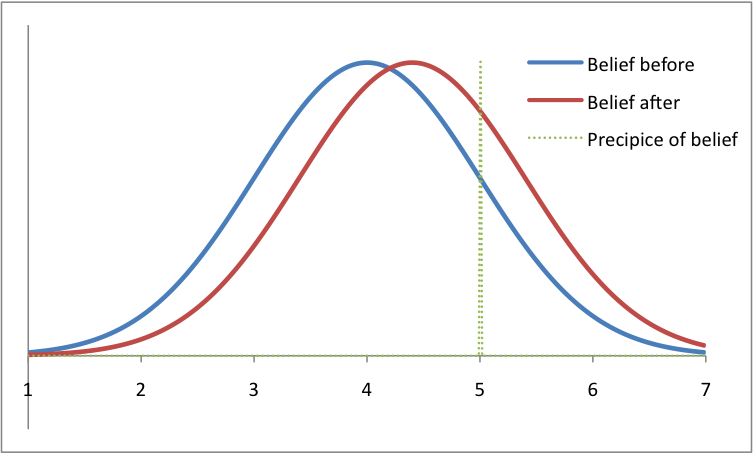
Previously, I tried to illustrate my take on the “accommodation vs. confrontation” issue using a model from statistics. In brief, I pointed out that by asserting a strong, persuasive position it is possible to shift a population of people along a continuum from absolute belief toward absolute disbelief. This shift can occur despite the fact that you may not move a single strong believer into a position of disbelief:

In the graph above, the blue line represents the distribution of a priori level of belief in a proposition (to wit, the existence of a god/gods with 1 reprsenting gnostic theism and 7 representing gnostic atheism), and the green dotted line is what I call a “precipice of belief” – the point at which people begin to ask serious questions and doubt the validity of their beliefs. The red line is a hypothetical distribution after someone has made a compelling argument against belief. Notice that many people have crossed the “precipice”, particularly those that were already close to questioning. Note also that none of the “strong” believers (those 1s, 2s and 3s) are atheists now, but are still somewhat shifted.

The question inevitably arises in such discussions: is it necessary to be aggressive? Doesn’t being aggressive and employing mockery of people’s beliefs make them less likely to listen to your argument? Wouldn’t it be better to state your case in a nice non-confrontational way, rather than arguing from an extreme point of view? I outlined my objections to this argument in the first post:

In general, there are 4 major objections: 1) someone who believes in something because the opponents are mean isn’t rational; 2) there would have to be a lot of people turned off for this to be ‘counterproductive’; 3) minds change over a period of time, not at a single instant; and 4) believers are not the only people in the audience.

I feel it’s important to expand on those points.

1. Someone who believes in something because the opponents are mean isn’t rational

If we grant for a moment the existence of people who will simply move further to the left, or completely shut down, if someone isn’t nice to them (and I’m sure they’re out there), this still fails to be a reasonable objection to the use of aggressive rhetoric. If the strength of your belief is predicated on the disposition of your critics, then you’ve abandoned rationality and are doing things from an entirely emotional perspective. As an analogy, imagine someone who believes in science primarily out of a hatred for hippies and anti-vaxxers. Her belief in science has nothing to do with its actual efficacy, but rather an ad hominem rejection of the opponents. Her reasons for belief are therefore non-rational, and a reasoned argument against them would be a complete waste of time.

It is certainly someone’s right to believe or disbelieve for any number of reasons, but then we have to stop pretending that a rational argument, no matter how friendly, will sway them in the slightest. It therefore requires a different type of argument to convince someone with this mindset, one that is based on emotive reasoning rather than logical. Unless “Diplomats” are advocating abandoning reason as a means of dialogue, then we have to accept that a variety of approaches are necessary.

People whose beliefs will not respond to logical reasoning represent only one portion of the population of believers, and those ones are likely in the 1s and 2s, rather than close to the precipice of belief. After all, if you’ve drawn the cloak of your belief around the shoulders of your brain that tightly, you’re probably not interested in hearing dissenting opinions anyway. It’s also nearly impossible to find arguments that aren’t offensive to believers, when any questioning of their faith is seen as an unforgivably rude insult.

2. The issue of ‘counterproductive’

One of my least favourite words that always pops up in this argument is “counterproductive”. The assertion is that being aggressive turns more people off than it turns on. If we look at that curve in the above image, we can see that while no ‘strong believers’ have crossed the “precipice”, quite a number of those living in the middle are now in a position to seriously question their position. In order for this to be a “counter-productive” shift, an equal or larger number of people would have to be pushed away from questioning their belief.

There is no evidence to suggest that such a shift happens. What is more likely is that people simply ignore a given argument if they don’t like the speaker, and their level of belief remains fixed where it was before. Viewed in isolation from an individual level, this may look like a failure of the argument, but we have to remember that we’re dealing with a distribution of beliefs in a population, not the efficacy for any one person. Furthermore, the audience for an appeal that includes aggression is, by definition, those who are mature enough not to dig in their heels every time their feelings get hurt.

3. Changing minds takes time

The “Diplomat” position also makes the implicit assumption that the goal of a given argument is to turn someone from a believer into a non-believer immediately. This is an attractive fiction, but a fiction nonetheless. People do not arrive at their beliefs all at once, but rather over a period of time. It is a rare person who can look at even the most compelling argument against a position and switch their beliefs immediately. More common is that a series of kernels of cognitive dissonance are introduced, whereafter more questions are asked. This process eventually leads to the changing of minds.

As evidence, consider the stories of people who are outspoken atheists. Many of them start from a position of strong belief and then turn to a more liberal form of their religion. Then, as time progresses and they allow themselves to ask more questions, they slowly (over a number of years, in my case) progress toward a complete rejection of those religious beliefs, then of religious beliefs altogether. More rare are stories of people who have a friend point out, in the nicest language possible, that YahwAlladdha is fictional, after which they say “those are good points – I’m an atheist now!”

4. Believers are not the only audience

Once again, I am up against the word limit for this post, and I think I can devote an entire 1,000 to the fourth (and in my mind, most important) of these defenses of aggression. What I will do instead is summarize what I’ve said above and leave off the final part of this discussion for next Monday’s “think piece”.

Much of my objection to the “Diplomat” position is that it demands exclusivity. It says that being confrontational is inherently a bad idea because it fails to convert a believer into a non-believer. My contention is that it is neither desirable nor practical to focus on converting individual believers into atheists, especially given the diversity of belief within the general population, and the fact that changing minds takes time. We must remember that we are speaking to a variety of people, who are at different stages in their journey away from belief. One approach is not going to reach everyone, and pushing hard can move people who are already close.

Like this article? Follow me on Twitter!

21 In defense of my bigoted moron brothers

  • June 14, 2011
  • by Crommunist
  • · blog · crapitalism · critical thinking · crommunism · hate · LGBT · race · racism · skepticism

Black Nonbelievers of Atlanta is a non-crazy freethinkers group in Atlanta, and you should check them out.

This morning I went on a bit of a tirade against KD and Black Son, two of the hosts of a public access television show called “Black Atheists of Atlanta” for their completely non-scientific rationalization of their anti-gay stance. I got so fired up about tearing them a new asshole, that I forgot to talk about the original point I wanted to make about the show.

The first point was that being a member of a minority group (whether that be a racial or ideological minority) doesn’t make you immune from being a bigot or an idiot. Similarly, being an atheist doesn’t automatically mean you’re intelligent – it just means you have at least one thing right. KD and Black Son are just as seeped in the heterosexism of their society as anyone else. While we might be surprised to see someone that is a religious skeptic use the same kind of nonsensical “reasoning” we complain about in apologists, it’s not completely mysterious. The challenge is to be skeptical about all claims, and to apportion belief to the evidence – KD and Black Son clearly aren’t very skilled at appraising the quality of evidence.

The other thing I wanted to say but didn’t get a chance to was a response to something that Hemant wrote:

At one point, someone calls in to say that there is, in fact, a biological basis for homosexuality. The response?

KD: “Those scientists were white, weren’t they?”
Caller: “Why does that matter?”
KD: “It matters to me because I’m black… if you’re not careful, even science can be racist.”

(I’ll admit it’s true that black people have been victims in some experiments, but that’s the fault of individual scientists, not science as a process.)

Hemant’s comment represents a fundamental misunderstanding of racism, and the climate from which things like the Tuskegee experiment came. It wasn’t simply a handful of unscrupulous scientists operating outside the norms that were responsible for the atrocities of the now-infamous abuses done in the name of science. Rather, the rationalization for using these people as they were used sprang from the societal idea that black people were little better than animals, and as such could be used as instruments of medical testing rather than treated as people.

KD’s remark about science being prone to racism is not then an indictment of the process of science, nor is it a misplaced criticism of a few people. It is justifiable skepticism about truths that come from the scientific establishment – an establishment that has demonstrated again and again its vulnerability to racism, sexism, heterosexism… all the flaws we see in human beings. Seen from this perspective, KD’s point is entirely justified – one does have to be careful to ensure that science isn’t racist. We see this taking place in clinical trials, where medicines are tested in primarily white, male populations, and then distributed to the population at large without checking to see if the results are generalizable. To be sure, this is getting better, but we haven’t reached the point where we have to stop being careful.

That being said, the correct response is to remain skeptical – not to reject the science. Animal studies of homosexuality have been performed by a variety of scientists in many countries, and they are based on observation. They were also not performed with the purpose of proving that gay sex happens in the animal kingdom, they are based on field observations and followup hypothesis testing. This is quite ancillary to the fact that there is nothing inherent in people of European descent that is pro-gay; white people and black people alike hate LGBT people, in equal measure, and with equally little rational support.

So while I am still appalled and horrified by what KD and Black Son said in their broadcast, and find it just as stupid and meritless as I did this morning, I have to defend that particular comment, because it is rooted in a justifiable and rational response to a scientific establishment that is predominantly white and has a long history of racism. Science, properly applied, leads to the acceptance of homosexuality in humans just as sure as it does lead to the conclusion that black people are equal in all meaningful ways to all other people.

Like this article? Follow me on Twitter!

6 Normalizing belief

  • June 13, 2011
  • by Crommunist
  • · blog · crommunism · skepticism

Today I want to dive back into the issue of “accommodation vs. confrontation” that is currently a topic of discussion within the atheist community, but which is germane to any social movement. Summarized, this debate centers on what the “best” way is to engage public opinion and advocate your position. The accommodation camp prioritizes civility, compromise and co-operation as the optimum solution, whereas those in the other camp elect to use direct and uncompromising language to spell out their (our) position.

You may find it strange that I put the word “best” in scare quotes in the above paragraph; I will explain why. As best I can tell, the two positions are talking past each other (actually, I think it is more accurate to say that the “accommodation” camp simply isn’t listening to the other side of the argument because they have repeatedly demonstrated their inability to respond to the criticisms of both their position and their approach). The “Diplomats” (a term I use for ‘accommodationists’, because it’s much less unwieldy) consistently invoke examples of one-on-one personal interaction, where the intention of the debate is to change the mind of the other party over the course of discussion. The implication is that insulting someone to their face is a poor way of getting the point across.

The problem with this approach is that it is severely flawed both in its premises and its conclusions. First, the majority of interactions between atheists and believers happens in the course of one-on-one interaction between friends or family members – the idea that atheists are going on rants against their acquaintances is largely fictitious (I will completely ignore the straw man that Diplomats erect of how “Firebrands” speak). Second, the assumption that minds are changed over the course of a conversation or blog post is ridiculous – people are largely resistant to completely changing their minds on positions that are of high importance to them. Third, and what I think is the biggest problem with the position, it presumes that believers are the only audience worth speaking to.

Blog posts, speeches, debates, books – any public exposition of ideas reaches an audience with a diverse range of opinions. As a thought experiment, assume for the moment that public opinion vis a vis atheism is normally distributed, and can be plotted on Richard Dawkins’ 7-point scale of statements of belief:

  1. Strong Theist: I do not question the existence of God, I KNOW he exists.
  2. De-facto Theist: I cannot know for certain but I strongly believe in God and I live my life on the assumption that he is there.
  3. Weak Theist: I am very uncertain, but I am inclined to believe in God.
  4. Pure Agnostic: God’s existence and non-existence are exactly equiprobable.
  5. Weak Atheist: I do not know whether God exists but I’m inclined to be skeptical.
  6. De-facto Atheist: I cannot know for certain but I think God is very improbable and I live my life under the assumption that he is not there.
  7. Strong Atheist: I am 100% sure that there is no God.

Both of these assumptions are likely false – there are far more “strong theists” than “strong atheists” in the world, and because of the nature of the variables the distribution terminates at 1 and 7, rather than continuing indefinitely. However, for the purposes of this illustration, violation of these assumptions does not meaningfully impact the point. Granting the assumptions for a moment, we would have a population that looks something like this:

Let us also imagine for a moment that there is something like a “precipice of belief” – a point of confidence beyond which people allow themselves to start asking difficult questions. Arguably, the location of that precipice is entirely dependent on the individual, and there is just as likely to be one for atheism as there is for theism (i.e., it’s theoretically possible for an atheist to begin questioning whether or not there really is a god/gods – in practical terms this is far more rare). But again, looking from the perspective of the general population, there will be an “average” point at which people will start questioning their faith:

It is crucially important at this point to reiterate that I am talking about a population of people rather than any one individual. It is the failure to understand this distinction that is the central flaw of the “Diplomat” position. When an author writes a blog post, or a book, or gives a speech that articulates something from a position of, say, “6”; she/he is speaking to this general audience rather than a particular individual. The goal of the argument is to effect a general shifting of the curve of belief, moving the general population further toward the threshold:

When we consider the new graph, it is immediately clear that while not everyone has crossed the “precipice”, there has been a general shift toward the rightmost edge. But who is it that moved over? It was people who were already teetering on the edge of that precipice, rather than people at the leftmost edge – the “True Believers”, so to speak. True Believers are still believers, but have been subtly moved along in their level of questioning (if it is a particularly effective argument). Even though not a single strong believer has been converted into an atheist, we have accomplished a population-level shift toward atheism, made up of those who were already somewhat predisposed to question.

Doesn’t aggression turn some people off?

The common response to this line of reasoning is to point out that some people will refuse to engage if their feelings are hurt. The general point is that those who are 2s and 3s might move further left, or simply shut their ears, thus blunting the effectiveness of the argument (and further arguments to boot). There are a variety of reasons why I don’t find this line of reasoning compelling, but I am butting up against the word limit of this post, so I will save my response for another post. In general, there are 4 major objections: 1) someone who believes in something because the opponents are mean isn’t rational; 2) there would have to be a lot of people turned off for this to be ‘counterproductive’; 3) minds change over a period of time, not at a single instant; and 4) believers are not the only people in the audience.

To summarize, when we think of belief, we have to recognize that we are dealing with a population that has a continuum of strength of conviction. Not everyone is at the point where they are ready to question their beliefs, but when we address an audience we can expect that some people can be moved towards disbelief, even if we don’t reach everyone.

Like this article? Follow me on Twitter!

1 Anti-racism: gettin’ skeptical on yo’ ass

  • June 1, 2011
  • by Crommunist
  • · blog · critical thinking · race · racism · skepticism

I’m a skeptic. For those of you who don’t know, that means that I subscribe to the general principle that the strength of a person’s belief in an idea or position should be proportionate to the amount of evidence. Ideas for which there is no evidence I do not accept, and ideas for which there is mixed evidence I can be persuaded either way.

I take an identical approach to all positions – if you show me the evidence that something works then I believe it. If the only thing you’ve got supporting your position is vague ideas and logical fallacies, you’ll be unlikely to persuade me. However, I’m only human, meaning that you’ll have to work harder to convince me of something I don’t agree with than you would to gain my agreement on a subject I support. This is bad skepticism – I should apply the identical standard to all things.

I care about race and racism, and that desire to understand the topic better has given me a position that is based partially on experience, partially on research, and partially on verifiable evidence (to the extent that these kinds of things can be observed scientifically). However, it behooves me to apply my same skeptical look for positions I agree with as I do for ones I don’t (like this morning’s example). In the interest of being a fair race skeptic, here’s a position that doesn’t pass muster for me:

University coursework should be marked anonymously to deal with concerns that potential bias against a “foreign-sounding name” can cost students marks, a report by the National Union of Students recommends. The report also urges universities to minimise “eurocentric bias” when drawing up curriculums. “This is critical, not only to demonstrate to black students that their learning reflects their own experience, but to promote understanding among their white peers,” it states. It is standard practice for universities to assess exams anonymously because of concerns about preconceptions relating to race, sex or previous knowledge of a candidate, but the NUS report calls for anonymity to be extended across all “assessment procedures”, which would include coursework…

The report, Race for Equality, is based on a survey of 900 students with African, Asian and Caribbean backgrounds. The survey found that, while most students were positive about their institutions, 23% described the universities they attended as “cliquey” and 7% as “racist”. There was also widespread frustration that courses did not reflect non-white backgrounds and views.

I have the same criticism of this finding as I do of the Tufts study – it measures perception and not reality. Are these schools actually cliquey? Are they actually racist? We can’t use the results of student opinion surveys to draw that conclusion, especially given the multitude of possible explanations for the perception. One has to do actual observational work to justify making a huge policy change, not simply jump at every measurement of how people feel.

While I am generally inclined to believe the claims of the respondents (based on my own experience of what institutes of higher education look like as a black student), I think that these responses – like the ones from this morning – are useful and interesting areas for scrutiny. If the scrutiny yields results then a policy change is in order. However, until then, we should remain skeptical of all claims – even those we agree with; perhaps especially so.

Like this article? Follow me on Twitter!

4 The normal kind of crazy

  • May 31, 2011
  • by Crommunist
  • · blog · critical thinking · religion · skepticism

I might be the only atheist blogger in the world that hasn’t yet talked about the absurdity of the Family Radio rapture announcement last Saturday. For those of you that didn’t read my post that preceded the event, a radio host from the United States (of course) named Harold Camping performed a rigorous mathematical analysis of the Bible (read: pulled some numbers out of his ass) and announced that the world would be judged on May 21st, 2011. Jesus would return in glory and take faithful to heaven. He also ‘prophesied’ that there would be massive earthquakes and millions of deaths on that day, which would continue until the world actually ends in October of this year.

As you’ll remember, he was totally correct, and that’s exactly what happened.

Well, no. What actually happened is that the universe has existed for billions of years. For some of those billions, there has been one star among trillions that had a handful of planets. On one of those planets existed the proper chemical conditions for self-replicating molecules to form and propagate. Some of those molecules spontaneously organized to form multicellular organisms, one of which eventually became capable of organizing into units capable of exchanging ideas. Among the thousands of stupid ideas that this random process inevitably spit out, one of them was about a man who was the son of one of the gods who was killed but promised to come back and avenge his death in a most bloody fashion.

One of the multicellular organisms took the stupid idea to a wacky conclusion based on weird information, and got it dead wrong. Instead of being among the small minority of multicellulars that is willing to admit when it does something wrong, this one decided instead to engage in stereotypical hand-waving and try to change its story:

As crestfallen followers of a California preacher who foresaw the world’s end strained to find meaning in their lives, Harold Camping revised his apocalyptic prophecy, saying he was off by five months and the Earth actually will be obliterated on Oct. 21. Camping, who predicted that 200 million Christians would be taken to heaven Saturday before global cataclysm struck the planet, said Monday that he felt so terrible when his doomsday message did not come true that he left home and took refuge in a motel with his wife. His independent ministry, Family Radio International, spent millions — some of it from donations made by followers — on more than 5,000 billboards and 20 recreational vehicles plastered with the Judgment Day message.

First off, I have a bone to pick not only with this article, but with the slavering hordes of people eager to make jokes at Camping’s expense. Strictly speaking, he did not predict the world would end on May 21st; he predicted that Jesus would judge mankind on that day. All along he said that the final day of the Earth would be in October, and he hasn’t changed his mind about that.

Secondly, there’s a larger point to be made here. Harold Camping is a guy with really weird ideas. They’re bizarre and nonsensical and have only a fleeting and occasional relationship with observable reality. He has taken those beliefs out of the privacy of his head and has decided to plaster them all over the place, gathering followers and collecting vast sums of money in the process. The people who follow him appear to be earnest and kind but simple-minded fools who have fallen victim to Camping’s particular brand of lunacy.

Here’s the point: what Harold Camping believes is different from what the Pope or the Archbishop of Canterbury or Billy Graham or (insert famous religious personality) believes only in terms of magnitude, not type. Belief in a supernatural entity in the absence of evidence is what licenses all kinds of weird beliefs, even those as extreme as Camping’s. I will avoid, for now, the obvious temptation of comparing his nuttiness to fanatics like Ayatollah Khomeni or Joseph Kony – Camping did not advocate violence or totalitarian rule. However, the fundamental basis of his position is rooted on identical grounds: the will of an undefinable and unobservable supreme being.

And so while believers and non-believers alike spent the day laughing at the stupidity of the May 21st Rapture, we were laughing at two different things. Believers (the Christian ones, anyway) were yukking it up at the audacity of trying to pick a date for the return of the human son of the supreme being on the universe:

Tim LaHaye, co-author of the bestselling Left Behind novels about the end times, recently called Camping’s prediction “not only bizarre but 100 per cent wrong!” He cited the Bible verse Matthew 24:36, “but about that day or hour no one knows” except God. “While it may be in the near future, many signs of our times certainly indicate so, but anyone who thinks they ‘know’ the day and the hour is flat out wrong,” LaHaye wrote on his website, leftbehind.com.

Everyone else was laughing at how stupid the idea is.

When black people in the United States jumped on the Proposition 8 bandwagon to pass an amendment to ban gay marriage, I couldn’t fathom how a group that has experienced (and continues to experience) the suppression of its civil rights would be so eager to take the same rights away from other people. It was the same blindness I saw at work in believers who were happy to deride Camping but couldn’t see that their own religious beliefs were simply a diluted aspect of the same irrationality at work. While I’ve discussed the recalcitrance of the religious to examine their own behaviour, I am slowly learning that this is simply a product of human brains, not something unique to religious faith alone.

So what happened on the 21st? As it had for the past billions of years, the particular planet orbited about the particular star in the particular far-flung region of the universe, completely oblivious to the stupidity happening on its surface. Who wants to take bets on what’s going to happen in 5 months?

Like this article? Follow me on Twitter!

Page 11 of 16
  • 1
  • …
  • 9
  • 10
  • 11
  • 12
  • 13
  • …
  • 16

  • SoundCloud
  • Twitter
  • Facebook
  • YouTube
  • Subscribe Subscribed
    • Crommunist
    • Join 82 other subscribers
    • Already have a WordPress.com account? Log in now.
    • Crommunist
    • Subscribe Subscribed
    • Sign up
    • Log in
    • Report this content
    • View site in Reader
    • Manage subscriptions
    • Collapse this bar
 

Loading Comments...