Crommunist
  • Blog
  • Music
    • Video
    • Audio
  • Media
    • Audio
    • Video
  • Events
  • Twitter
  • Ian Cromwell Music
  • Soundcloud

Category: Canada

8 Saskatchewan: Flat, dull, and now gay!

  • January 19, 2011
  • by Crommunist
  • · blog · Canada · civil rights · law · news · religion

I have a good friend who is moving out to Victoria in a couple of months. She decided she would explore this great country of ours by driving across it. For those of you readers who are not from Canada, you honestly haven’t any idea of how huge an undertaking that is. If you’ve ever driven from New York to Seattle, you’ll have some idea of the horizontal distance this involves, but not quite the vertical. Perhaps the best approximation is to imagine driving from Orlando, to New York, and then to Seattle. That’s what happens if you drive about 3/5 of the way across the country (there’s still all of French Canada and the maritimes to the east of where Niki’s driving from).

In a recent conversation, she confessed to me that she’s a bit worried about driving through the rockies, since there’s nothing quite like the perilous mountain driving anywhere in Ontario. I told her that she should be more wary of the prairie provinces, because while the Rockies are a challenge of skill, the prairies are a trial of endurance. Nothing can prepare you for the unbelievable flatness of the prairies. As you drive west, the road curves slightly to the right every 20 or so minutes – this is to adjust for the curvature of the Earth. It’s flat. And while there is a certain majesty and grandeur to how flat and open it is, after a few hours of driving and having nothing to break the eyeline, the novelty of the flatness wears away quickly.

Suffice it to say, Saskatchewan, in the very middle of the prairies, is not a terribly exciting place. So when there’s news out of Saskatchewan, I jump on it:

Saskatchewan’s highest court will rule Monday morning on whether provincial civil marriage commissioners can refuse to perform same-sex ceremonies on religious grounds. The province asked the Saskatchewan Court of Appeal for advice on whether proposed legislation allowing commissioners to recuse themselves from performing same-sex marriages for religious reasons would be constitutional.

Of course, the court already has ruled (these stories I post under the ‘news’ category are very rarely ‘news’ by the time they go up here). As someone who understands the Charter and the mood of jurisprudence in Canada would have predicted, the appeals court found that someone who is employed by the government does not have the right to refuse service to someone on religious grounds. It makes sense – the government does not grant marriage licenses on religious grounds, it does so as a civil matter. Since the law does not allow for religious discrimination, it follows that civil employees are not allowed to discriminate against people who are pursuing a legal entitlement on the grounds of religion.

Imagine, for a second, that there was an imam from Calgary who held the belief that a woman, once divorced, is unclean and cannot be married within his particular mosque. While this position may or may not be supported by the Qur’an (scripture can really be used to justify any position), let’s pretend, for the sake of argument, that such a case existed. This imam, being otherwise quite moderate and progressive, offers his services to the government as a wedding officiant. At this point, he has left the auspices of his mosque and is operating as a provincial contractor. At this point he is obligated to give (at least) the same quality of service that would be given by any other provincial contractor, regardless of his individual aversion to marrying divorcées. There would be, and rightly so, outrage over any provincial employee who refused to give services to an ‘unclean divorcée’. For the same reason, it is similarly wrong to refuse to grant marriages to gay couples on religious Christian grounds.

I can understand the argument on the other side of this issue, however. Why should a priest be forced to violate his own religious beliefs? What business does the government have telling someone that they must perform a ceremony that conflicts with their stupid bigotry closely-held spiritual beliefs? The response from Reynold Robertson, government lawyer, is about as concise a refutation of this position as I’ve seen:

“The decision confirms that people have their religious beliefs, and they may entertain that — there’s complete freedom of religious beliefs,” said Robertson. “It’s only when your conduct on doing something might have an effect on somebody else which has a discriminatory effect.” Robertson also noted that the decision applies only to marriage commissioners — public servants performing civil ceremonies — and not religious clergy.

This is a problem that many libertarians and conservative moderates have with the idea of human rights – that your having human rights means that you have to respect the rights of others. If this were a perfect world (for a libertarian), there would never be a conflict and you could simply live your own life without interference from anyone else. As a result, there would be no need to prioritize rights, and would never be a circumstance that would infringe upon your ability to do and say whatever you want. Of course that describes no world that ever has or ever will exist. We live in a world with other people, and as a result we can’t allow personal prejudices to become the practice of laws. If someone is working under civil authority, they must enforce the rule of law, wherein religion has no jurisdiction.

Like this article? Follow me on Twitter!
0 The face of racism in Canada – same as it ever was

  • January 13, 2011
  • by Crommunist
  • · blog · Canada · politics · race · racism

There is a great scene in one of my favourite movies where a black TV executive assembles a writing team for his new black-themed TV show, and expresses his baffled dismay at the fact that they are all white. To try and explain the phenomenon away, the writers sitting around the table offer a variety of suggestions: maybe they couldn’t find anyone qualified; maybe black writers didn’t want to work on the show; the executive sardonically suggests that maybe they couldn’t put their crack pipes down long enough to fill out the application.

Of course there is a real answer to why there weren’t any black writers around the table: the people that make the decisions on who gets hired picked a group of white people. It’s not a mystery, it happens all the time. For reasons that are (likely) completely unconscious to the powers that be, the black writers who applied just didn’t “seem right” for the position, so they didn’t get hired. Aren’t we lucky that this kind of thing only happens in movies, right?

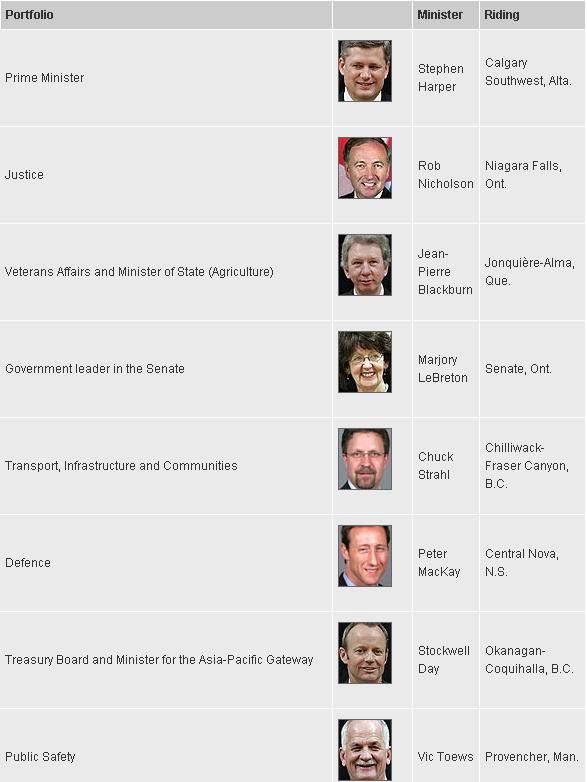
While it is my usual practice to post an excerpt from the articles I link to these stories I am sadly unable to do justice to what’s contained in the link. I will, however, provide you this screengrab:

January 2011 Federal CabinetDo you see what I see? Go to the link, scroll down the list, and see if you can spot what I’m talking about. Yes, it’s a sea of white faces. White, male faces actually.

Now I feel the need to back up here and clarify a lot of things.

  1. I am not not not not not accusing Stephen Harper of being a bigot. I don’t like the man, I don’t like his politics, I don’t like his policies, and I definitely don’t like who he’s in bed with (although I do find his wife delightful). However, none of that, nor anything that he has said or done, leads me to conclude that he is particularly racist (at least not above and beyond what I would expect from any other person). Anyone who thinks I am trying to smear him by tagging him as ‘a racist’ is way off base.
  2. This cabinet is not not not unusual or particularly white and male. In fact, the linked article points out that there are more women in this cabinet than served under the previous Martin Liberal government. While conservatives and Conservatives tend to be an old-boys club, this particular cabinet does not reflect that any more than Liberal cabinets.
  3. This isn’t about black people. Given that black people represent about 2.5% of the population of Canada, I’d be surprised to see a preponderance of black faces on the Federal Cabinet (especially since few of the ministers are from the Toronto or Ottawa areas).
  4. I have no reason to suspect that unqualified white politicians were hired over qualified People of Colour (PoCs), with the exception of Gary Goodyear who isn’t qualified to hold my cock while I take a piss, let alone be the federal minister of science. I’m sure they are all (with the aforementioned exception) competent politicians in their own right.

This is not a commentary on this cabinet. Please rest assured that while I have strong political disagreements with the Conservative party, I am not interested in smearing them with as ugly and ham-fisted an approach as “they is a bunch of racists”.

This is a commentary on all cabinets, at all times. This is a commentary on the cultural zeitgeist (I am sorry, I cannot avoid using the word) that surreptitiously pushes out PoCs. Aside from Bev Oda and Leona Aglukkaq (and possibly John Duncan, although I don’t think so), the cabinet is made up of white faces. This is not in any way unusual, although it probably should raise some eyebrows that the minister for the Asia-Pacific Gateway, the minister for Citizenship, Immigration and Multiculturalism, and the minister for Indian Affairs (I think) are all white faces. To be sure, International Co-operation and Health are not rinky-dink positions and there are two prominent female PoCs in those ministries, but the preponderance of positions are monochromatic.

As I’ve said countless times, this is how we can tell that we have not reached anything that even resembles the post-racial utopia that many of us (liberals and conservatives alike) would like to pretend Canada is currently. Instead what we have is tokenism and rampant under-representation by one group, with an accompanying over-representation by the group that just happens to be the one with the most political clout historically. This is no accident, although I am doubtful it happens on purpose. It is for this reason that I roll my eyes whenever someone talks about “personal responsibility” being the answer to racial disparity – so much of it happens below a level where we are aware of it. As a result, we get more of the same thing, by a process that looks quite accidental.

This is no accident.

Like this article? Follow me on Twitter!

12 Canadian Native communities face a new kind of challenge

  • January 5, 2011
  • by Crommunist
  • · blog · Canada · conservativism · culture · First Nations · good news · politics · race · racism

There was once a time when I called myself a libertarian. After all, I believe that people should be allowed to do what they like, as long as it hurts nobody besides themselves (Scary Fundamentalist is going to poke me for this statement, too). I think that innovation happens when people are allowed to address challenges in whatever creative ways, rather than when they are forced to abide by a strict set of rules. I think that the more free a society is, the better off its citizens are. However, these are principles that have caveats: external regulation is necessary to prevent exploitation and fraud; liberty is not absolute, particularly when one person’s liberty infringes on another’s; it is sometimes justifiable to curtail the actions of a few to benefit the many in the long term. As such, I am not well-described by the term libertarian, and unlike CLS, I am not attached enough to the term to try and reclaim it.

However, the ghosts of my long-dead love affair with Ayn Rand were momentarily stirred when I read this story:

[Brian] Smith had made headlines for leading a grassroots uprising against the elected leaders of the Glooscap First Nation, after learning that his chief and councillors were each collecting more than $200,000 in salary and other payments — for running a community of 87 people.  He organized a petition demanding a community meeting, where Glooscap leaders were made to account for their extraordinary pay and promise more transparency in the future.

“You’re changing the way things are done,” said one email to Smith from an Ojibway supporter in Central Canada, whose sentiments were typical of the messages Smith received after the Glooscap details broke.  “I’m really, really, really happy you are standing firm on this and giving voice to us First Nations people who want better governance. I’m (also) proud that change is going to come from the community level, and from a First Nation person.”

It is a well-understood fact in sociology circles that if you want to engender lasting and meaningful change in a community, the solutions must come from the community itself. As well-intentioned as outside help might be, it stands the risk of being resented or worse, mischaracterizing the problem and failing to take salient details into account. Friends of mine went on a humanitarian aid trip to Attawapiskat First Nation in Northern Ontario a few years ago, to conduct what is known as a Needs Assessment – determining what problems face a community and what resources are needed to address them through dialogue with members of the community. The community expressed a strong desire to have public health education and resources made available. When the team pointed out that there was a federal building staffed with 2 public health nurses and the resources they had asked for, the community pointed out that it was “the government’s building”. Branded as it was with the federal logo and built without consultation from the community leaders, members of the public distrusted the service and assumed it was for the government’s use.

It has been a common practice to see a problem and swoop in to try and solve it. However, as anyone who has been on the receiving end of such an effort knows, this approach is rarely helpful. What is needed is direction from within the community, which fosters a sense of ownership and responsibility for solving the issues. To make it fully effective, such an effort should be supported by resource allocation (from the government or the NGO or whatever external parter is present), but their use must be determined by those stakeholders who use the service, not by those providing it. It seems perverse and exclusionary, but it is the only way to sufficiently address the problem.

With issues of good governance, it seems that members of First Nations communities are realizing this for themselves:

“I don’t have any desire for the federal government to come in and solve our problems,” says Cherie Francis, another Glooscap member angered by what her chief and councillors were being paid. “We elected these people. At some point, we have to step up in our own community and be responsible for our own actions, and our own leaders.”

…

“I’m glad Indian Affairs is staying out of this,” says Smith, who works as director of operations for the Vancouver-based National Centre for First Nations Governance, an independent group that promotes good leadership in native communities. “In the past, Indian Affairs would have jumped right in. That has changed in recent years. I think the message First Nations people are giving to the federal government is, at the end of the day we want to be more responsible for ourselves. And sometimes you’ve got to learn the hard way what is the right and wrong way of doing things.”

Ronald Reagan lampooned this (perhaps) well-intentioned bungling and over-reaching with his immortal line about the nine scariest words you’ll ever hear: “I’m from the government and I’m here to help”. Of course, as with most conservative calling cards, this drastically over-simplifies the issue. There is absolutely a way for government to help, and sometimes it is necessary for it to do so. However, when it overasserts its role and tries to solve the problem rather than making available the resources required for an organic solution, problems inevitably arise. The opposite approach, a sort of laissez-faire approach where government sits back, does nothing, and waits for problems to solve themselves, does nothing other than allowing the current conditions to continue unabated. A deft touch is required – one that is sensitive to the contemporary and historical forces at work in the situation and navigates the waters accordingly. This deft touch involves active engagement, and exists somewhere between the authoritarian “we fix it” and the libertarian “you fix it”.

This is fertile ground for a much longer discussion, but suffice it to say that the racial barriers, stigma, and long cultural history of betrayal and oppression facing First Nations people in Canada can be addressed, and self-government goes a long way toward starting that process. There is a role for all Canadians to play in this fight, and a role for government as well; provided it stays its hand and acts according to the will of the people rather than its own ideas of how to “fix” the Native “problem”.

Like this article? Follow me on Twitter!

0 Vancouver does something good

  • December 23, 2010
  • by Crommunist
  • · blog · Canada · gender · good news

I was poking around the archives from the past few weeks, as I do from time to time, and I realized I haven’t done a “good news” segment in a while. I started hunting for good news segments after it got back to me that a friend of mine thought the blog was too ‘ranty’. While I am inclined to think that anyone who puts their beliefs forward without apology will be accused of “ranting”, but in the interest of maintaining a sense of balance, I throw out stories like this from time to time:

Vancouver’s mayor Gregor Robertson and police chief Jim Chu announced Monday the launch of the Sister Watch program, designed to make the Downtown Eastside safer for women. Chu said police were targeting “predatory and violent drug dealers” who were responsible for attacks against women. “The levels of violence against women in this community must not be tolerated. We must work together to reduce [them],” he said.

One of the things that politicians like to do is legislate larger punishments for crimes. This is a quick and easy way to gin up votes without having to commit any money up front to solve a problem. The logic behind such legislation is that if punishments are high, it will deter would-be criminals from committing the crimes. The problem is that, despite what the rational agent theory within economics would have you believe, there is a ceiling for such disincentive, beyond which the magnitude of the disincentive is immaterial. If, for example, someone threatened to stab you if you didn’t do something, would it make any difference to you if they said they were going to stab you and then punch you in the face? The addition of the face-punch is not the point – if you’re willing to risk getting stabbed then you’re probably hell-bent on doing the thing anyway.

It is for this reason that I favour programs that actually do something rather than just assuming something will be done by a policy. Those of you regular readers who are not from the Vancouver area may not know much about Vancouver’s Downtown East Side. Imagine it like a much whiter (and more Native) version of Compton or Harlem – this is the “rough part of town” in Vancouver. There is a great deal of drug use and abuse that happens in this area, and a lot of associated assault and violent crime. Passing stricter drug laws and proscribing harsher penalties for possession and distribution have not deterred crime in the area. Nor, sadly, has increasing police presence (although there is a caveat here, since increased familiarity and rapport between police and DTES residents has led to greater reporting of crime).

Of course, women in the DTES are particularly vulnerable, as with the regular risk of muggings, assault, and the hodgepodge of random crimes that anyone is at risk of, there’s a whole slate of sexual crimes that women are particularly targeted for. Putting a service like this in place is actually two things – first, it is the recognition of a particular problem affecting a subpopulation of Vancouver residents, and it is a policy targeted at community involvement. This serves the purpose of both protecting women and raising the consciousness of the community at large. This will hopefully result in a sea change in which people are more aware of the issues surrounding violence against women, and will reverberate through the city of Vancouver outside the specific issues related to the DTES.

Hurray.

Like this article? Follow me on Twitter!

26 Why separation of church and state is important

  • December 21, 2010
  • by Crommunist
  • · blog · Canada · civil rights · law · news · politics · religion · secularism

Canada does not have an explicit legal separation between religion and government, which is obviously cause for concern for me as an atheist. However, whatever your beliefs, this kind of thing should concern you too:

A senior Iranian cleric, Ayatollah Ahmad Jannati, has suggested that opposing the country’s supreme leader amounts to a denial of God. Correspondents say the unusually strong comments appear to be aimed at silencing internal dissent over the leadership of Ayatollah Ali Khamenei.

Sometimes in our more contentious debates, we are tempted to accuse political opponents of being heartless, or say that a position we hold is what God wants. I’m not sure how much anyone actually believes that God cares about politics, but the rhetoric definitely gets amped up at times. However, that’s (mostly) harmless talk; we don’t hear that kind of stuff from our political leaders. This is a good thing, because both of those arguments (liberal and conservative respectively) are thought-stoppers – no reasonable conversation can proceed once we start building our house on the sand of emotion or in the cognitive quagmire of faith.

However, Iran has no such restraint:

The latest comments were made by conservative cleric, Ayatollah Jannati, who heads Iran’s powerful Guardian Council, which oversees the country’s elections and the constitution.

Analysts say the unusually strong demand for public loyalty to Iran’s supreme leader is an attempt by the influential cleric to liken political dissent to religious apostasy – a crime which carries heavy punishment under Iran’s strict Islamic code.

The danger of such statements, especially when backed by state power, is fairly obvious. When the religious establishment controls the state power, and opposition to a political leader is tantamount to a religious crime, then any political opposition is, as a result, a crime. If the leader is corrupt, if the leader abuses his power, if the leader violates the rights of the people, the people have no recourse. Political speech is blasphemy, subject to severe punishment. Forget the idea of an opposition party, forget the idea of free speech, forget the idea of fairness or justice under the law.

Obviously nothing about this particular story will be surprising to anyone who’s been paying any attention at all to the situation in Iran. I only began paying attention in the wake of the election madness a couple years ago, but since then I’ve seen nothing but repeated arrogance, stupidity and evil come from this religious republic. However, abstracting a general rule from this specific case may be possible – it is to everyone’s benefit to have religious power separated by law from state power. The only people who would benefit from an erosion of state sovereignty by the religious establishment is those who agree completely with the leading class’ views. History shows us again and again that fractions will appear within religious communities as they grow larger and more powerful. There is no long-term benefit to the rule of religion – there will always be a group that is seen as heretical until there is only one absolute ruler. Religion knows no satiety in its appetite for power.

So regardless of your religious beliefs, a separation of state power from religious influence is to your benefit. Eventually your beliefs will come into conflict with the ruling party’s, at which point you will find the religious/state power directed at you. The solution, of course, is to wall off religion – allow people their individual rights to believe as they want, but to ensure that state power flows from the people, not from the whims of a capricious God.

Like this article? Follow me on Twitter!

3 Free speech vs… The TDSB

  • December 16, 2010
  • by Crommunist
  • · blog · Canada · civil rights · free speech

Seriously, Toronto? What the fuck are you doing?

Speaking at a Nov. 22 assembly at Northern Secondary School that was supposed to be a celebration of the school’s athletic achievements, Emil Cohen said: “We now have it instilled into us that soccer [at Northern] is synonymous with the word ‘unnecessary.'”

Cohen, 17, said he was upset that students had to take it upon themselves this year to “to do the phys ed department’s job to find a coach” for the school’s team. In past years, the team also had to supply most of its own equipment and was frequently forced to cede use of the school’s field to the football team, he said.

The day after his speech, Cohen was suspended for two days and was barred from all sporting activities at the school.

Back in high school I was a director of the Young Actor’s Company, a school drama production where grade 11+ students directed one-act plays performed by grade 9/10 students. It was an opportunity for older students to get some directing experience, and for younger students to be in a play without having to compete with older, more experienced actors.

The play we did, called Of the Blue, was about a philosopher who is injected with an unknown substance and has to deal with the sudden relevance of his potentially-impending mortality. In one scene, he is arguing with his girlfriend, who says “don’t you think we should wait for the test results to come back before we start… fucking?” The line is delivered in the context of an argument where he basically tells her that she owes him sex because of his distress.

Of course the teachers involved in the production told us (a week before we went on stage) to censor the line. Their suggestion was “doing it” instead of “fucking”. The first night we tried the substitution line and absolutely hated it. I told the person playing the girlfriend to leave the line as-is. Shit hit the fan, and I was told that I wasn’t allowed to be in the school play that year.

Even at the age of 17 I knew that this was a bunch of bullshit. The language we used was not particularly strong – no stronger than you’d encounter walking the halls. It was appropriate in the context of the scene, and we had even warned audience members that the play contained strong language.

The issue was that I had stepped out of bounds and defied the teachers. I had done so in a way that was entirely consistent with the regulations of the school, so they had no grounds for official “on-the-books” punishment, so they had to get their revenge through unofficial means. Luckily, the school play was a total stinker that year, so I kind of dodged a bullet there.

This story is far worse. This kid is not being punished for defying teachers, he’s being punished for lodging a legitimate criticism of his school in an appropriate venue. How can anyone at the TDSB think that this is a legitimate defense of their autocrasy?

“He certainly didn’t comply with his teacher in the process that he was supposed to follow,” he said. “There are pieces in terms of the Education Act around students needing to be able to follow through with expectations and directions of their teachers.”

Student fails to comply with censorship… and is suspended for standing up against an unfair teacher? Something’s rotten at the school board.

Like this article? Follow me on Twitter!

3 Canada doesn’t have a race problem

  • December 9, 2010
  • by Crommunist
  • · blog · Canada · history · race · racism

Wow, it’s been a while since I did one of these.

Remember a month ago when I talked about a campaign to get the Crown to recognize the abhorrent and racist treatment of New Brunswick’s black population?

This is an interesting bit of history that I wasn’t aware of. Apparently under the charter that created the city of St. John, its black inhabitants were not granted the rights of citizens. They were barred from living within the city’s walls or fishing in the outlying rivers. Even though they helped build the city, they were disallowed from reaping the fruits of their labour – not because of systematic, subtle racism, but because of an official decree.

The whole point of apologies like this isn’t to make people feel guilty for what their ancestors did, but to have an honest accounting of our history. Knowledge of our history allows us to put the present into context – how did we get here? The alternative is to just make up explanations that fit our prejudices (a.k.a. conservatism).

However, an element of these apologies has to be official recognition that it happened. Part of an apology is the admission that an act was wrong. Simply saying “well you got over it, so it couldn’t have been that bad” is not sufficient. Well, at least not unless you’re David Johnston:

The Governor General won’t apologize to Saint John’s black community for a 1785 decree that severely restricted where they could live or fish in the southern New Brunswick city.

Buckingham Palace forwarded the request to Gov. Gen. David Johnston so that he could consult with federal ministers. An official at Rideau Hall said in a letter to Peters that they could not meet his request for an apology.

Racism isn’t abstract or historical. It is real, and it still lives with us. I went to Waterloo while David Johnston was the president – he struck me as a good and fair person. However, to deny the black community even the courtesy of an official apology – a move that has ample precedent – smacks of racism.

I’m going to follow this story and see if I can get more information about why the request was denied, but I’m not holding out any hope for a forthcoming explanation.

Like this article? Follow me on Twitter!

4 Free speech vs… assholes with bike locks

  • December 2, 2010
  • by Crommunist
  • · blog · Canada · civil rights · free speech · liberalism · news

I’m pissed off.

Chained by his neck to two female protesters, University of Waterloo doctoral student Dan Kellar was nevertheless in control of the situation at a campus lecture hall last week, as he sat on stage and chanted slogans to prevent journalist and author Christie Blatchford from speaking about her new book on the native protests at Caledonia, Ont.

I’m not just pissed off because the asshole in question is from my alma mater.

Ms. Blatchford, the Governor-General’s literary award-winning writer of Fifteen Days, was slightly delayed by traffic on Friday, and as university spokesman Michael Strickland announced this to the small audience, he was shouted down with calls of “racist, racist, racist.”

I’m not just pissed off because this asshole is trying to advocate a position that I consider similar to my own, or that I will be lumped in with his assholery.

I’m not just pissed off (although I am mightily pissed off) that free speech is being run over roughshod by a dick, using the principle itself to deny another person the right to speak.

No, all of that would be tolerable. I could deal with these insults and more. The reason I’m really pissed off?

Bike lock, $28
Rent-a-protest, $150 pizza bill
Suppressing the free speech of someone you don’t agree with, priceless.

This asshole has forced me to agree with Scary Fundamentalist. Come on, man! That’s beyond the pale. It’s like when the NAACP got all hot and bothered about Shirley Sherrod and I had to be on the same side as Glenn Beck. I had to take an extra-hot shower after that. Now I’m in the same camp as Scary? C’mon dude! Not cool.

I joke, of course. While pretty much everything that SF says makes me want to ragevomit all over my keyboard (I wear a bib when browsing his site), we are definitely allied on the cause of free speech. Free speech has nothing to do with left or right – it is the only way that a democratic society can work. Where we differ is on… well… everything else.

I don’t care what your position is, whether or not I agree with it, and I am absolutely not above criticizing the assholery of those who are on my end of the political spectrum. You don’t get to be a total douchehat and lock yourself to a podium to protest someone’s speech. Tearing down a building, maybe. Protesting against the government, sure. But to prevent someone from speaking? That’s bullshit.

Usually I’m a bit more articulate than this, but quite frankly, I’m too pissed off to be clever. I also try to have a pithy little signoff at the end of these things, but I can’t think of one, so here is a picture of Johnny Cash expressing exactly how I feel about Dan Kellar.

Like this article? Follow me on Twitter!

11 Religion meets the courts

  • December 1, 2010
  • by Crommunist
  • · blog · Canada · crapitalism · law · news · religion

I would make a shitty judge. Don’t get me wrong – I look turbo-hot in robes. The problem I’d have is rendering a judgment that fits the law, rather than what I know to be right. After all, a skilled enough lawyer can make a case that a company that dumps toxic waste on baby seals has not broken the law, and my judgment must adhere to that principle.

The courts here in BC seem to be doing a better job:

Dissident conservative Anglicans in Vancouver and Abbotsford have no right to hold on to four church properties valued at more than $20 million, the B.C. Court of Appeal ruled Monday. As a result of the decision, more than 1,200 Anglicans who oppose same-sex blessings and reject the authority of Vancouver-area Bishop Michael Ingham are expected to have to vacate their church buildings soon.

Dismissing the main argument of a costly appeal by the conservative Anglican congregations, Justice Mary Newbury wrote that the dissidents “cannot in my respectful decision remove themselves from their diocesan structures and retain the right to use properties that are held for purposes of Anglican ministry in Canada.”

I read the decision (a fun exercise in legal thinking that I recommend everyone do from time to time), and the main point of the argument seems to be that while the congregation does hold the buildings in a trust, they do not have the right to divorce themselves from official church doctrine. The trust is held based on the assumption that the congregation is defending the official articles of faith – claiming to be “true believers” doesn’t grant them license to violate the official doctrine of the church.

Of course, this is a complete and total waste of time from my perspective. The whole undertaking is based on the belief that an invisible super-being cares who puts what in which orifice. I’ll simplify it for you, conservative Anglicans: nobody cares. There is no super-being, and the only people who are outraged by homosexuality are you. My advice: if it bothers you so much, don’t do it. But please don’t clog up the appeals courts with your superstitious nonsense – some of us are trying to build a society.

Like this article? Follow me on Twitter!

2 MS procedure claims its first(?) victim

  • November 30, 2010
  • by Crommunist
  • · blog · Canada · health · science · skepticism

I like lots of things. I like dogs, I like children, I like rainstorms, I like canoeing (although I haven’t gotten my act together to go in a long time). Another thing I like is being right. I am unashamed to say that I get a giddy little thrill when I can clarify a position and bring someone around to my way of thinking. It’s not particularly humble or diplomatic of me, but I figure as long as I don’t throw it in anyone’s face I am okay.

There are some times I wish I wasn’t right:

An Ontario man with multiple sclerosis died of complications after a controversial treatment in Costa Rica to open up his neck veins, CBC News has learned. Mahir Mostic, 35, of St. Catharines died on Oct. 19, one day after doctors in the Central American country tried to dissolve a blood-clot complication.

Let’s back up for a second. Back in April, I wrote a post about a new proposed therapy for the treatment of Multiple Sclerosis. This therapy involves inserting an angioplastic balloon into a neck vein and inflating it. The proposed mechanism violates the current scientific understanding of MS, but patients have reported dramatic symptom improvement after receiving the procedure, so it was worth investigating. However, the rules of skepticism must be particularly adhered to when a new “miracle” procedure appears that completely changes the current understanding of any phenomenon. If someone, for instance, claimed that they had invented a ‘gravity beam’ that could attract objects by firing gravity at them, we’d probably be more skeptical than if someone had said they’d invented a ‘sound beam’ that could fire sound over long distances – the latter requires a slight tweaking of current understanding, whereas the former requires a complete re-imagining of how gravity works.

So, by the same token, I was concerned at the flood of patients demanding access to this procedure without adequate testing beforehand. Even the doctor who invented the procedure cautioned people to wait until it had been evaluated. However, out of their (totally understandable) desperation to alleviate their symptoms, patients demanded that the approval for the surgery be fast-tracked. When the various health authorities said that they needed to have actual testing before they would approve it, the predictable happened: a private company began shipping people to countries that don’t care about health regulations.

The problem with failing to regulate health care is that it allows quackery to go on unmonitored. These patients who circumvent the system do not receive adequate follow-up:

Suddenly, after nine weeks, [patient Brandon] Layh began to deteriorate. His neurologist said he had two blood clots near the stent, and he was prescribed more blood thinners. The couple fears what could happen if the clot moves. “If it lets go, we were informed that he could have the clot move into his brain, which would cause a stroke,” said his wife, Sindy Layh. “I know they can fix it. He shouldn’t have to wait to get into a dire situation where he is on death’s door to be treated.”

The couple is now exploring whether to seek treatment in the U.S. to dissolve the clot at a cost of $20,000.

Stents increase blood turbulence, which promotes the formation of clots. The problem with clots is that there is a “damned if you do, damned if you don’t” scenario: a clot can become dislodged and cause a stroke, but prescribing clot-busting drugs when the clot itself is that far advanced makes such an event more likely. Blood thinners are prescribed to prevent the clot from growing and reducing turbulence, but at any point the clot could break off. Proper follow-up and monitoring may have been able to prevent this from happening, but so would not having the procedure in the first place.

And now, thanks to patient zeal and the happy willingness of the private sector to exploit that zeal, a man has died. Apparently his isn’t an isolated case either:

[Vascular surgeon Barry] Rubin said Mostic isn’t the first case of a serious complication in an MS patient who has sought treatment outside Canada. Last week, he treated a woman who had the vein procedure in Mexico.

“We found extensive clotting in the left arm reaching into the chest veins, and some of the clots had broken off and travelled to her lungs, which is called a pulmonary embolus, which is life threatening, potentially life-threatening complication.”

This is what happens when you skip steps and jump right into a risky procedure. This is why science works in small, incremental steps. This is why it’s a good thing that such studies take time. None of this means that the procedure doesn’t work, it just means that there are significant risks to the patients, and we don’t know if the benefits are worth it.

I have friends whose careers tip-toe into the realm of woo-woo, who often chastise me for my skeptic approach. “If it gives people hope and makes them feel better, what’s the harm?”

This is the harm.

Like this article? Follow me on Twitter!

Page 24 of 29
  • 1
  • …
  • 22
  • 23
  • 24
  • 25
  • 26
  • …
  • 29

  • SoundCloud
  • Twitter
  • Facebook
  • YouTube
  • Subscribe Subscribed
    • Crommunist
    • Join 82 other subscribers
    • Already have a WordPress.com account? Log in now.
    • Crommunist
    • Subscribe Subscribed
    • Sign up
    • Log in
    • Report this content
    • View site in Reader
    • Manage subscriptions
    • Collapse this bar
 

Loading Comments...