Crommunist
  • Blog
  • Music
    • Video
    • Audio
  • Media
    • Audio
    • Video
  • Events
  • Twitter
  • Ian Cromwell Music
  • Soundcloud

Posts By Crommunist

4 Why are you hitting yourself? Part 6: SJT writ large

  • November 3, 2011
  • by Crommunist
  • · blog · critical thinking · gender · privilege · psychology · race · religion · science · skepticism

This is part 5 of an ongoing discussion of a paper by Jost, Banaji and Nosek discussing System Justification Theory. Read Part 1. Read Part 2. Read Part 3. Read Part 4. Read Part 5.
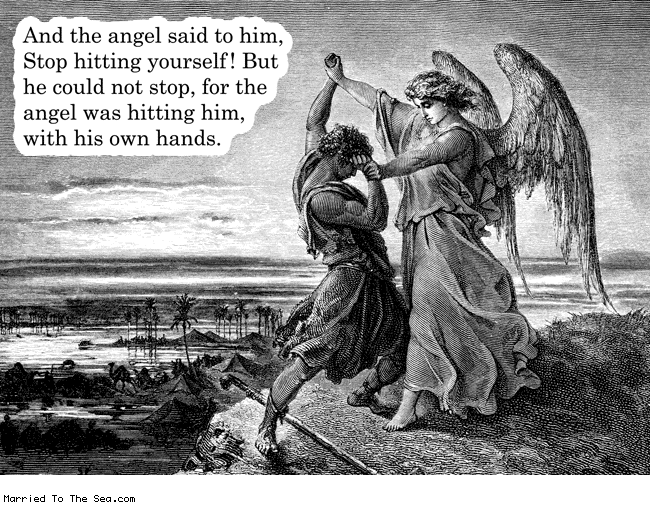
We left off exploring the consequences of conflicts between how we see ourselves in context of a group, and of how we see the society we live in. There is, the authors suggest (and demonstrate as described in the previous 5 installments of this series), a strong drive within us to reconcile our self of self-worth, in-group approval, and societal outlook. It has the somewhat idiosyncratic effect of causing us to harbour ideas that may work directly to our detriment, but allow us to align these three desires (through the use of stereotyped thinking). Aside from resulting in the advantaged staying at the top, it also leaves those at the bottom with increased psychological issues.

Up until now, our exploration of the specific hypotheses stemming from System Justification Theory has been focussed on individual-level attitudes and effects. In the final section of the paper, the authors explore some of the larger themes that are explained, at least in part, by the desire to approve of the status quo. Most skeptics will be familiar with the concept of cognitive dissonance – it refers generally to a brain state in which we are trying to reconcile two contradictory beliefs. Believers in a deity have pioneered a wide variety of methods to resolve cognitive dissonance – the most popular is the notion of “faith”: recognizing that something is logically impossible but believing it anyway. Throughout this whole discussion, but particularly in the previous installment, we see cognitive dissonance being a key component of the wacky outcomes of SJT. … Continue Reading

5 Why are you hitting yourself? Part 5: this post is entitled

  • November 3, 2011
  • by Crommunist
  • · blog · critical thinking · health · privilege · psychology · science

This is part 5 of an ongoing discussion of a paper by Jost, Banaji and Nosek discussing System Justification Theory. Read Part 1. Read Part 2. Read Part 3. Read Part 4.

We left off last week discussing the relationship between where one stands in the power dynamic, and how we see those at the top. If we are part of the high-status group, we have an implicit bias toward ourselves, where as those in the low-status group have an out-group – which also favours those at the top. When pressure is high to justify the status quo, we reach for stereotypes and facile explanations to rationalize why things are the way they are. Interestingly, insofar as this effect (called system justification) is identical to political conservativism, we see these biases exacerbated in people who confess to being conservative.

One of the advantages of having the kind of education I did (broad-based – a hard science candy shell with a delicious nougaty humanities core) is that I can draw on a variety of analogies when trying to impart unfamiliar concepts. Most of you have taken at least some science courses, so you will perhaps be familiar with Boyle’s Law which states, among other things, that gas will expand to fill its container. It’s that concept I want percolating in the back of your mind as we charge forward through our exploration of System Justification Theory. … Continue Reading

1 Why are you reading this?

  • November 3, 2011
  • by Crommunist
  • · blog

This blog has moved to Freethought Blogs, and is bigger and better than ever!

15 You don’t have to be crazy to work here, but it helps!

  • November 2, 2011
  • by Crommunist
  • · blog · Catholic church · crime · law · religion · secularism

I hope nobody can confuse me with someone who approves of religion, my recent posts supporting the idea of humanist ‘churches’ notwithstanding. I don’t. Religion is built on a foundation of unwarranted belief in claims that are nonsensical at best, and horribly destructive at worst. It concentrates unchecked and unimpeachable power in the hands of people who have done nothing to warrant it, and propagates abusive practices through threats and bribery:

Britain’s madrassas have faced more than 400 allegations of physical abuse in the past three years, a BBC investigation has discovered. But only a tiny number have led to successful prosecutions. The revelation has led to calls for formal regulation of the schools, attended by more than 250,000 Muslim children every day for Koran lessons.

The chairman of the Mosques and Imams National Advisory Board said he would treat the issue as a matter of urgency. Leading Muslim figures said families often faced pressure not to go to court or even to make a formal complaint. A senior prosecutor told the BBC its figures were likely to represent the tip of an iceberg.

But hey, so does the Boy Scouts, apparently:

CBC News has learned that Scouts Canada has signed out-of-court confidentiality agreements with more than a dozen child sex-abuse victims in recent years, shielding the incidents from further media attention. In many of the agreements, a confidentiality clause prevents victims from revealing the amount paid or even the fact that there was a settlement. At least one bars a former boy scout from publicly divulging that the abuse took place. Scouts Canada has refused to disclose details about any of the settlements. Sources tell CBC News that some settlements were around $200,000. … Continue Reading

8 This is what happens when you put a woman in charge

  • November 1, 2011
  • by Crommunist
  • · blog · feminism · gender · good news · news · politics

One of the things that drives me absolutely squirrel-burying nuts about how we choose political leadership is the fact that those decisions get made based on our personal evaluations of the candidates. For some reason, we can’t separate the qualities necessary for effective policy-making from the qualities necessary for bowling. Our news cycles get clogged with personal flotsam about whether or not this candidate or that one is affable, is nice, wears the right clothes… whatever. I’m not saying that there aren’t some personal qualities that are also required for effective leadership – I’m sure consensus-building and interpersonal skills are a necessary component of getting policy made – but they are certainly not the whole bag.

The part that especially grinds my gears is that our interminable evaluations based on the same handful of largely meaningless characteristics gives us, predictably, the same kinds of candidates all the time: people who are great at campaigning and lousy and governing. Because of deeply-entrenched attitudes about women, it also tends to give us a abundance of male candidates. Incidentally, because of similar attitudes about visible minorities, they tend to be white, but that’s a conversation for another time. This is, to be blunt about it, our society voluntarily shackling itself. While I am sure there are many white men who are incredibly competent politicians, I do not believe that political leadership is their exclusive province. Having more women in leadership positions probably makes us pass better policy.

Maybe you disagree with me. But you know who’s probably on my side? Germany and the rest of Europe: … Continue Reading

24 “Atheist church”: one week later

  • October 31, 2011
  • by Crommunist
  • · blog · critical thinking · crommunism · religion · secularism

So last week I posted a Monday “think piece” in which I examined the arguments against and for a community for humanists, and explained why I thought it was not a bad idea. I followed it up with a spitballed example of what I thought one could look like. My basic position, boiled down to a couple of sentences is that I think there is a positive role that a humanist organization modeled after a church can play, particularly for those who find home and community in the church environment (but may not agree with all the positions stated there). I don’t think that all components of church, including ritual, are necessarily harmful, and that we should try to take as much good as we could, while leaving behind the bad.

This issue got more responses than just about anything I’ve ever blogged about, and I’m taking this opportunity to go over them and summarize. … Continue Reading

35 I don’t believe in ‘agnostics’

  • October 31, 2011
  • by Crommunist
  • · blog · critical thinking · crommunism · forces of stupid · religion

As someone who believes strongly in his opinions, and who doesn’t shy away from debate, I often find myself having heated discussions with friends. They’re not always about atheism (in fact they rarely are), but they often end up back at the same point: “look, you believe that, but other people disagree – I think there’s truth on both sides.” They seem to think this is some kind of profoundly meaningful truth that I, in my zeal, couldn’t possibly comprehend. “Here I am,” they say “happily ensconced in my island of neutrality, not dirtying myself by having an opinion on something.”

I’m not a big fan of theists as a group, but I have a great deal of respect for honest ones who are at least willing to expose their beliefs to scrutiny and will drop a bad argument once it’s been exposed as fallacious. There’s precious few of those around, but when I find them I go out of my way to express my appreciation. I hold those kinds of people in much higher esteem than I do self-proclaimed “agnostics” who are just soooo over the whole religion question. Indeed, there are few people I have more contempt for than someone who archly sits on the sidelines, piping up only long enough to shit on people on both sides for being so crass as to believe in something being true or not.

First, I would be remiss if I didn’t clear up an important issue of semantics. Atheism is a response to a claim: that there is a god. If you are going to classify yourself with respect to the god question, simply ask yourself “do I believe in a supernatural entity responsible for the creation of the universe that involves itself in human affairs?” If the answer is anything besides “yes”, then you are an atheist. If your answer is “I believe that there is some kind of superior intelligence out there responsible for the universe, but not one as defined in any religious tradition” then you might describe yourself as a deist, provided you also believe that this ‘intelligence’ doesn’t interact with humans in a meaningful way. Deism is incredibly lazy, but whatever I don’t care. … Continue Reading

7 Movie Friday: Witchboard

  • October 28, 2011
  • by Crommunist
  • · blog · funny · movie · skepticism

Happy Hallowe’en, everyone. Well yes, technically Hallowe’en is Monday, but it’s Movie Friday! I can’t rob you of some seriously spoooooky content!

When I was a kid, my sister and I rented one of the corniest horror B movies I’ve ever seen. It has it all – terrible acting, cheesy special effects, a stupid plot, and to top it all off, the lamest twist ending of all time. That movie, dear readers, was called Witchboard:

Warning: This might make you laugh, so maybe don’t watch it at work.

Sadly, the video montage above doesn’t give you what I think is this movie’s most excellent moment. The protagonist, Linda, is becoming more and more connected to a murderous Conquistador ghost through the Ouija board that she foolishly used by herself. In a dream sequence, she wanders through a dream realm until suddenly, there is Malfador! In a stroke, he chops her head off with an axe. I’d describe the rest of the scene to you, but you should just skip to 1:59 of this movie:

Man, that’s some scary shit!

There is a skeptical point to be made here though. The whole premise of the movie is that you’re not supposed to use the Ouija board alone, or you’ll get possessed. Of course the actual reason is because Ouija boards, like ghosts and psychics and other ‘supernatural’ things, require at least two people to work: one to run the scam, and one to give away their money. Using the Ouija board alone would, unless you’re particularly prone to delusion, simply result in you sitting in the dark alone, feeling ripped off. Much like I felt at the end of this movie.

Like this article? Follow me on Twitter!

43 Why are you hitting yourself? Part 4: the self-hating 99%

  • October 27, 2011
  • by Crommunist
  • · blog · conservativism · critical thinking · LGBT · liberalism · politics · psychology · race · science

This is part 4 of an ongoing discussion of a paper by Jost, Banaji and Nosek discussing System Justification Theory. Read Part 1. Read Part 2. Read Part 3.

In this morning’s installment, we explored the phenomenon of implicit valuation of members of high-status groups. Despite what we may say, or what we may consciously believe about ourselves, our actions reveal subconscious attitudes that we may have. Our wish to approve of, or make excuses for, the status quo of our social lives leads those who are on the top of power gaps to exhibit bias towards themselves. At the same time, that same desire puts those at the bottom of those divides in the somewhat bizarre role of showing the same bias – toward those at the top. This effect is not seen when measuring explicit attitudes – what people are willing to admit to – but shows up when we can find ways to ‘bypass’ conscious processing.

In this installment, I’m going to look explicitly at one aspect of how system justification theory manifests itself: political ideology. … Continue Reading

15 Why are you hitting yourself? Part 3: this post contains implicit content

  • October 27, 2011
  • by Crommunist
  • · blog · critical thinking · LGBT · privilege · psychology · race · racism · science

This is part 3 of an ongoing discussion of a paper by Jost, Banaji and Nosek discussing System Justification Theory. Read Part 1. Read Part 2.

We left off last week looking at the ways that factoring in someone’s desire to approve of the way the world works (“I like things the way they are”) will lead her to defend the status quo, even if that status quo puts her at a disadvantage. The authors suggest 5 different mechanisms by which this effect might be seen: 1) rationalizing observed events by seeing the likely as the desirable; 2) using stereotypes to rationalize differences in power between groups; 3) using stereotypes more often when there is a cognitive ‘threat’ to the status quo; 4) accepting explanations regardless of their legitimacy; and 5) misremembering those explanations as being more legitimate than they are. When these factors work in parallel, we can explain much of the seemingly-idiosyncratic ways in which members of disadvantaged groups will sometimes defend the very system that holds them down.

In this installment, I will be delving into their discussion of what is one of the recurrent themes within my own analysis of racism: the fact that many of these mechanisms operate below the level of conscious awareness. Freud postulated the existence of three separate agents within the mind: the ego, the superego, and the id. His argument was that while conscious beings were able to be aware of their actions, many of the things that influence our behaviour happen without our even realizing it. While this idea has been around for decades and has a great deal of face validity, it is often ignored when we examine why people around us behave the way they do (another psychological concept called the Fundamental Attribution Error). … Continue Reading

Page 86 of 151
  • 1
  • …
  • 84
  • 85
  • 86
  • 87
  • 88
  • …
  • 151

  • SoundCloud
  • Twitter
  • Facebook
  • YouTube
  • Subscribe Subscribed
    • Crommunist
    • Join 82 other subscribers
    • Already have a WordPress.com account? Log in now.
    • Crommunist
    • Subscribe Subscribed
    • Sign up
    • Log in
    • Report this content
    • View site in Reader
    • Manage subscriptions
    • Collapse this bar