Crommunist
  • Blog
  • Music
    • Video
    • Audio
  • Media
    • Audio
    • Video
  • Events
  • Twitter
  • Ian Cromwell Music
  • Soundcloud

Category: secularism

0 Why do I want to take religion away?

  • August 30, 2010
  • by Crommunist
  • · blog · conservativism · critical thinking · crommunism · religion · secularism

People who argue against the influence of religion, and argue for its separation from public life (which Jesus also did, by the way, for those of you who actually bothered to read scripture), are commonly asked the same question: why do you want to get rid of religion? Atrocities have occurred throughout history committed by people who tried to outlaw religion (Pol Pott, Stalin, Mao) – why would you want to go down that path? Surely outlawing religious practice would lead directly to the same atrocities!

Unlike other arguments that I present and then ridicule, this argument actually has some merit. History has indeed shown us what happens when you try to force a belief system upon a group of people, whether it be state-sponsored atheism or state-sponsored religion. Horrific deeds are the result when you try to control someone’s mind. The problem with the argument is that it makes an erroneous assumption: that I (or those with similar viewpoints) want to get rid of religion.

I will state here unequivocally that I have no interest in taking religion away from people, even if such a thing were possible. Religion, like racism (and herpes) will be around in some form or another regardless of legislation or acts of physical force, and will just keep cropping up here and there. However, even if I could somehow mandate the removal of religion, I would not. I have no right to make decisions on someone else’s behalf – respect for individual autonomy is a fundamental tenet of ethics.

So why write all of this stuff then?

There is a common misconception that people who argue against the influence that religion has in public life are somehow trying to take away their ability to believe what they want. This is the same line of reasoning used by people who accuse affirmative action advocates of taking away jobs from white people. It comes from a mindset (which I’m sorry to say  seems to be held pretty much exclusively by conservatives) that the way the world is now is the way it is supposed to be. White people are at the top of the heap worldwide? Ah, well that must be their manifest destiny! Christians dominate the political spectrum? It must be God’s will.

This is inherently built in to the concept of ‘conservatism’ as opposed to ‘progressivism’. Conservatism, by definition, is about holding on to and maintaining traditional structures and events. In and of itself, this isn’t a bad thing. Some traditions are important to maintain, in order to understand where we came from – go to a military parade exercise and look at the seemingly-archaic procedures of marching and saluting. However, when we take a nuanced view of traditions, we understand that some of them need to be updated to reflect present-day reality. Conservatives deny this, instead fighting to maintain the status quo.

Some people who identify themselves as ‘conservative’ will say that the conservative movement is about maintaining individual autonomy, and refusing to capitulate to societal pressure or government shows of force. This philosophy is correctly called Libertarianism, and for reasons that I can’t quite fathom it has been rolled up in the conservative platform. Libertarianism stands opposed to collectivism (or authoritarianism – a rose by any other name…), and should not be confused with conservatism. In the same way, many people who identify themselves as ‘liberal’ (myself included) do not see themselves or their values reflected in the communal-authoritarian or arch-relativistic philosophy of progressivism. While their/our beliefs may often overlap with those in the liberal movement (gay rights, public education, health care), there are things to which they/we voice strong objection (health “freedom” woo, the role of business, religious “tolerance”).

What does this have to do with anything?

Humankind, like anything else, must constantly adapt to reality as things change. This philosophy is perhaps best encapsulated in the Taoist tradition, in which one is exhorted to be mindful of the flow of the universe (the Tao), and instead of resisting its direction, to allow one’s self to move in harmony with it. This adaptation and change is necessary for survival – as we know from evolutionary biology, those species that cannot adapt, die. If we want to survive as a species, or as a society, or as individuals, we must learn to respond to environmental/social/political challenges and find a way to live with them.

This need for change stands diametrically opposed to the religious/conservative philosophy (small wonder that those who oppose the teaching of evolution are almost exclusively conservative religious people), in which the status quo must be preserved. If the world works this way for a reason, then any attempt to adapt the way we do things is a betrayal of the order of the universe. Change is bad, and so are those who advocate it.

Religion is an impediment to human progress. It is the yoke around our necks that slows us and prevents us from being able to adapt and explore and challenge new frontiers. While sometimes progress needs to be examined closely through the eyes of caution (life-extending technology is perhaps one example), that is not the same as standing as a roadblock to progress at every opportunity. Sometimes (in fact, often), rapid response is needed to relieve or prevent human suffering, and when we have to wrangle at every step with those who refuse to accept rationality or observed reality as truth, suffering is prolonged. The problem with simply throwing up our hands and agreeing to disagree, is that one of these philosophies is trying to kill us.

So should we abolish religion?

I don’t think it is generally advisable to abolish religion. It’s definitely not a good idea to outlaw certain types of belief. That is merely substituting one form of tyranny for another. This seems to be the fear of religious people in the face of secularism – that somehow they will be persecuted and forced to recant, or prevented from practicing their beliefs.

Nobody is advocating this position – not seriously, anyway.

But there needs to be an admission on behalf of the religious community that curtailing the outrageous level of privilege that religious belief has enjoyed over the past few thousand years is not the same as oppressing religious people. Currently, being a “person of faith” is somehow seen as a virtue, and piety is confused for righteousness. Religion has become a qualification for public office (thankfully not so much here in Canada, but that may be changing), and school boards everywhere are becoming entrenched in fights that are ideological, rather than fact-based.

When we no longer accept religious beliefs as valid arguments, and instead rely on evidence and logic, we are better-suited to adapting to changing reality. The founding fathers of the United States understood this, which is why they expressly forbade religious involvement in legal and political matters. Sadly, this has been slowly and steadily eroded to give us a system wherein Sarah Palin is taken seriously when she says we have a Judeo-Christian heritage in this society. However, the principle still stands. If we are able to move back toward such principles, in which superstition is not granted equal time to fact, we will be in a much better position to address the challenges that we face today as a species, and the ones we will undoubtedly face anew tomorrow.

TL/DR: While I do not think it is a good idea to outlaw religion, I would like to see us move toward a system that does not grant it the special privileges it currently enjoys. Also, a bunch of stuff about how conservatives are trying to kill us.

Like this article? Follow me on Twitter!

3 CFI Vancouver stands in solidarity with Sakineh Ashtiani

  • August 29, 2010
  • by Crommunist
  • · blog · Canada · politics · religion · secularism · skeptivism

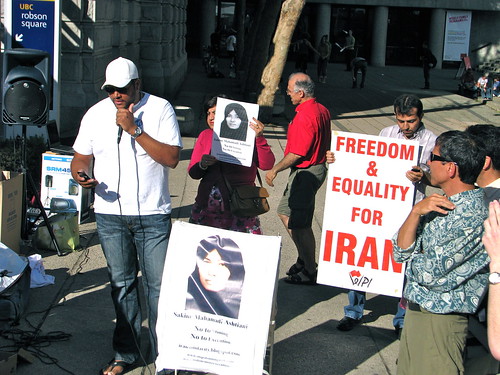
On Saturday, August 28th skeptics from Centre for Inquiry Vancouver attended a rally on the south steps of the Vancouver Art Gallery. The rally was in support of Sakineh Ashtiani Mohammadi, the Iranian woman who was sentenced to death by stoning, for the alleged crime of adultery. I say ‘alleged’ not simply because I don’t see adultery as being a crime worth punishing, but also because Ms. Ashtiani has denied the charge several times. The Iranian government, refusing to bother with little things like truth or integrity, staged a bogus confession on live TV. This rally was one of 100 held in cities all over the world, and was a follow-up to a rally I attended on July 24th.

A handful of members of CFI Vancouver were present to show our support for both Ms. Ashtiani and for the international movement opposing stoning. We arrived, spoke with the organizers, and participated in the event. There was a series of speeches, a large petition poster (which we all signed) and a (somewhat disturbing) simulation of a stoning victim. Organizers also handed out postcards destined for the United Nations assembly, demanding that Iranian president Mahmoud Ahmadinejad be barred from speaking there in September.

We were asked to say a few words on behalf of CFI, and since I had spoken at the last rally, I volunteered to speak for the organization:

“My name is [Crommunist]. I’m a volunteer with Centre for Inquiry in Vancouver and I’m very happy to represent the Centre for Inquiry at today’s important event to save the life of Sakineh, and to bring awareness of the unconscionable human rights violations in the Islamic Republic of Iran.

“We’ve heard other speakers detail the specifics of this horrible story. What I’d like to do briefly is remind the world that this is not an isolated case of abuse. Iran has been accused of violating multiple international agreements, the most egregious being the UN Convention on the Rights of the Child, in its execution of minors. Iran is one of the last countries to engage in the execution of children, accounting for two-thirds of the global total of such executions, and currently Iran has roughly 120 people on death row for crimes committed as juveniles. In one of the most well known cases in 2005, Human Rights Watch brought to light the case of two young boys – 16 year old Moahmoud Asgari and 18 year old Ayaz Marhoni, who were whipped and then hanged supposedly for unidentified sexual offenses, but in reality likely simply for being gay. It’s rather amazing how Iran can violate multiple human rights at once, in this case those of children and gays.

“In 2004 a UN resolution condemned Iran for human rights violations including the execution of children and gays, torture, the persecution of political opponents, discrimination against minorities, and violations of freedom of speech and expression.

“The Centre for Inquiry is deeply concerned about human rights abuses around the world, and we fight for the advent of rational, critical and scientific thinking, coupled with secular humanist ethics of compassion and tolerance and secularism itself, which means church-state separation. Iran is an example of what can go so terribly wrong when the principles and values that we stand for are trampled on in almost every possible way.

“Iran may be among the world’s most extreme examples of how bad a government and society can become when it’s run by a theocracy that has no conception for church-state separation, but it does remind us of why we must fight around the world and right here at home for the continued prioritization of the values of the enlightenment. Those values are rationalism, accountability, freedom of expression, secularism, human rights, an openness to new ideas and a spirit of respect and compassion. These may be abstract and lofty philosophical ideals, but they are given a very human face today by the plight of these victims of stoning.

“The CFI is proud to stand with Iran Solidarity, we are proud to stand against the horrific act of stoning, we are proud to stand with over 100 cities around the world to say with a loud voice ‘we will not tolerate this any more‘.”

This issue is precisely what CFI should be standing up for. Such atrocities can only happen in places where the religious establishment wields control over the secular authority. While I’m not ready to strap on a rifle and charge into Iran to fight the regime, I am happy that I was able to take part in this event, and join people all over the world in showing our opposition to the practice of stoning.

Special thanks go to Justin Trottier of CFI Canada and Jamie Williams of CFI Vancouver for preparing the speech, and to Fred Bremmer for taking the photos.

0 Is there a worse name than ‘honour killings’?

  • August 26, 2010
  • by Crommunist
  • · blog · Canada · cultural tolerance · gender · law · news · religion · secularism

When you think of the word ‘honour’, it conjures an image of someone who is honest, plain-dealing, and trustworthy. What it doesn’t invoke is the image of a man who murders his children for wearing revealing clothing or dating outside his/her nationality, or for refusing an arranged marriage.

There’s no honour in murder. It is the weak-willed act of a coward who lacks any human decency. One might be able to persuade me that there is honour in the suicide tradition of Bushido, in which failure to act honourably moves the samurai to take his/her own life. I’m generally against the idea of suicide, but a person’s life is their own to do with what they want. What he is not entitled to do, however, is murder someone else to restore his own sense of ‘honour’. Any society in which one person’s mental state or social status trumps another’s right to the security of their person cannot stand.

India seems to be realizing this:

India’s home minister proposed Thursday a bill to provide specific, severe penalties to curb honour killings, saying they brought “dishonour” to India as a secular, modern democracy. “We are living in the 21st century and there is a need to amend the current law and the law must reflect what the 21st century requires,” he said. “We have to look ahead and build a society that is based on secular values and enlightened views.”

I’ve talked previously about the social climate changing for women in India. The linked article mentions that there has been an upswing of violence against women in India, and that it is necessary to make changes in the status quo if India wishes to achieve its goal of being seen as a major world power. Let it never be said that international peer pressure and secularism can’t make the world a better place to live. There are around 500 million women in India who would likely agree.

The problem with passing these kinds of laws, however, is that murder is a crime. I am still uneasy about punishing people extra for the reasons behind why they commit crimes. Punishing specific groups of people for committing certain types of crimes against other specific groups is ethically dicey ground. Is it still an ‘honour killing’ if a non-religious man kills his son for being gay, or his daughter for dating a black man? Maybe it is, and if there’s a way to state that unambiguously, I’ll be interested to hear it.

Canada seems to be realizing this:

Justice Minister Rob Nicholson says prosecuting honour crimes is a priority for the government but that there isn’t any real need to change the Criminal Code.

Murder is wrong, and that must always be the focus. If passing specific statutes against honour killing will make it happen less, then that’s a discussion we can have. I doubt very much, however, that adding on a few extra years to a life sentence is going to meaningfully demotivate a person who is willing to murder his/her children from committing the act. The way to approach these things is that we have to model and encourage secular values of respect for the integrity of a human’s autonomy and security of person, and discourage the equation of “faithfulness” with righteousness.

Every time I hear of an honour killing, there is an almost-overwhelming temptation to immediately blame religion. The stories that get the most press are those in which the murderers are Muslim or immigrants from Muslim countries. I’m skeptical of this explanation for being overly simplistic, not to mention the fact that this type of killing is not founded in Qu’ranic verse. It’s sort of like when an abortion doctor is murdered by a Christian fundamentalist – it’s a flawed interpretation of scripture (which is, in itself, flawed, but we won’t go into that here) and isn’t an accurate reflection of doctrine. The problem is the belief that underlies both Christianity and Islam (and all religions) – that there exists an unobservable external standard which is accountable only to itself, but to which all of humanity is subject; and further, that this standard is not based on something reasonable like observable consequences to humankind, but based only on how fervently you believe in it. Sexism, homophobia, xenophobia and the like existed in the societies that spawned these religions, and they persist today. Blaming a book for a human failing neglects the larger and more accurate story that’s going on.

Like this article? Follow me on Twitter!

18 CFI Vancouver Skeptics ‘welcome’ John Edward

  • August 16, 2010
  • by Crommunist
  • · blog · critical thinking · secularism · skepticism · skeptivism

It was another big weekend for Vancouver skeptics. We hosted Dr. Christopher DiCarlo for a discussion of human origins in Africa, and we once again handed out flyers at a reading by self-proclaimed ‘psychic medium’ John Edward.

On Sunday, August 15th, our fair city of Vancouver played host to self-proclaimed psychic medium John Edward. Mr. Edward is perhaps most famous for his television show Crossing Over with John Edward, a half-hour show in which he claims to speak to the deceased relatives of audience members. In his show, he reveals intimate and personal information about those who have “passed to the other side”. Like other mediums, Mr. Edward claims to be a vessel through which information passes from the realm of the dead to the living.

The problem, of course, is that there is no evidence whatsoever that Mr. Edward can actually do what he claims. His approach is nearly indistinguishable from a well-known technique of manipulation called ‘cold reading‘. Basically, a ‘psychic’ cold reads a mark by initially using words or phrases that are so vague as to apply to anyone. Once a mark responds, the psychic hones in and sends progressively more specific probing phrases and words until the mark is completely convinced. At this point, the psychic can make claims about the feelings and wishes of the dead person with full buy-in from both the mark and the audience, who by this time are also staunch believers. A better explanation and illustration can be found here.

Why were we there?

A handful of volunteers from the Centre for Inquiry – Vancouver were present at the event to hand out some informative flyers to audience members (a pdf of the flyer can be seen here). As we have done previously with Deepak Chopra, we stood on the sidewalk outside the venue, and handed flyers to people as they came in. I must admit a bit of deception on my own part, as I asked people if they were here to see the John Edward show, and if they affirmed, I told them that we had flyers for them. While I did not lie (more on this in a bit), I didn’t dissuade them of the impression that I was working for the show.

Once again, we were not there to tell people they were stupid, or gullible, or uneducated. We weren’t there to feel smarter, or a smug sense of satisfaction at ‘educating the rubes’, nor were we there to ‘convert’ people to skepticism. It is my personal belief that most people are skeptical about some things, but seem to be readily willing to accept other things at face value.

We had two primary goals – first, to encourage people to be skeptical of claims by showing them some of the techniques ‘psychics’ use to trick people; and second, to engender a discussion of critical thinking and skepticism in a group of people who are likely not skeptics. We wanted people to be asking themselves ‘does this really make sense?’ We hoped that by showing people what the techniques were, we would prime them to ask real questions about what they were seeing.

How did it go?

Most people took a flyer and looked over it as they walked in. Some people asked for multiple flyers for their friends who were inside in line. We didn’t have a particular target for how many flyers we wanted to distribute, but we estimate our output at just under 100. The room in which the event was held has a 300-person capacity, meaning we missed more than we hit. We weren’t exactly thrilled that we didn’t get everyone, but we had a few hitches.

When we first arrived, we learned that many people had already gone inside the venue and were waiting in line for the doors to open. We ventured inside and up the stairs, and were suddenly face to face with 60-70 people, most of whom were much older than we were. A number of attendees were in wheelchairs and walkers. Standing there, faced with a group that outnumbered us 12:1, standing patiently waiting to speak to their dead relatives, we quickly lost courage and beat a hasty retreat to the Starbucks across the street to rethink our strategy.

We decided to stick to the sidewalk and get people coming in. This was decided for a few reasons. First, we felt a bit dickish going to people waiting in line and putting flyers in their hands. It felt opportunistic and mean. Second (and probably most importantly), it was scary. I kept having visions of a growing angry murmur going through the crowd, followed by a stampede of wheelchairs thirsting for our blood. On the sidewalk at least, we rationalized over frappuccinos, people had the opportunity to ignore us, or engage us, without having to face a giant crowd. Yes we’d miss the die-hards who showed up early, but they’d probably reject us out of hand anyway.

Overall, we walked away happy that at least we had done something, even if we didn’t shake up the world.

My personal experience

One woman offered us an extra ticket, and I jumped at the chance to get some intel from inside. When I went to talk to her, she asked me if I liked John Edward. I told her I’d never met him. The rest of the conversation went thusly:

Her: But do you like his work?

Me: No, not really.

Her: Why not?

Me: The world is a complicated place, and there are serious questions we have to ask ourselves. Whenever someone offers easy answers to difficult questions, I’m immediately skeptical. In the course of my skepticism, I’ve learned there are much better explanations for why John Edward can do what he does than believing he can talk to ghosts.

Her: Well then I’m afraid you can’t have the ticket.

Me: Oh, okay.

Her: If you bring negative energy in, it will prevent the spirits from speaking to him.

Me: Surely they wouldn’t be afraid of me. I’m just a guy.

Her: They aren’t afraid, they just require you to have an open mind.

I thanked her for the offer, and she thanked me for my honesty. I wasn’t about to take this woman’s money (tickets ran over $200) based on a lie. As much as I would have loved to get the inside scoop for you, there was no way I was going to do it through deception. She really believed in the supposed powers that Edward claims to have, so much so that the presence of even one person who didn’t believe would chase away all of the ghosts. This kind of insular environment allows Edward to prey on people, where not even one dissenting voice will be tolerated (although I suppose I could have just bought a ticket – even $25 would have been too much in my opinion).

The low point, of course, was high-tailing it out of the hotel at our first pass. I was amazed at how powerful the normative pressure was. Nobody was staring or being aggressive, yet as soon as we saw the line I could feel the pressure to run away. I’m not a shy person – I have no problem talking to strangers or approaching people in social settings; however, I was petrified by this situation. I have a bit more appreciation for people who are afraid of public speaking after failing in our first attempt.

The highlight for me was meeting Debbie, an attendee who came outside to ask us why we were there. Debbie felt that we were being uncharitable, and calling people stupid for not doing the research themselves. She told me that until you’ve had a supernatural experience, you have no right to criticize someone else’s search for truth. I told Debbie that I had indeed had several experiences that I attributed to supernatural causes, but once I had been exposed to better information and given the opportunity to make up my mind, I was grateful to have learned something. I also pointed out that we were no more calling people stupid than a public health campaign for hand-washing was calling people stupid – we are merely presenting people with information that we think could help them. She was not entirely swayed by my argument, although she did laud us on our non-confrontational style and general affability.

It is easy to dismiss the positions of those who disagree with you, especially when they are paying money to see a well-known fraud, but if we want to gain allies in the skeptical movement, we have to take criticism from all sides and evaluate it on its own merit. Debbie may have had a point – who were we to take away people’s false hope? My response to that as always is that the truth is important. We need to get as close to objective truth as we can in order to deal with each other honestly, and to allow humankind to progress. Permitting nonsense and charlatanry like John Edward to pass us by uncontested is an invitation for more deception, and a betrayal of the ideals of humanism. Things like this should be discussed and criticized, and people should not be allowed to defraud each other simply because “everyone is entitled to their opinion“. We have a duty to the truth, and ought to talk about it openly.

Hopefully our exercise in “skeptivism” encouraged a few people to think critically about what they were hearing. As we continue to do these events (James van Praagh, another ghoul who preys on the grief and credulousness of an non-skeptical public, will be in Richmond at the end of September), we invite members of the skeptical and non-skeptical community to give us commentary on how we can be more effective, and/or less offensive to those who buy in.

Welcome to all those here from Pharyngula!

Like this article? Follow me on Twitter!
0 Michael Bloomberg gets it EXACTLY right

  • August 9, 2010
  • by Crommunist
  • · blog · cultural tolerance · secularism

Holy crap, can I vote in the next New York City election? That is, can I vote for Bloomberg to move to Canada and run for office?

“On that day, 3,000 people were killed because some murderous fanatics didn’t want us to enjoy the freedoms to profess our own faiths, to speak our own minds, to follow our own dreams, and to live our own lives. Of all our precious freedoms, the most important may be the freedom to worship as we wish. And it is a freedom that even here — in a city that is rooted in Dutch tolerance — was hard-won over many years.”

This is in reference to the so-called “Ground Zero Mosque“. Bloomberg had expressed his opposition to the attempts to block the building previously, but this was a great speech in support of civil rights and personal freedoms. While I’m not thrilled about the “God’s love and mercy” part, I recognize a political pander when I see one. Secular society requires us to respect the rights of people to think and believe as they like, even if we don’t agree with them.

For the text of the speech, you can click here.

4 “Ground Zero Mosque” is contentious issue

  • August 3, 2010
  • by Crommunist
  • · blog · cultural tolerance · religion · secularism

You may have heard recently about plans to build a mosque close to the site of the World Trade Centre remains. Many people are outraged that “they” would try to put up “their” religious centre near where “they” committed an act of terrorism. I put the “they” in quotes for what I hope are obvious reasons – it wasn’t representatives of the Muslim community that hijacked the planes. It wasn’t representatives of the Muslim community that rejoiced when the towers fell.

But it was Muslims, and its easy to paint “them” with the same brush.

So a group that is representative of the Muslim community (whatever that may be) wants to put up a mosque in Manhattan. The stated purpose of the mosque is an admirable one: show the terrorists that Muslims are Americans too, and that they stand solidly behind the United States in ensuring religious freedom. However, the monster of prejudice and mistrust is rearing its ugly head:

A landmark commission hearing may determine the future of a proposed mosque near Ground Zero. The ranking Republican on the House Homeland Security Committee said Monday he favours an investigation into the funding of the mosque.

Given the reality that terrorist groups and foreign governments who are friendly with those groups are peddling influence in the United States, a review of the funding is perhaps warranted. What isn’t clear to me is why this structure and not others are of particular importance, unless it’s simply due to its locale. Mayor Bloomberg, who is opposed to such investigation, surprises me for taking the stand that he does; however, I don’t necessarily disagree with him.

Amazingly, the network media is doing exactly what I hoped they’d do:

Entitled “Kill the Ground Zero Mosque”, the video calls the proposed mosque a “monstrosity” that will invite further attacks on the US. The advertisement has received over 100,000 page views on YouTube. Neither CBS nor NBC, two of the major US television networks, will screen the advert.

The important thing is not whether or not they refuse to air it, but why. It appears that the reason has nothing to do with “not offending Muslims”, but more to do with the actual values of the United States:

In emails obtained by the news website Politico, NBC Universal advertising standards manager Jennifer Riley wrote that because it did not make a distinction between terror groups and the religious organisation behind the mosque, “the ad is not acceptable under our guidelines for broadcast”.

This is not blind capitulation to the sensitive feelings of the Muslim community, but a recognition of the need to distinguish between terrorists and people who share their religious label. As far as I am concerned, this is being handled correctly. This is how secularism can work, even if I don’t like the fact that in excess of $100m is being spent on a site of religious worship.

2 How NOT to do secularism

  • July 7, 2010
  • by Crommunist
  • · blog · news · religion · secularism

We secularists are in a tough spot. Religion has dominated the political and social landscape for so long that it is held by many to be an intrinsic value, and one that ought to be free from criticism. Of course this is nothing but special pleading – no ideas are sacred, criticism is the only way we figure out which ideas are good. That being said, there is a reality that the challenge of secular society must take into account that people do have an intrinsic right to belief and conscience, and we have to respect those rights. However, if the goal is to create a society that establishes equal rights for all people, the secular agenda will often come into conflict with the religious agenda. In cases like that, there is a right way to handle it, and an unbelievably stupid way to handle it.

So now it’s time for another “Good Idea, Bad Idea”

Good idea: treating a church with the same respect that you would treat any other business in the conduct of a criminal investigation.

Bad idea: drilling holes in the tombs of dead people to find non-existent hidden documents:

As well as searching a couple of main Church offices and a cardinal’s home, [Belgian] police had drilled holes in two archbishops’ tombs, said the Church.

Personally, I don’t share our society’s taboo about death. Once you’re dead, that’s it. You’re beyond caring about what happens to your body after you die – “you” don’t exist anymore. You could dress up my dead body in a Klan robe if you wanted to… I’d be too dead to notice. However, the way we treat our dead does have consequences for those who are still alive. We respect the integrity of the dead person out of respect for those who knew him/her, and because it shocks the conscience to see a body’s resting place violated. There are occasions in which it is reasonable to violate this respect, if the consequences to the living warrant it. However, drilling holes in tombs to find allegedly secreted documents of sexual abuse is extreme, and doesn’t do our side any favours. Just because some priests have done horrible things does not in any way justify the mistreatment of priests in general. They have the same rights as any person, and should be treated with the respect we extend to anyone else. Bad job, Belgium. I prefer my Tomb Raiders to look like this:

Good idea: granting freedom of religion and freedom of conscience to people.

Bad idea: letting “freedom of religion” trump reason in the court of law:

In a decision handed down Friday, Justice Gérard Dugré agreed with Loyola’s opposition to teaching [a provincially-mandated course on ethics and morality] on the grounds of religious freedom. Loyola argued the course was redundant because the school already offers instruction on ethics and morality from a Catholic point of view.

As much as I hate to dictate interpretation of the Charter to a provincial judge, Justice Dugré has fundamentally misapplied the concept of freedom of religion. Freedom of religion means, at its essence, that individuals are free to believe and practice as they like. It does not grant special immunity to people from hearing ideas they don’t like, or that conflict with their prejudices set down in magic books. The province of Quebec mandated that all schools must provide instruction in ethics. I am not sure how easy it is to teach ethics to schoolchildren, since their brains are not sufficiently mature to reason abstractly, but surely people of any age can be taught not only what is right and wrong, but be at least introduced to the reasons why. That’s what ethics is – a branch of philosophy that deals in why things are good or bad, not simply a list of commandments.

I have received religious “moral” instruction. Catholic morality is based on the idea of the supremacy of Yahweh, in the teachings of His son Jesus of Nazareth, and the Holy Spirit of Yahweh that dwells within all people. According to Catholic teaching, the Holy Spirit reveals right and wrong to faithful believers, who may use doctrine and scripture (if you have to) to discern between the righteous voice of God and the evil temptations of the Devil.

Of course this is wildly impractical, since it doesn’t really help you work through what is good and what is bad in those situations where doctrine is ambiguous and scripture is contradictory. It also begs the question of how we know doctrine and/or scripture are correct. It’s basically just paternalism – “we know what’s right and wrong. If you get confused, blow this whistle and I’ll come help you.” Religious doctrine and scripture can equally be used for good or for evil.

Requiring students to learn about ethics and the religious teachings of other groups is a great way to instruct them on what processes are available to them to work through issues of right and wrong. If that process conflicts with their religious sensibilities (or, more accurately, those of their parents), then a frank discussion is required. That’s the way freedom of religion works – we can’t tell you what to think, but we can equip you with tools so you know how to think. Education is the purview of the provincial government, who passed a law requiring students to learn ethics. Unless you can demonstrate that the law violates the Charter, the government is free to pass it.

However, it is absolutely false to claim that requiring private schools to abide by the curriculum infringes on freedom of religion. It is no more true than it is to say that laws against murdering your children violate the religious freedom to conduct honour killings, or that laws requiring vaccinations to go to public school violate your religious freedom to stave off measles with a bag of dried chicken heads and a sharp stick. Justice Dugré has acquiesced to the special pleading of this Catholic school, that they should not have to teach their students anything that doesn’t agree with their Christian beliefs. Would we tolerate this same exception for Creationism instead of science, or scripture instead of literature, or prayer instead of phys-ed? I sincerely hope not.

Secular society has to respect the rights of religious people in the same way it has to respect the rights of irreligious people. No group should get special privileges by virtue of group membership, nor should they be unduly punished in the same token. Treat all people fairly under the law – that’s a good idea.

0 I have a perfect face for radio!

  • June 30, 2010
  • by Crommunist
  • · blog · religion · science · secularism · skepticism

Yesterday I was privileged to join Ethan Clow, the Vancouver chapter president of CFI Vancouver (the handsome devil you saw talking to Deepak Chopra) on his radio show “Radio Freethinker” on UBC’s campus radio. This is a weekly skeptic podcast that looks at skeptic issues in the news and discusses various salient skeptic topics. I was present as a special guest, along with Jakob Liljenwall, head of the Simon Fraser University Skeptics group.

We discussed, among other things:

  • Belgian police raiding a Catholic Church;
  • Organic pesticides being worse than synthetic for the environment;
  • The G8/G20 events; and
  • Confrontation vs. Accommodation in the skeptic movement

Of course Ethan, Jakob and I have similar views on things, but we had a fairly lively discussion nonetheless. As you listen to the podcast, you’ll immediately notice two things:

  1. Some of the things I talk about have appeared (or will appear, depending on when you’re reading this) on this blog, and
  2. There is a reason I prefer writing to speaking – I backtrack a lot while trying to explain myself.

So if you’ve ever wondered if I have a sexy voice, or you’re a friend of mine and you miss my sexy voice, give “Radio Freethinker” a listen. If the subject matter interests you, check it out Tuesdays at 3:30 on CITR 101.9 FM in Vancouver.

Page 7 of 7
  • 1
  • …
  • 5
  • 6
  • 7

  • SoundCloud
  • Twitter
  • Facebook
  • YouTube
  • Subscribe Subscribed
    • Crommunist
    • Join 82 other subscribers
    • Already have a WordPress.com account? Log in now.
    • Crommunist
    • Subscribe Subscribed
    • Sign up
    • Log in
    • Report this content
    • View site in Reader
    • Manage subscriptions
    • Collapse this bar
 

Loading Comments...