Crommunist
  • Blog
  • Music
    • Video
    • Audio
  • Media
    • Audio
    • Video
  • Events
  • Twitter
  • Ian Cromwell Music
  • Soundcloud

Category: gender

63 Both sides of the coin

  • January 25, 2012
  • by Crommunist
  • · blog · feminism · gender · health care · medicine

Most people who support a woman’s right to choose when to have children call themselves just that – pro choice. While most rankle at the lazy characterization of “pro-abortion”, I’m personally okay with it. I am for abortion access. I think every time someone makes the choice to have a child it should be celebrated, and every time someone decides that now is not the right time, that’s a smart move too. I feel no sense of moral panic at the consequences of my stance. Anyone who would use abortion as birth control (the religious right’s nighmare scenario) isn’t someone I want raising a child, not even as some kind of twisted form of ‘just deserts’ punishment.

As I’ve explained before, it is wildly inaccurate to call the opposite side – the anti-choice side – anything else. They’re not “anti-abortion”, since restrictions on abortion do not reduce the overall number of abortions. And they’re not “pro-life”, because when women seek out abortion services outside of a licensed medical practitioner, the results can be fatal: … Continue Reading

13 #Mencall Kathryn Marshall things

  • January 17, 2012
  • by Crommunist
  • · blog · Canada · crapitalism · feminism · forces of stupid · gender · hate · politics

So every time I see the kind of cruelty that is leveled against women for the arch-crime of existing, it always catches me flat-footed. I always approach things with a mindset of “naw, people can’t be THAT bad”. I am almost always wrong.

Case in point – watch this video:

Now, if you didn’t make it all the way through the video in one go, I don’t blame you. It took me 4 or 5 bites to actually force that turd down my throat. For those of you who couldn’t watch, I will briefly summarize. On a Canadian Broadcasting Corporation (CBC – roughly the equivalent of NPR but less… well, less NPR) program called Power and Politics, Evan Solomon hosts a debate between John Bennett of the Sierra Club and Kathryn Marshall of Ethical Oil. The debate is over the pipeline from this morning’s story.

Ms. Marshall has clearly been instructed to make the following points:

  1. The Sierra Club accepts foreign donations
  2. Foreign interests should not be involved in a Canadian regulatory decision
  3. Ethical Oil is supported by grassroots donations
  4. The pipeline creates Canadian jobs and is important to economic growth
  5. Opponents of the pipeline want to oppose any development projects … Continue Reading

16 Racism confounds us all

  • January 16, 2012
  • by Crommunist
  • · blog · crommunism · feminism · gender · race · racism · science

My academic background is in epidemiology and biostatistics. Briefly, epidemiology is the study of the interaction between potentially causal external factors and human health, usually at a population level. So, when someone tells you that BPA causes cancer, or that wind turbines or wi-fi signals don’t cause illness, they are speaking in terms of epidemiology. Because of the diffuse nature of many cause/effect relationships and the difficulty of measuring historical exposure, epidemiology is often looked at as a ‘soft science’, which is perhaps a fair charge – we do not deal in certainties; only probabilities.

One of the fundamental concepts that it is necessary to understand in epidemiology is the concept of ‘confounding’. Most of you are likely familiar with the maxim “correlation does not necessarily imply causation” or some permutation of that phrase. Many relationships that may seem causal are better explained by the involvement of a third variable. The classic example is coffee and lung cancer – there is a statistical relationship between frequency of coffee drinking and incidence of lung cancer. However, it would be wildly inaccurate to say that coffee causes lung cancer; what is actually happening is that many people have a cigarette with their coffee, and it is the smoking that causes the cancer. The presence of the third variable (smoking) explains the seeming relationship between the other two. … Continue Reading

33 Politically INcorrect? As though that was a good thing…

  • December 12, 2011
  • by Crommunist
  • · blog · crapitalism · critical thinking · crommunism · gender · privilege · race

Over the past couple of months I have become more active on Twitter. While at first I used it primarily as a secondary RSS feed, with automatic updates for these blog posts, after a while I began to use it as a way of getting politics updates and rapid news on the Arab Spring uprisings. From there, it was a slippery slope down to constant updates from various Occupy sites and recording artists I particularly like.

As I’ve become more active (and after moving from the outer realms of anonymity to FTB), I’ve been steadily picking up followers of my own. Most are atheist/skeptics who I assume follow me because of the consistent reminders I put at the bottom of each of these posts. Others have, I presume, seen my full-throated defenses of Occupy or election reform politicians in the United States, or caught me uttering a particularly clever bon mot and thought I was worth checking out in greater detail.

I was perusing my list of followers one afternoon when I came across one who described hirself as, among other things, “politically incorrect”. This struck me as sort of an unusual thing to brag about. I have, on occasion, been caught describing myself as an “asshole”, because while I am constantly dissecting my language, I very rarely mince words. This is not bragging about my lack of restraint, but is intended as more of a wry observation on our tendency to prioritize tone over substance when evaluating each other.

The phrase ‘political correctness’ was common parlance in my upbringing during the late ’80s and early ’90s. By then, however, it had begun taking on a decidedly negative connotation – something akin to ‘thoughtcrime’. The spin on it was that whiny liberals were hopping up and down on semantics, getting hot under the collar over linguistic non-issues. Plain spoken folks were, as a result, forced to tiptoe across a minefield to make even the simplest of points. Political correctness was a muzzle that prevented the free exchange of ideas, and to buck the trend and declare oneself ‘politically incorrect’ was a bold and courageous move.

Even typing that made me feel ill. … Continue Reading

27 Warning: this story is full of win

  • November 15, 2011
  • by Crommunist
  • · blog · Catholic church · gender · good news · LGBT · politics · secularism

Sometimes the stuff I blog about gets me pretty down. There’s a lot of ugliness in humanity, and a lot of things to despair about. The ever-persistent stain of racism, rampant and unabashed misogyny, the easy lies of conservatism… it’s enough to wring a tear from even my stony gaze, and I have to reach for my supply of otter pictures.

Then again, sometimes a story comes along and completely cheers me up:

Poland’s first transsexual member of parliament has been sworn in, in what has traditionally been a socially conservative country. Fifty-seven-year-old Anna Grodzka was previously a man, known as Krzysztof, before having surgery in Thailand.

Okay, that’s pretty cool. Poland has made a progressive milestone by electing someone who, no matter how qualified, would not have been able to serve in office a generation ago. That’s pretty cheering. But wait, there’s more… … Continue Reading

15 Wives, be subject(ed) to your husbands

  • November 9, 2011
  • by Crommunist
  • · blog · civil rights · feminism · free speech · gender · hate · news · secularism · sex

I’m not married. I have no idea if I ever will get married. But if I do, it won’t be to anyone who’s read this book:

Malaysian officials have banned a controversial book that offers sex tips to Muslim women, reports say. The book, entitled Islamic Sex, is believed to have been read by a few hundred people. It was published by a group known as the Obedient Wives’ Club, which has been widely criticised for promoting polygamy and denigrating women.

The Obedient Wives’ Club told journalists last month that the book was intended as a spiritual guide to be read only by club members to help them comprehend sex. The club has previously said women should act like “first-class prostitutes” to prevent their husbands from having affairs or resorting to violence.

Yikes.

Funnily enough, there’s no advice to the husbands on how to make sex a life- and relationship-affirming experience for their wives. It’s almost as if the publishers of this book think that sex is a woman’s duty, and that the husband’s role is to simply enjoy it. Almost as if, despite constant propaganda from Muslim apologists (and other theists, to be sure), following the Qur’an doesn’t establish women and men as equals, but rather as a dominant and submissive relationship (but not the good kind). … Continue Reading

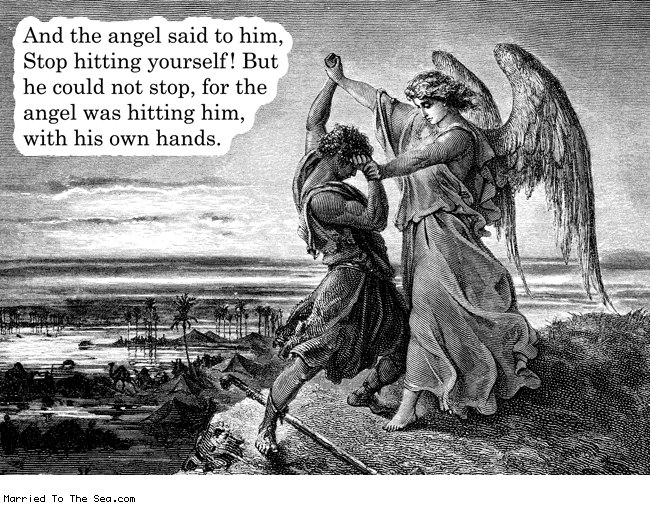
4 Why are you hitting yourself? Part 6: SJT writ large

  • November 3, 2011
  • by Crommunist
  • · blog · critical thinking · gender · privilege · psychology · race · religion · science · skepticism

This is part 5 of an ongoing discussion of a paper by Jost, Banaji and Nosek discussing System Justification Theory. Read Part 1. Read Part 2. Read Part 3. Read Part 4. Read Part 5.

We left off exploring the consequences of conflicts between how we see ourselves in context of a group, and of how we see the society we live in. There is, the authors suggest (and demonstrate as described in the previous 5 installments of this series), a strong drive within us to reconcile our self of self-worth, in-group approval, and societal outlook. It has the somewhat idiosyncratic effect of causing us to harbour ideas that may work directly to our detriment, but allow us to align these three desires (through the use of stereotyped thinking). Aside from resulting in the advantaged staying at the top, it also leaves those at the bottom with increased psychological issues.

Up until now, our exploration of the specific hypotheses stemming from System Justification Theory has been focussed on individual-level attitudes and effects. In the final section of the paper, the authors explore some of the larger themes that are explained, at least in part, by the desire to approve of the status quo. Most skeptics will be familiar with the concept of cognitive dissonance – it refers generally to a brain state in which we are trying to reconcile two contradictory beliefs. Believers in a deity have pioneered a wide variety of methods to resolve cognitive dissonance – the most popular is the notion of “faith”: recognizing that something is logically impossible but believing it anyway. Throughout this whole discussion, but particularly in the previous installment, we see cognitive dissonance being a key component of the wacky outcomes of SJT. … Continue Reading

8 This is what happens when you put a woman in charge

  • November 1, 2011
  • by Crommunist
  • · blog · feminism · gender · good news · news · politics

One of the things that drives me absolutely squirrel-burying nuts about how we choose political leadership is the fact that those decisions get made based on our personal evaluations of the candidates. For some reason, we can’t separate the qualities necessary for effective policy-making from the qualities necessary for bowling. Our news cycles get clogged with personal flotsam about whether or not this candidate or that one is affable, is nice, wears the right clothes… whatever. I’m not saying that there aren’t some personal qualities that are also required for effective leadership – I’m sure consensus-building and interpersonal skills are a necessary component of getting policy made – but they are certainly not the whole bag.

The part that especially grinds my gears is that our interminable evaluations based on the same handful of largely meaningless characteristics gives us, predictably, the same kinds of candidates all the time: people who are great at campaigning and lousy and governing. Because of deeply-entrenched attitudes about women, it also tends to give us a abundance of male candidates. Incidentally, because of similar attitudes about visible minorities, they tend to be white, but that’s a conversation for another time. This is, to be blunt about it, our society voluntarily shackling itself. While I am sure there are many white men who are incredibly competent politicians, I do not believe that political leadership is their exclusive province. Having more women in leadership positions probably makes us pass better policy.

Maybe you disagree with me. But you know who’s probably on my side? Germany and the rest of Europe: … Continue Reading

11 Movie Friday: How to hit on an Asian girl

  • September 16, 2011
  • by Crommunist
  • · blog · funny · gender · movie · race · racism · sex

I live in Vancouver, which is a city that has a very large population of east and south Asian people. Having spent a number of years in Brampton, Ontario, and having done a degree at the University of Waterloo, I am more or less used to being in an environment with a large minority population. Some people, however, seem to have a difficult time dealing with the diversity, and retreat immediately into crude stereotypes when interacting with non-white people. If you think you might be one of those (and you are attracted to women), here’s a few handy tips:

Many people (mostly white people) express a great deal of incredulity when people of colour (PoCs) share stories like this. “How could anyone be so stupid?” they ask. Or, more commonly, “you’re exaggerating”. Life as a PoC in most cities in North America is emphatically not a non-stop barrage of racial insensitivity and adversity. However, it doesn’t take a lot of these kinds of comments to make you feel as though two things are overwhelmingly true:

  1. Your race/ethnic identity is the most important thing people see when they look at you
  2. You are the ‘other’ – a person who is tolerated but not part of the group

Now I don’t get hit on a lot (and when I am, most of the time I can’t hear the comments over the sound of me saying ‘yes’ and high-fiving myself), but it’s a pretty safe bet that when I’m flirting with someone who seems interested, at some point I will hear either “I just love black guys”, or “I’ve never been with a black guy before”. I’ve yet to hear “I’ve never been with a viola player before” or “health economists are so sexy” (and we really are – we’ve done extensive studies proving it through the use of computer simulation). It’s not a huge problem, but it’s just one of those things.

While it’s tough enough for women to walk down the street without being openly and unapologetically objectified by strangers, when you add race to that equation, life becomes even more difficult.

Like this article? Follow me on Twitter!

7 Why do we want diversity?

  • July 18, 2011
  • by Crommunist
  • · blog · critical thinking · crommunism · gender · race · secularism · skepticism

A copy of this post appears at Phil Ferguson’s Skeptic Money blog.

The skeptic/atheist movement is an interesting case study in group dynamics. It is a group that is subject to all the same vices and cognitive blindnesses that plague all human beings: self-centredness, arrogance, in-group bias, lack of self-awareness, hostility and stubbornness in the face of dissenting ideas. However, it is simultaneously a group that is acutely aware of human failings and constantly looks for ways to overcome them. As a result, we see pretty regular blow-ups, scandals, and strings of self-righteous blog posts that take opposing sides of pretty much every minor issue that crops up.

I, for one, wouldn’t change that for the world. Political movements thrive on passion, and provided we don’t start splitting ourselves into irreconcilable camps that are too busy tearing each other down to work together, occasional (read: incessant) spats are a small price to pay. Debate is good, debate is important.

One of my favourite aspects of the group is that, despite the diversity of beliefs, we tend to be a fairly liberal bunch. This is, to my mind, the natural result of being a critical thinker – when you replace “obviously” with “evidently” as the sufficiently persuasive criterion, your beliefs become more fluid and nuanced. Things that are “obvious” are seldom so to everyone, and usually coloured with a whole host of assumptions, many of which are unwarranted. Freethinkers have been quick to adopt the cause of the LGBT movement, and are currently struggling through the task of embracing feminism. Freethinkers like Debbie Goddard, Sikivu Hutchinson, and myself (if I can flatter myself and place my name in such august company) are pushing to introduce anti-racist ideas into the freethinkers toolbox.

At the same time, I also recognize that there is a great deal of normative pressure involved in the group dynamic – even among a group of freethinkers, a fair amount of ‘group think’ tends to go on that we try and sweep under the carpet. Some ideas are adopted as slogans without really being vetted by the cerebral cortex. We’re only human and not every idea can be fully chewed over – we’d cease getting anything else done.

I’ve said all the above to say the following. The freethinking community has, of late, embraced the word “diversity” with both arms. Panels are popping up at major meetings to discuss the need for multiple voices, groups are starting to look less monocultural/monosexual, and discussants nod their heads sagely when ‘the D word’ comes up in conversation. We are, as a group, beginning to talk more and more about the importance of including women and visible minorities in the conversation.

Of course, I couldn’t call myself a skeptic if I wasn’t just a little bit cynical about what is fueling this fairly rapid adoption. Maybe ‘rapid’ is a mischaracterization borne of my own recent arrival to the movement, but it seems as though a few people started talking about diversity and then within a span of a year or so, everyone was talking about it. It may in fact be the case that people were flogging this issue for years before I started paying attention, and I just noticed at the last minute. If this is so, then I apologize. However, the salient point is that diversity went from being “not a big deal” to “central to the freethinking movement” very quickly.

The most optimistic explanation of this fact is simple: because the freethinking movement is open to new ideas and stocked with humanists, we are of course going to work to address inequities when they happen within our own ranks. It is no strange feat, therefore, for this particular group to make rapid wholesale changes in how they (we) talk and think about important issues. Diversity of thought is embraced because it is important, and we have recognized that.

A slightly more nuanced explanation is that a small number of opinion leaders started listening to those who had been speaking about the need for diversity, and the audiences of those opinion leaders adopted the new position. When speakers and media figures and bloggers began talking about the need for diversity in the movement, people who watch read and listen incorporated the subject into their lexicon without really needing the kind of understanding that is borne of a full explanation.

The most cynical of the potential explanations is that because the movement is chock-a-block with white liberals, the popularity of diversity is due to a strong desire to avoid appearing sexist/racist/anti-gay. Anyone familiar with the term ‘white guilt’ will immediately understand what I’m driving at – oftentimes being a member of the majority leaves you with a feeling of obligation and the overwhelming drive to ensure that nothing you do can be construed as bigoted. While this is a useful way of getting white people to do what you want (as a minority), it’s an incredibly limited and shallow solution that eventually breeds resentment.

My reason for suspecting the presence of this third motive comes from a few sources, but there is one instance that sticks out in my mind. I shared a link to a blog post I had written on Reddit’s r/atheism subgroup. In the comments section, someone disagreed with my general thrust along a predictable line (“why do people need to identify as black atheists? Why can’t we all just be atheists?”) When I tried to explain my position, the conversation ended with the commenter saying “well you should post an AMA [ask me anything – a common type of post on Reddit] about what it’s like to be a black atheist.” My response was “I have an entire blog about that. You should read it – it’s good.”

My interlocutor seemed to think that his involvement in the conversation was over by telling me that it was my responsibility to explain myself – despite the fact that I had already explained myself to him, and despite the fact that I have an entire website explaining myself. His interest was in shutting down the conversation because the topic was making him uncomfortable. The onus wasn’t on him to learn something, it was on me to make him feel better. This is typically symptomatic of white guilt – I am interested in feeling better, not in learning how to contribute.

I am inclined to think that there is a bit of all three of the above motives going on. As I said earlier, while we are freethinkers and skeptics, we are also human beings, and human beings are full of frailties and flaws. As much as we’d like to believe our thoughts are pure, true skepticism is an ideal only – not achievable in a complete sense. Also insofar as we are talking about a group of people, there are going to be a variety of factors that compel us to act. Given that fact, I am going to take a moment to speak to those who understand that diversity is good, but may not really understand why.

Why do we want diversity?

Most everyone is familiar with the parable of the blind men and the elephant – a group of men who cannot see encounter an elephant and each describes it differently, based on which part they are feeling. The resolution to that story, depending on the cultural context, is that a wiser man (or one who has encountered an elephant before) tells them that they are all right, despite their wildly disparate descriptions.

The truth is rarely accessible from a single perspective – there are often a wide variety of interpretations that bring us a fuller understanding of a phenomenon, particularly when we are talking about topics related to personal interaction. This is not to say that “all perspectives are equally valid” – that’s a load of post-modernist bullcrap. What it is to say is that when it comes to perception, it is rare that any one narrative captures the full experience, and that multiple overlapping points of view brings us a much better picture.

Given that one’s experiences as, say, a black woman or a gay man or a person with physical disability colours one’s perception in ways that someone outside of that group might have difficulty understanding, it is expedient to include members of those groups. Doing so grants us a wider and richer set of experiences that we might not otherwise be able to access. It opens us up to avenues and sensitivities and nuances that we’d overlook unless we were particularly attuned to them.

The typical rejoinder often comes back: “so are you saying it’s impossible for a white person to understand issues facing black people?” No, I am not saying that. If I believed that, then I’d have given up on writing long ago. There are certainly many white people that are scholars of the black experience that probably know the issues better than most black people themselves. What I am saying is that it is far more difficult to find people like that, and far easier instead to include people who have had those experiences personally, rather than by proxy.

Beyond this simple issue of expediency of wisdom, however, there is another reason why diversity is a good thing. I alluded to it last week, and while the example I gave was perhaps not the ‘smoking gun’ type of evidence for me to draw this conclusion, I hope that I may be granted a bit of leeway. It is entirely possible that diversity makes us smarter – that bringing a variety of experiences and types of communication to a group may, counter-intuitively, collectively make us better at solving problems. Failing to foster a diverse environment may be hurting our cause needlessly – surely the monocultural environment reported by minority skeptics isn’t intentional – more likely simply a product of ordinary inattention.

Concluding thoughts

While the freethinking movement has gained a great deal of momentum in the past few years, it is important to reflect and ‘take stock’ of where we are going. We have a number of tools at our disposal, and I think we are doing ourselves a disservice if we don’t begin to see diversity of experience as an asset rather than an obligation. Whatever our reasons for ‘talking the talk’ when it comes to diversity, the sooner we come to realize that it is a boon for us to ‘walk the walk’, the faster this process will take place.

TL/DR: There has been a lot of talk about ‘diversity’ in the skeptic/atheist movement of late, and I am a tad suspicious as to why it has gained such rapid acceptance. There are a number of reasons why this may be so, some more noble than others. Regardless of our motives, diversity is a benefit to the movement, and this should be a good enough reason on its own to work to encourage it.

Like this article? Follow me on Twitter!
Page 4 of 6
  • 1
  • 2
  • 3
  • 4
  • 5
  • 6

  • SoundCloud
  • Twitter
  • Facebook
  • YouTube
  • Subscribe Subscribed
    • Crommunist
    • Join 82 other subscribers
    • Already have a WordPress.com account? Log in now.
    • Crommunist
    • Subscribe Subscribed
    • Sign up
    • Log in
    • Report this content
    • View site in Reader
    • Manage subscriptions
    • Collapse this bar