Crommunist
  • Blog
  • Music
    • Video
    • Audio
  • Media
    • Audio
    • Video
  • Events
  • Twitter
  • Ian Cromwell Music
  • Soundcloud

Category: culture

3 What does winning look like?

  • June 9, 2011
  • by Crommunist
  • · blog · culture · good news · liberalism · race

It is easy (tantalizingly so) to rail against racism, pointing out only the negative aspects. After all, it doesn’t take a great deal of creativity or courage on my part to say ‘racism is bad’ and for readers to say ‘I agree’. I doubt I will ruffle any feathers making such proclamations, although I know there are definitely some of you that weren’t completely with me at first and have since come around to my way of thinking. This is encouraging, as it means that there is some collision of persuasion and open-mindedness happening on these pages. It takes only a few such interactions to make major change.

And it may… just may be that we are seeing some of that change happening before our eyes:

In 1994, Ellis Cose surveyed successful, middle-class African-Americans and uncovered an often unspoken rage. He described his findings in the book The Rage Of A Privileged Class. Now, 17 years later, Cose has discovered a major change among middle-class blacks: They have become one of the most optimistic groups in America. He reveals his findings in a new book, The End Of Anger.

This is encouraging news indeed, for a few reasons. First, it suggests that at least some progress has been achieved toward a harmonization of the middle class, despite racial differences. Second, it shows a decline in the narrative of ‘us vs. them’ that often seems to pervade the discussions of black/white racism. Third, it flies in the face of those who would claim that black people prefer to play victim rather than work to advance. Fourth, and perhaps most importantly, it may be possible to learn what things have worked and what haven’t and to use those lessons to inform future social progress.

To the first point, it is important to be cautious. This study does not say that black people no longer feel like racism is a problem:

Cose tells NPR’s Neal Conan that the rise in optimism is not linked to perceived end of discrimination. “No one black who I talked to thinks we have arrived at a point where we are an equal opportunity nation,” Cose says.

What it does say is that the perception of opportunity is greater, and this has begun to pervade the general consciousness. Spurred perhaps by the existence of prominent models of colour in high-ranking positions (other than the sport or other entertainment industry), black kids have grown up with a substantially different understanding of the possibilities of achievement than their parents did. At the risk of reading way more into this than the evidence warrants, this exact effect is one of the goals of affirmative action policies: increase the number of high-profile professionals that are people of colour (PoCs) so as to provide role models for others. Whether or not that is the reason for this shift is debatable, but it certainly nods in that direction.

Second, this study seems to corroborate what we saw last week: namely, that the entrenched conflict between black and white seems to be diminishing (at least in the eyes of black people). Instead of general frustration at the barriers in place to advancement, young black professionals are reporting belief that with hard work, they can advance. Again, these are perceptions, not observed data, so we must be cautious when interpreting what this actually means. This culture of advancement works to benefit both sides: black professionals can begin to assert themselves and change the narrative about what it means to have dark skin, while white professionals will begin to see that having intelligent and hard-working black colleagues is not a zero-sum game, but rather a boon to their business and productivity.

Critics of anti-racism often charge them (us) with coddling PoCs, and promoting a culture of victimhood. Black people wouldn’t be where they are, these critics say, if the liberals didn’t spoon-feed them and convince them that all their problems were someone else’s (whitey’s) fault. Of course, as is the way with this brand of criticism, it comes without evidence. When the attitudes are measured, we see that as we work to improve society’s permeability for PoCs by legislating against some forms of discrimination, PoCs are ready not only to take advantage of the opportunity but to adjust their expectations. Black people (at least those in this study) are happy to take control when opportunities are presented and barriers are taken down.

This is good and useful information, and this phenomenon must be explored more thoroughly. Considering the increasing visibility of the Latin and Arab communities in the United States, South and East Asians in Canada, and the looming spectre of systemic race problems in Europe, it is vital to have an understanding of what works and what doesn’t. While different minority groups have their own unique issues, we can learn what narratives are conducive to progress and which ones simply allow the status quo of single-group supremacy to maintain indefinitely.

Many of these issues are generational, meaning that children born in this era will likely not see the same kinds of racism that, for example, I saw while I was growing up. They will have a profoundly different understanding of what race means, and they will have to grapple with brand new issues that we can’t even conceive of now. However, it is good to see that their parents will be bringing them up in a world that gives them a positive attitude about what they can achieve with hard work. Some of that may be illusory, some of it may be true only thanks to policies enacted in their parents’ lifetimes, and some may indeed have always been true.

So while we are far from a true version of a ‘post-racial’ utopia, we may be seeing some of the initial signs that point the way to a more productive and equitable conversation about race.

Like this article? Follow me on Twitter!

0 Special Feature: I participate in SlutWalk Vancouver

  • May 17, 2011
  • by Crommunist
  • · blog · civil rights · feminism · First Nations · gender · privilege · race · sex · skeptivism

This past Sunday, I participated in the local (to Vancouver) SlutWalk event. I have spoken previously about the issues that preceded this event, so if you haven’t heard of it you should probably read that post. I will attempt to summarize: a police officer in Toronto suggested that women who don’t want to get raped probably shouldn’t “dress like a slut”. Giving Constable Sanguinetti the benefit of the doubt for a moment, I’m sure what he was trying to say is that rapists are more likely to target women who are wearing clothes that expose skin than someone dressed in, say, business casual (more on this later). What followed was a backlash against the idea that rape victims are “asking for it” through their dress, as though a woman’s job is to not provoke the ravenous male hordes through improper dress.

Obviously, when put into context, this idea is not only wrong but very dangerous. Women are often blamed for being raped, disbelieved by even their own families and the judicial system. This kind of slut-shaming double standard inherently disadvantages women – “slut” is always a gendered term even when used (subversively) to describe men. Inherent in the word slut is the idea that a woman enjoying her sexuality is dirty and immoral. It is leveled against women irrespective of their level of sexual activity – a girl who sleeps with her boyfriend for the first time (or indeed, who has never done anything sexual) is just as likely to be called a slut by those around her as is a professional sex worker. Neither of them deserves the appellation – the word should never be used.

In this post, I will give some of my reactions to the event.

The Good

1. Attendance

I wasn’t sure how many people would bother to come to an event like this. Keep in mind that it was pouring rain at various points that day (this is Vancouver, after all), but there was a crowd of around 1,000 people (my estimate would have been higher, but that’s what the paper said) there. Some were dressed in a variety of costumes: three men in operatic drag, a woman in a Saran Wrap dress, a young woman in a really uncomfortable-looking corset, a guy wearing a tiny t-shirt and silver bicycle shorts (not a flattering look… they kept slipping down), and my personal favourite: bandana man – so named because that’s all that covered his junk. My response to my friend (who I will call “Julie” just for simplicity’s sake) was “wow, who knew people actually cared about women’s rights?”

2. Who Attended

One would expect that an event like this would be almost entirely women. I was pleasantly surprised at the gender mix: still majority women but with a lot of friends, spouses, boyfriends, and people like me who simply care about the issue there. It is a sad fact of the sexual double-standard that these kinds of issues only seem to gain real traction when men start speaking about them, but at least the Y chromosome camp was well-represented. It certainly surprised a couple of knuckle-draggers who showed up expecting a parade of sluts, and were instead confronted by a group of passionate feminist allies.

3. Support

This was not a fringe event where only a few whackos showed up (although there were a few of those, to be sure). In addition to various legal and social support organizations, the deputy mayor of Vancouver Ellen Woodworth showed up and spoke at the kickoff to the march (“As a lesbian, a queer, a dyke… I know the power that words have”). Media were present, and sponsors had donated materials and time to the event. The Vancouver Police were also on hand to block traffic, which was important because there were a lot of people on the streets.

4. The Reaction

Nothing was more rewarding than seeing people’s faces as the parade moved past. People were shocked to see not only the attire, but the word “SLUT” paraded defiantly and openly through the streets. I said to Julie “that is the face of consciousnesses being raised.”

The Bad

1. Messaging

One of the stated purposes of SlutWalk was to reclaim the word ‘slut’, in order to rob it of its power. Ultimately, I disagreed with this part of the campaign. Like with the word “nigger”, I don’t think that re-appropriating words is a useful endeavour. I am of the opinion that people should be forced to deal with the full history and implication of a word like ‘slut’, and to understand that it is a word that cannot be separated from inherent hatred of women. Once people understand not only where it comes from, but how it is used to silence, shame and victimize women, they won’t want to use it. I have never been the target of the word ‘slut’, and so it is not my place to say that women shouldn’t re-appropriate it; my criticism is of the idea of re-appropriating words in general.

2. Failing to understand the point

I spotted a number of signs saying things like “real men don’t rape” and “don’t tell me how to dress; tell men how not to rape” and “rapists cause rape, not women”. Even one of the organizers went up and said “women don’t need to be reminded not to dress slutty; men need to be reminded that they will go to jail!” While I understand the spirit behind the statement, I think it demonstrates a fundamental misunderstanding of rape and slut-shaming. Men that rape women do not do so because they want to get laid*. They certainly don’t do it because they “are rapists” any more than people commit crimes because they “are criminals”. Failing to understand this is committing a fundamental attribution error.

Rape is an issue of control and respect. Rape is the result of someone believing that their own wishes supercede the rights of another person, and that the victim deserves her/his treatment for whatever reason. Rape, like all violence against women, is the product of the idea that women do not have the right to sexual self-determination. The word ‘slut’ is a manifestation of that idea. It is the idea that needs to be fought, rather than focussing on “rapists” – as though that was a group in and of itself that must be identified and punished. A man who doesn’t rape because it’s illegal will rape as soon as he thinks he can get away with it. Better to make fewer men that think rape is acceptable.

3. Failing to address the fallacy

There was a particularly powerful moment during the introductory speeches, where one of the organizers said “I am a woman, a colleague, a friend, a girlfriend, and a person deserving of respect.” She then removed her pants, revealing a short sequined skirt, followed by the words “I am still a woman, a colleague, a friend, a girlfriend, and I am still a person deserving of respect.” It was a perfect demonstration of the fact that regardless of a person’s apparel, she/he should be treated as a self-determining individual whose body is her/his own. However, as great as the demonstration was, it skipped over an important point.

While it is difficult to get exact numbers on this (since many sexual assaults go unreported, particularly in places where they are not taken seriously), I hope those of you who are skeptically-minded will allow me to get away with the following assertion: places that have strict dress codes for women do not have lower rates of sexual assault. While it is my suspicion that these places have higher rates of assault, at least we can conclusively state that covering women head to toe does not eliminate the risk of sexual victimization. The fallacy committed by Constable Sanguinetti was not that he was impolitic in his wording, it’s that the original statement is nonsense. The way that women dress is not related to their risk of being raped, at least at a population level.

I am reminded of the old joke about the two hikers that run afoul of a bear. While the first hiker starts running, the second quickly starts putting on his running shoes. “You fool!” calls the first hiker “Those shoes aren’t enough to outrun a bear!” The second hiker says “I don’t have to outrun the bear, I only have to outrun you.” There is no standard definition or quantitative parameters for what “dressing like a slut” means. It is entirely subjective – the things that are worn by the women I work with would be considered pornographic in many Middle-Eastern countries. The problem is not the clothes; it’s our attitudes towards women and sexuality.

This point was not adequately addressed by the speakers, and I think it was a real missed opportunity.

The Ugly

1. The Racial Double-Standard

Vancouver is a city with a large East- and South-Asian population. Black women and aboriginal women are disproportionately more likely to be victims of sexual assault (including rape) than are white women. Neither of these facts would have been apparent while looking at the crowd. Like most feminist and social activist causes in North America, SlutWalk Vancouver was attended by white people, organized by white people, and focused on issues that do not include race. One of the speakers was Angela, a woman who works front-line for a victim support service in Vancouver’s downtown East Side (DTES). She began talking about the work that she and her colleagues did while dealing with assault victims, and whenever she talked about defending women from rapists, her every sentence was greeted with enthusiastic applause and cheering.

When Angela pivoted to point out that there is a racial component of the word “slut” that is largely ignored, that women of colour don’t particularly want to take back the word “slut”, that this wasn’t an issue of wearing a little black dress but of not being beaten and subsequently ignored by the legal system, the reaction was far more muted. I think I might have been the only person who cheered.

There is a common theme in the intersection between race and feminism. Feminism is well-tended by white women, and many women of colour recognize that there is a need for shared mutual struggle. However, when issues of race and racism – particularly the fact that PoC are disproportionately affected by sexism – come up, there is significant hesitation to face those head-on. Aura Blogando calls this ‘white supremacy’ – I think that characterization is perhaps a bit strong. I think of it more in terms of “white blindness”, or more familiarily, privilege. White women are very enthusiastic to address those issues that are germane to themselves, but more reluctant (it seems) to bring issues affecting PoCs to the fore except in very tokenistic ways (for example, the organizers of SWV noted correctly that Vancouver is built on unceded Saalish territory, but didn’t say word one about the fact that Aboriginal women are more often the victims of assault).

By completely dismissing, or at least not making a point of raising, the issues associated with race, SlutWalk Vancouver allowed white people to feel good about themselves for standing up to one injustice, without having to deal with the related injustice in which their own (unexplored) attitudes play a role. This criticism should not be interpreted as an indemnification of white people, merely an observation that these issues tend not to become publicly-relevant until they affect the majority (in much the same way as sexism issues don’t get treated seriously until men complain about it too).

So in all of it, the good bad and ugly, I think SlutWalk Vancouver was a success. People from many different walks of life were present to raise consciousness about an issue that I think is very important, and hopefully a conversation will be sparked about not only the word “slut”, but how we think of women in our society in general. I was proud to participate, and look forward to more opportunities to do the same.

Like this article? Follow me on Twitter!

* I will no doubt be criticized for making the generalization that it is only men that rape women, or that only women are raped. I fully recognize that men rape men, and less frequently women rape men or other women. Rapists are not exclusively male, and victims are not exclusively female. I also recognize that transpersons are caught in a tricky gender classification limbo, and are disproportionately more likely to be victims of sexual assault and rape than are cispersons. It is not my intention to diminish these cases, and I hope I do not come across as dismissive of this very real issue.

1 Canada DOESN’T have a race problem… grading on a curve

  • April 20, 2011
  • by Crommunist
  • · blog · Canada · cultural tolerance · good news

I make a lot of hay on this blog by pointing out negative things in Canada, the country I love. As a blog about race and racism (with some gay shit sprinkled in there for flavour), I go out of my way to find, illustrate and criticize things that happen here that are to the detriment of minority groups. Reading my writings here, some may walk away with the impression that I think that Canada is a particularly bad place to be a person of colour (PoC), a gay person, a woman, or member of another disadvantaged group. This is simply not true.

Part of the reason I am so passionate about Canada and the issues facing Canadians is because I recognize that our country has the overwhelming potential to model positive values to the entire world. Perhaps uniquely, Canada is making the experiment of multiculturalism work and has found a way to maintain a level of civility and understanding that transcends any kind of formal legal protection, but that has simply become a feature of our national identity. How could I approach such an important issue with anything less than my full attention and fervor?

However, all the doom and gloom that I cast around may serve to distract from the fact that Canada is a really amazing country:

Canadians are hard-working, great readers, the most tolerant people in the developed world, and enjoy more “positive experiences” than everyone but Icelanders, according to a new analysis of social trends released here Tuesday. “At 84 per cent on average, Canadians report the highest community tolerance of minority groups — ethnic minorities, migrants, and gays and lesbians — in the OECD, where the average is 61 per cent,” the report said. Residents of the U.S., Australia, New Zealand and the Nordic countries were among the most tolerant, while those in southern and eastern Europe, as well as Japan and Korea, were less tolerant.

This is something to celebrate – among countries in the developed world, Canada still stands out as a place where minority groups are, by and large, respected and tolerated. The kinds of racial strife and discord that seem to run rampant in many developing countries (particularly those in the Middle East and Africa) are completely foreign to us, and aren’t likely to degenerate to Rwanda or Bosnia levels ever. We should be happy about this.

However, and I cannot stress this enough, we should not be satisfied. It’s wonderful that we’re at the top of the OECD, but racial and cultural tolerance are not a competition. We are not trying to win the “world’s nicest people” award, at least we shouldn’t be. And while accolades are nice, it is dangerous to judge our successes by the failures of others – downward comparisons are a bitch.

While we are doing very well, we can still do better. By highlighting and discussing the issues that I do, I am trying my best to keep these conversations from getting swept under the rug of complacency. There are many areas to improve, and by doing so we can show the rest of the world how they can make the same improvements.

Like this article? Follow me on Twitter!

1 Special post: Crommunist goes to America

  • March 28, 2011
  • by Crommunist
  • · blog · feminism · First Nations · history · race

So this whole past week I was visiting two of my good friends in the Northeastern United States. One, a friend from graduate school, lives in Philadelphia, Pennsylvania. The other, a friend I’ve known since I was a kid, lives in Cambridge, Massachusetts. I talk about things in Canada quite a bit, and was excited to get a bit of a perspective on the differences between living in Vancouver and being in a major American city.

Philadelphia

I’ve never been to Philadelphia before, and I wasn’t really sure what to expect. My preconception was to think of Philadelphia as a mostly white industrial city, but I was surprised to learn that it has one of the oldest black communities in the country. In our touring around town we came across the African American Museum of Philadelphia, which had a very cool interactive display that detailed some of the stories that comprise the history of Philadelphia. I was happy to see a number of couples of various ages and racial backgrounds there (at 2:00 on a Wednesday afternoon). It was particularly eye-opening to hear some of the stories of how black entrepreneurs, politicians and activists had to struggle simply to achieve basic human recognition.

Because of its lengthy black history, Philadelphia has a huge black population. In fact, the city has roughly an even number of white and black residents. There is a thing that is common among black people (at least in places where there aren’t a lot of black people) where we will recognize each other with a reverse head tilt (also known as “the black guy nod”). I kept catching myself having to inhibit my instinct to perform this action every 5 or 6 seconds, as I’m sure I would look like a total spaz.

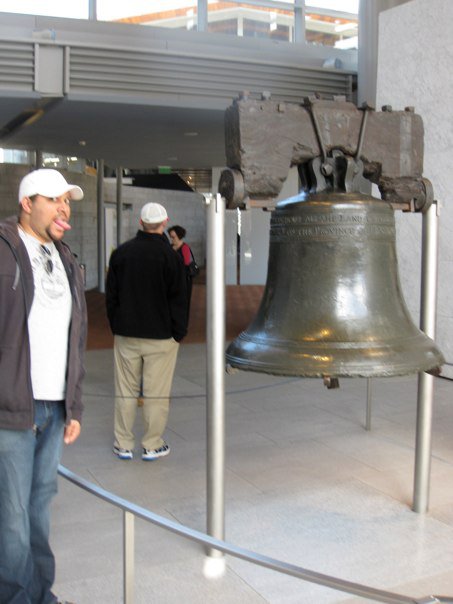
Here’s me at the Liberty Bell:

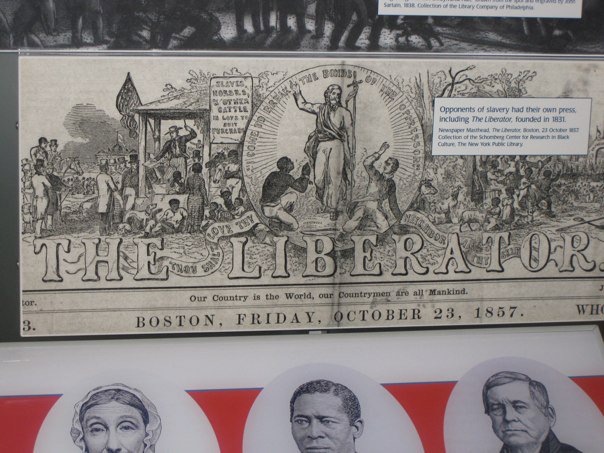
The bell is a profound symbol of liberty and was used by the Abolition, Suffrage and Native rights movements alike. There is a certain irony present in the fact that a nation founded on liberty took more than 100 years to recognize the equal status of women, and another 50 to recognize certain ethnicities:

I really enjoyed my time in Philadelphia, minus the fact that the city seemed to be completely bereft of people having any fun (except the gay bars). It was then off to Boston for the second half of the trip.

Boston

I’ve been to Boston once before, back in 2008. The city has a feel that is not very dissimilar to being in a Canadian city – it’s clean, people are friendly, and there is government-funded health care. There were far fewer people of colour in the city, but more than I expected and definitely more than I see in Vancouver. The “black guy nod” might have made an appearance once or twice in a moment of distraction when I forgot I wasn’t at home.

Boston has a deep connection to the history of the United States. The whole city is structured to allow even casual tourists the opportunity to connect with history. As I might have mentioned before, I find cemeteries fascinating. Boston has old cemeteries in the middle of the city that you can visit. It was there that I learned that one of the first victims to be shot in the Boston Massacre was a black former slave named Crispus Atticus. We also saw a tomb marked with the name “Freeman” – usually the name of a freed slave (but not necessarily a black slave).

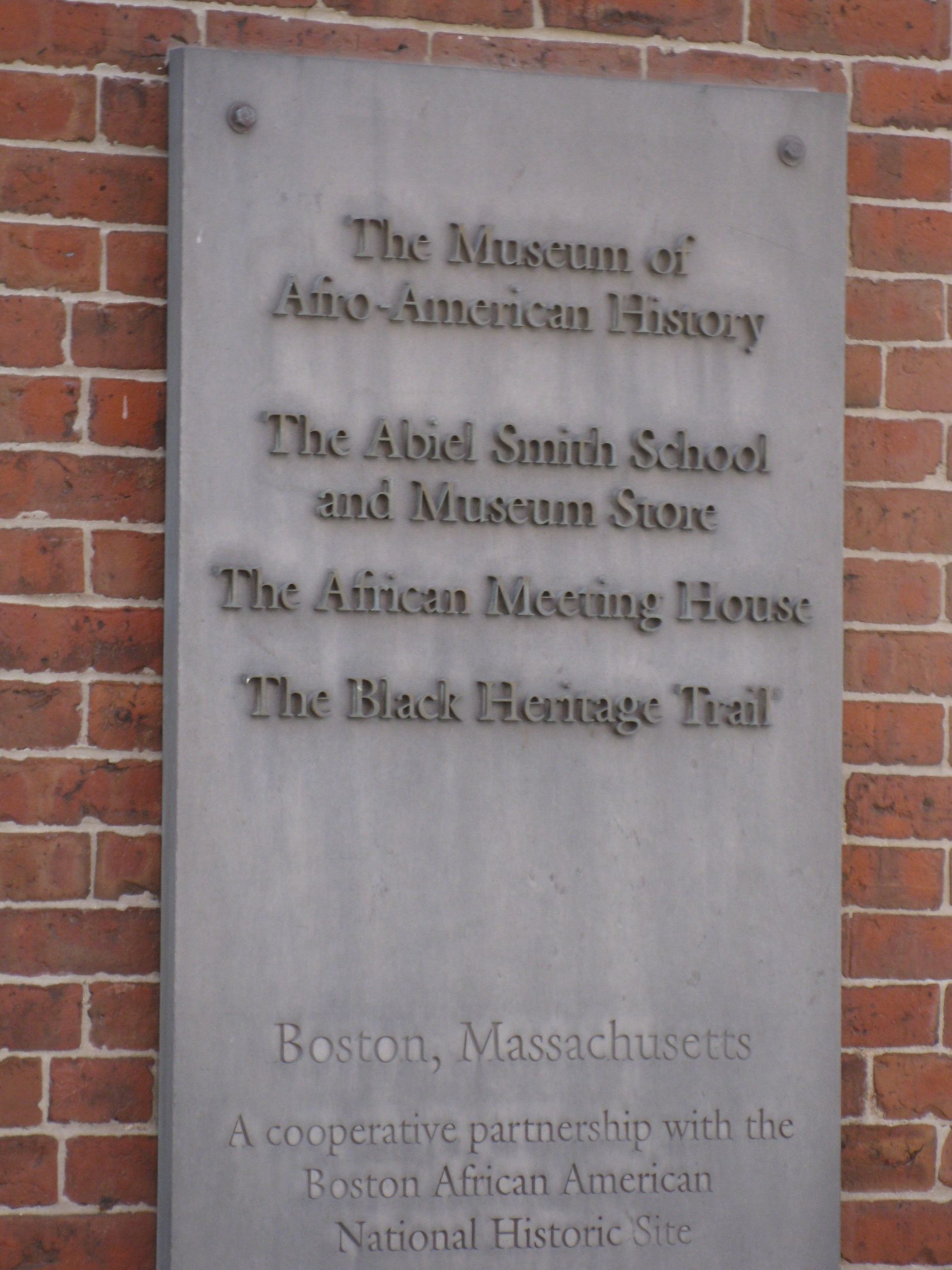
Part of tourism in Boston is what is called the “Freedom Trail” – a self-guided footpath through the city that highlights a number of sites of historical interest. Part of the trail is the Black Heritage Trail – a side-trip that showcases a few sites of import to the African-American community in Boston, one of which is the Abiel Smith School:

Sadly, I didn’t have time to go inside the museum, so I’ll have to save that for either a later trip or a few afternoons spent poking around with Google to see what I can see.

Anyway, for a history nerd like myself, walking through Boston was great. Philadelphia too. While my agenda was to party (hence last Wednesday’s post… for which I apologize), I’m glad I was able to learn something and get to connect physically with sites that marked major events in world history. As I said, it will take me a couple of days to get back into my groove, but expect me to go back to my regular post quantity and quality starting next week.

Like this article? Follow me on Twitter!

0 If you’re surprised, then you haven’t been paying attention

  • March 16, 2011
  • by Crommunist
  • · blog · Canada · culture · hate · liberalism · racism

We often like to delude ourselves into thinking that we have, as a society, somehow transcended racial barriers. That through sheer will-power and positive liberal vibes, we’ve managed somehow to craft the first society in the history of the world where racism is a thing of the past. Even those who reject my view of racism will point to the fact that at least we don’t see black men getting beat up for the crime of being black, right?

Right?

The people targeted in assaults in February by four men alleged to be white supremacists say the attacks were provoked by race. “I couldn’t believe something like this could happen,” one of the victims, who was born in Saudi Arabia and raised in Canada, said Wednesday. “I was upset and angry.”

The young man, who CBC has agreed not to name, was having a cigarette on the sidewalk outside a Whyte Avenue bar early on Feb. 13 when a friend was bumped by one of a group of men. “My friend looked back and he was like ‘Hey, excuse me,’ and the guy just ran towards him … I put out my hand so I would just stop them and he just punched me,” he said.

I cannot be clear enough about this point. When I say that we are all racist, I do not mean that we are all capable of doing something like this. I do not wish to imply that I look at my fellow citizens with fear and suspicion that, given the opportunity, they would assault me for being black. The very idea is nonsense – my race probably means more to my black friends than it does to my friends from other racial groups. I’d go so far as to say that 99.9% of Canadians would recoil from the idea of perpetrating physical violence against people based on their racial background. White supremacists of this type represent a vanishingly small proportion of the overall population, and can be looked upon as fringe elements that do not reflect the attitudes of the general public.

In fact, I’d imagine that even among the white supremacist community, these men are seen as outliers. They claim to be members of a white supremacist group known as Blood and Honour (link totally NSFW, and probably not safe for eyes either – bright red background), which is somewhat dubious given that B&H isn’t really known for violence. However, it’s not particularly relevant which particular supremacist group these particular assailants belong to – the point is that even among white supremacists they are a minority. White supremacists tend to exist in largely rural areas, where their extreme form of race-based hatred is considered a minority opinion.

However, a more general kind of race hatred does tend to exist in greater volume in many rural communities – a generalized intolerance and feeling that non-white people are somehow the “other” that deserves special scrutiny and attention. This is not because people who live in rural communities are bad people; I was a child in a racially-monolithic rural community, and the people there were some of the warmest, friendliest and most welcoming people I’ve ever met. All the same, my “otherness” was palpable from a very young age. The attitude within these rural communities is a concentrated version of a generalized feeling of racial normalcy that exists as a popular myth in the broader culture that says that America was founded by white people, for white people, and PoCs are here by the magnanimity of their white brethren (so don’t forget to genuflect).

So here’s the thing: each one of the subcultures I’ve mentioned here gain support and succor from the larger group they exist in. While most members of Blood and Honour would likely repudiate the violence perpetrated in their name, they would likely agree with everything else the attackers stand for. While most rural people disagree with the members of Blood and Honour, they tend to tolerate the non-violent race bigotry of their neighbours. The general sense of mistrust and non-citation-supported anti-immigrant sentiment prevalent in the rural communities gestates in the larger sea of the white Canada myth. Each level of the pyramid is supported by a larger group in an act that diffuses responsibility, and makes the act of a handful of extremists seem to come out of nowhere.

Of course those of us who have been paying attention know better than to waste our time with arch-liberal hand wringing about how this could happen in our “post racial” utopia. We know that we all bear responsibility for at least a little piece of what happened in Edmonton, and by challenging the larger societal lies we can make the acts of violence even more unlikely.

Like this article? Follow me on Twitter!

0 You finished cleaning that glass ceiling yet, sweetheart?

  • March 8, 2011
  • by Crommunist
  • · blog · critical thinking · culture · feminism · gender · good news · news

Today is the 100th anniversary of International Women’s Day, which should be some cause for celebration. After all, 100 years of progress is an incredibly long time in human history. In the past 100 years we moved from horse-drawn carriages and plows to an international space station orbiting the planet. In 100 years we went from a largely-illiterate population with extremely limited access to information to a planet-wide network that puts virtually the sum total of all human knowledge at ready access from something that we can slip into our pockets. Our understanding of the universe has gone from the deterministic passage of small particles to a nuanced, varied and complex probabilistic model, allowing us to probe concepts previously written off as unsolvable “mysteries”.

Surely in all that time, with all that progress, we’ve made similar strides in the way we treat each other. The answer, as always, seems to be “yes and no”.

Why Feminism Still Matters:

Across the globe by almost every measure, women lag well behind men. Even though women do 66 per cent of the work and produce half of the food, UNICEF reports that they earn only 10 per cent of the global income and own just one per cent of the property. Nowhere in the world do women account for even a third of the national parliamentarians and, in most regions, including Canada, it is considerably less.

Still, this represents progress.

This article, published in the Vancouver Sun, is a pretty decent overview of the various stalls and starts of the movement for women’s equality, but it doesn’t do an explicit job of answering the question implied by its own title – why does feminism still matter? Why should we be focusing on issues that affect women? Anti-feminists, in their attempts to resemble reasonable and decent human beings (rather than reactionary dicks) often refute the feminist position by arguing that we should focus on having equal rights for everyone, and that focusing on women is the same as ignoring men. And while feminists sometimes just want to scream “men are doing just fine, shut your face hole!”, that’s a quick way to lose an argument for a stupid reason.

Canadian companies lack strategies for promoting women:

In the U.S., 70 per cent of companies surveyed lacked strategies for promoting women, compared to 71 per cent internationally. Despatie noted that the Canadian survey also showed that 43 per cent of companies didn’t feel they had a problem with promoting women to top jobs. To women, however, the lack of support strategies was clear. More than half (53 per cent) of all Canadian women and about 38 per cent of American women thought their organization provided “no or minimal support” for their promotion.

It’s right here that the importance of feminism is revealed: companies think they’re doing an excellent job promoting women, but the reality is that they are even worse here than they are in the United States, a place that we’re all happy to look down on socially (to my great chagrin). When there is such a huge gap between perception and reality, the status quo becomes deeply entrenched and progress becomes next to impossible. I am somewhat reminded of the bromide from Alcoholics Anonymous – the first step is admitting you have a problem.

When confronted with this kind of information, the usual reaction of the anti-feminists is to go with the old standby excuse of “maybe there aren’t enough qualified women for the positions”. To me that seems to invite the question: why the hell aren’t there? Women are statistically better educated, are supposedly guaranteed by law to be free from official discrimination based on sex, and equally intelligent as their male counterparts – wherefore the disparity?

Women are underutilized in executive workforce – study:

In both years, a full 30 per cent of the largest companies in Canada did not have a single woman in their executive ranks. “Time is up for ‘give it time’,” Gillis said, though she added that the solution is not simple tokenism. Research indicates that on average, companies with more women senior officers outperform those with fewer (emphasis mine).

That agrees very much with what one of Canada’s largest companies has found in its efforts to reduce the homogeneity of its executive ranks. “If you start to see it as one versus the other, you miss the point,” TD Bank CEO Ed Clark said of the bank’s efforts to promote more women in a recent CBC interview. “By framing it as a people development issue, you don’t get this zero-sum game; everybody wins.”

More and more we are finding that the stereotypical underperformance of women in “men’s fields” like sciences and mathematics are a product of the stereotypes, and not due to any actual difference in cognitive ability. Tearing down stereotypes is a process that requires the intentional encouragement of cognitive dissonance – creating highly visible and immediately recognizable violations of the stereotype. Faced with observed reality and “what I’ve always heard”, reality wins out in the end. Add to that the fact that encouraging women appears to have beneficial outcomes above and beyond being the right thing to do, and you’ve got the recipe for a winner.

(There is an important fact raised in that article that doesn’t fit the overall theme of the argument, but I thought it should be raised anyway. While Crown corporations had the largest proportion of women in executive positions, the private sector came in second place, a number that has increased slightly in the past 2 years. It appears that the private sector is doing a better job of promoting women than the public sector. Just food for thought.)

The premier-designate is a woman:

It may not be kosher to discuss the premier-designate (Christy Clark) in terms of her sex, given we are conditioned to believe that a person’s capability has nothing to do with gender, but it’s clearly a factor, because when it comes to positions of power, whether it’s Parliament Hill or a corporate boardroom, a skirt is still an anomaly in Canada.

And it is relevant. The majority of the population is female, and yet women remain woefully under-represented at the top -be it by historical choice or entrenched sexism. Women, despite making up the bulk of the workforce, are still traditionally considered custodians of the home and hearth and, as such, are often viewed as weaker than men, slower to decision and less likely to be strong political leaders who will go the distance.

My home province of British Columbia (or at least those who are registered members of the provincial Liberal party) recently appointed a new leader… and it’s a lady! If you scratch the surface of the image of the B.C. granola hippie yoga hipster, you’ll find that B.C. is still a western province with deep entrenched Conservative (note the capitalization) values. It is indeed, therefore, a big deal that the person with her finger on the button is a “her”. Despite the fact that the provincial Liberals would pass for Conservatives just about anywhere else in the country, a female premier (designate) is just the kind of high-profile stereotype-busting position I was talking about, and I wish premier-designate Clark success.

Ivory Coast women protesters shot:

Soldiers backing Ivory Coast’s defiant leader mowed down women protesting his refusal to leave power in a hail of gunfire Thursday, killing at least six and shocking a nation where women’s marches have historically been used as a last resort against an unrestrained army. Because the president’s security force has shown almost no reserve in opening fire on unarmed civilians, the women decided this week to organize the march in the nation’s commercial capital Abidjan, assuming soldiers would be too ashamed to open fire. But at least six of the thousands of women demonstrating Thursday were killed on the spot, said Mohamed Dosso, an assistant to the mayor of Abobo, a suburb of the city.

Women bring another set of sensibilities to the table when discussing issues, and a diversity of viewpoints is a strength. Whatever the final decision, having a plurality of insight allows decision-making authorities to consider a variety of potential outcomes. In the Ivory Coast, women have traditionally exercised a different kind of power to their male counterparts, and have been able to blunt the more outrageous actions of a male-dominated culture. Their execution by the army signals a disturbing new development in an already-disturbing conflict.

Closing thoughts

Which brings me back to the question I tried to address earlier: why does feminism still matter?

Well, do women experience disproportionately little political and economic power? Is the improvement of the standing of women irrevocably linked to the improvement of society in general? Have gains been made? Is there still work to do?

The answer to all of the above questions is “yes”. We are not yet, as a society, in a position to let feminism slide into history as obsolete. While I am primarily a commentator on race and associated issues, I am not so blind as to fail to recognize that the same societal forces that are stacked against black people are stacked against women. A victory for women is a victory for all of us, and there can be no equality until we see the advancement of women as being part of our own self-interest. In order to achieve that, people need to be talking about it.

Happy International Women’s Day.

Like this article? Follow me on Twitter!

20 In defense of the “weaker sex”

  • March 3, 2011
  • by Crommunist
  • · blog · Canada · civil rights · crapitalism · culture · feminism · gender · law · sex

Note: This article first appeared on Monday, February 28th on Canadian Atheist. While it is CA policy not to cross-post, I felt that this case needed to be made on as many outlets as I could.

A good friend of mine posted a story on my Facebook wall last week about a police officer who fell victim to the arch-stupidity of the “she was asking for it” argument:

A police officer who suggested women can avoid sexual assault by not dressing like “sluts” has apologized, saying he is “embarrassed” by the remark and that assaulted women are “not victims by choice.”

“I made a comment which was poorly thought out and did not reflect the commitment of the Toronto Police Service to the victims of sexual assaults,” Const. Michael Sanguinetti wrote on Thursday to Osgoode Hall Law School where he made the comment. “Violent crimes such as sexual assaults can have a traumatizing effect on their victims. . . . My comment was hurtful in this respect.”

It’s a tired trope that is almost guaranteed to come up in any discussion of women and sexuality – if women didn’t make themselves so open to sexual predators then they’d be safer. It is due to the privilege of being male that this argument offends me only intellectually, since I will never be the target of a sexual assault. I will never appreciate the visceral part of the feminist response to this argument, try as I might. The reason this particular friend posted the link on my wall is that she and I have gone 9 rounds on it in the past, with me articulating the “personal responsibility” position. Don’t worry – I got better.

However, a second friend of mine saw this and posted what he thought was an entirely reasonable response. His response (I’ll call him “Billy” just so we can avoid pronoun confusion) was that the story failed to take the police officer’s side into account. It is a fact, said Billy, that women will be less inviting targets for assault if they are dressed more conservatively and hide their sexuality. Billy didn’t understand why this was such a controversial statement, and was taken aback with Sheila’s (again, for the same of pronoun confusion) full-throated and confrontational response. Billy messaged me afterward to apologize for starting a fight on my wall, and confessing that he couldn’t really understand what he had said that was so inflammatory.

The problem with this “she was asking for it” argument, aside from the fact that it isn’t true (sexual assault is just as common in Muslim countries where women have to stay covered and none of them dress sexy for fear of being arrested, beaten, or scalded with acid), is that it completely misses the point, and tries to derive an “ought” from an “is”. The mere fact that a woman is more likely to be assaulted if she wears certain types of clothing does not make it right. The solution to the problem is not for women to “dress less slutty” (a phrase which is provocative enough on its own), but for men to realize that a woman’s choice of dress is not an open invitation to sexual assault.

It seems as though this seemingly-obvious (once explained) argument still has yet to suffuse through common consciousness:

A University of Manitoba law professor has concerns about a judge’s comments at a sexual assault sentencing. Karen Busby said the remarks by Justice Robert Dewar are a legal throwback to the time when how a woman dressed or acted could be treated as implied consent to sex. Dewar said “sex was in the air” when he spared a man jail time by handing him a two-year conditional sentence instead and allowing him to remain free in the community.

During the sentencing, Dewar also commented on the way the woman was dressed and her actions the night she was forced to have sex in the woods along a dark highway outside Thompson in 2006. The man and a friend met the 26-year-old woman and her girlfriend earlier that night outside a bar under what the judge called “inviting circumstances.” He pointed out the victim and her friend were dressed in tube tops, no bras, and high heels and noted they were wearing plenty of makeup. Dewar called the man a “clumsy Don Juan” who may have misunderstood what the victim wanted.

On a Facebook wall, the kind of statement that Billy made (although, to be sure, he didn’t intend to suggest that it is a rape victim’s fault for being assaulted and he went out of his way to say so) is merely annoying. When it comes from a judge’s mouth, it carries behind it the force of law. I do not wish to derogate Justice Dewar’s abilities as a jurist – perhaps he would have handed down an identical sentence if the victim’s clothing had not been a factor. One cannot guarantee that this would have been the case for all judges, although it certainly should be.

And certainly, this kind of cavalier attitude toward sexual assault does appear in other places:

Reports that women are being sexually assaulted at a Downtown Eastside shelter are being ignored, a coalition of women and women’s groups is charging. But the agency that oversees the First United Church co-ed shelter at Gore and Hastings says it has had meetings with both police and women’s groups on the matter and is actively working to address it. “The safety and security of people using provincially funded shelters are our top priority,” said a statement from BC Housing, which funds and has an operation agreement with the shelter. “We will continue working together to make sure the shelter is a safe place to stay.” But Harsha Walia, a coordinator at the Downtown Eastside Women’s Shelter, said women have reported sexual abuse to front-line workers, police and staff at the shelter, and nothing has been done about it.

When it is a woman’s fault for being assaulted, when her mere presence is provocation enough to justify some kind of violence against her, we know something has gone terribly wrong. When we turn a blind eye to women being assaulted, we cannot call ourselves a society where women enjoy equal or sufficient rights under the law. And because language like “she was asking for it” or “don’t dress like a slut” only serves to reinforce the casual tolerance of violence against women that leads to assault, it is the job of every feminist to speak out against it whenever it comes up. It will forever be a source of chagrin for me that I didn’t always speak this way, but I bloody well will from now on.

Like this article? Follow me on Twitter!

2 Black history in Canada moment: the maritimes

  • February 28, 2011
  • by Crommunist
  • · blog · Canada · culture · history · race

This year for Black History Month, I have decided to do a bit of research into black history in my home and native land, Canada. Since there are 4 Mondays in February, I am going to focus on 4 different regions of the country. Last week I looked at black history in Ontario. This week I will be concluding this series with a look at black history in the maritime provinces: Nova Scotia, New Brunswick, Newfoundland and Prince Edward Island.

It’s somewhat psychologically satisfying to conclude this series on the east coast. I say that because one of the very first things I ever talked about on this blog, and something I have made repeated reference to, is a hate crime that occurred in that region. At the time, I pointed to the complicated history of the region:

Nova Scotia is home to a surprisingly large number of black people – that is, surprising unless you know some of the history. Africville is an area in Halifax that was home to hundreds of recently-freed slaves and imports from Africa. Some black families in Nova Scotia can trace their lineage back hundreds of years. However, due to overt racism in the 1800s and early 20th century, and more subtle systemic (“polite”) racism in the latter half of the 1900s, black people in Canada have rarely been able to move into the upper middle class. Since race and class are closely related, and given the economic fortunes of the maritime provinces (largely agricultural, less industrial, economic decline in recent years due to fisheries changes), black people have commonly got the short end of the stick.

The maritime region of Canada has a long and storied racial history. With Nova Scotia and New Brunswick both joining confederation as one of the original provinces, much of the foundational history of these provinces is tied inextricably to Irish immigrants. In fact, even a brief period spent in Halifax or St. John will immediately call that lineage forth. However, in addition to British, Irish, Scottish and Welsh, a large population of black immigrants were instrumental in building the territories even before confederation in 1867.

The first group of black New Brunswickers were Loyalists – black men and women loyal to the British Empire who left America following the war of independence. Despite being given land to farm by the government, there was little by way of instructional assistance available to these Loyalists, meaning that they struggled to raise enough to live off of from their land. Given that they were barred from voting, essentially banned from living or practicing a trade within the St. John city limits (something that’s been mentioned on this blog before), and could be kept in unofficial slavery as indentured servants, life was not exactly pleasant for black Loyalists well into the 19th century.

One fascinating chapter of Canadian history that is unique in the world is our role in the country of Sierra Leone. This country enjoys the somewhat backhanded distinction of being an experiment in the “back to Africa” concept – returning the children of slaves back to Africa to return to their roots. 1200 escaped slaves and freemen who had given up on living in Canada were loaded onto transports and shipped back to Africa to establish a place for themselves. Of course, the interests of the colonial powers and foreign corporations undermined any attempt for the newly-relocated settlers to gain any kind of economic independence (a practice that still persists to this day), and the welfare of the relocated black people wasn’t much improved. Much of this process has been described in Lawrence Hill’s novel The Book of Negroes.

In addition to the Loyalists, another group of black immigrants landed in Nova Scotia following the war of 1812. These refugees, largely from Virginia and Maryland, were also given land. Many of them were relegated to ghettoes, the most famous of which being called Africville in Halifax. Despite having land and the right to trade within the city of Halifax, it was exceedingly difficult for black Nova Scotians to secure employment, due to a variety of factors which include lack of access to education, and the pervasive racism of the time. That employment that was available was mostly manual labour, working in shipyards or processing the imports and fisheries.

Africville was always considered a ghetto – while the rest of Halifax was kept modern with infrastructure, Africville lacked plumbing or sewage systems. Home ownership was low, meaning that the accumulation of wealth by black families was next to impossible. After a huge explosion in 1917, the city of Halifax was rebuilt and updated – Africville was not. The city began relocating whatever unsightly detritus they didn’t want in the nicer parts of the city into the Africville area, including sewage treatment plants, garbage dumps, and prisons. Advocates of a “chez nous” approach to social services will be interested to know that the churches provided most of the types of services that we would currently expect from the government. However, being consistently and purposefully excluded from the larger Halifax community meant that these approaches were limited in their effectiveness.

In the 1960s, the government decided (in their enduring wisdom) that Africville was an eyesore that could not be allowed to stand any longer. Residents were forcibly evicted (remember that most did not own their homes – those who did have ownership title were given a tiny stipend and forcibly relocated to housing projects) and the area was bulldozed. The matter would not be investigated, and an apology would not be forthcoming, until 2004 – 40 years too late to do anything about it. The CBC has a film archive of the history of the area and its eventual destruction.

It is perhaps unsurprising, given the context of this history, that there is a great deal of racial tension in Nova Scotia and New Brunswick today. Social norms and attitudes about racism don’t change overnight, and much of the history was swept under the carpet for many years. Black immigration into the eastern provinces would all but stop in the early 20th century. Despite the fact that black people helped build the maritimes, they were never granted a place there. The story of the maritimes reflects well the story of black people in the rest of Canada – we’ve been here forever, but have never been welcome.

Summarizing thoughts

The stereotypical refrain of the put-upon hight school history student is “why do we have to learn this stuff? It’s just names and dates!” A knowledge of history is crucial if we want to understand why things are the way they are now. Historical ignorance breeds contemporary ignorance – one of the many bones I have to pick with those who would clamor to “take our country back“: more likely than not there were real problems for major groups of people at any point in history you’d like to point to, and members of those groups do not particularly want to go back.

Black history in Canada is not merely a subject thrown in people’s faces to make up for historical injustices, or to remind us that black people used to be slaves a million years ago – it serves to remind us that the daily reality of being black in Canada is built on an ancient foundation of hatred, distrust, exclusion, and intentional suppression. From the east to the west coast, every black Canadian carries that heritage on her/his shoulders, regardless of how long or short her/his family has been here. I was born into this history, despite the fact that my father was not born Canadian.

You were born into this history too, regardless of what your feelings toward it are. We are all products of our society, which is itself a product of our history. Understanding the historical forces at work provides us with much-needed context with which to colour our daily experiences. To understand our history is to understand ourselves, and it is only when we are armed with that kind of understanding that we can take the steps necessary to walk into the future together.

Like this article? Follow me on Twitter!

0 Thou shalt NOT believe

  • February 24, 2011
  • by Crommunist
  • · blog · critical thinking · culture · free speech · religion · secularism

One of the more tedious and bizarrely inaccurate straw men that anti-secularists like to pin on secular advocates is that we want to take people’s religion away from them. Having established this completely untrue assertion, they trot out the shopworn examples of people like Pol Pot, Joseph Stalin, and Adolph Hitler. While atheists often counter that Hitler was a Catholic, that Stalin created a new religion based on worship of the state, and that Pol Pot created a cult of personality centred on himself – hardly non-religious actions – I think that this response grants far too much credence to the complete lack of merit present in the assertion.

There is a world of difference between the kind of mandatory atheism that were attempted in Cambodia, Soviet Russia and Nazi Germany and the kind of state atheism that is proposed by secularists. The first is an attempt at thought control – criminalizing certain types of beliefs as being non-harmonious with the interest of the state and punishing any kind of expression of those beliefs. The second is the prescription of a stance toward religion by the state – a refusal to recognize the supremacy of any supernatural belief as worthy of state sanction. The difference between these two positions is akin to the difference between eating at a vegetarian restaurant and murdering anyone who’s ever had a hamburger (albeit inverted – and I’m not likely to do either).

As a committed secularist (not to mention a decent, feeling person) I am an ardent supporter of the principle of freedom of conscience and belief. The punishment of thoughtcrime was, for me, one of the most chilling aspects of Orwell’s masterpiece 1984 – one did not even have to do something to merit punishment; one only had to betray a thought that didn’t meet official approval and one was subject to torture. Hand in hand with the idea of freedom of conscience must be freedom of expression – to me, the most important and least negotiable of the fundamental human freedoms. Every human person has the right to be sovereign in her/his own head, and should be allowed to civilly discuss and disagree with even our most closely-held ideals – it is the only path toward freedom and progress.

If this wasn’t a compelling enough reason to oppose the caricature of secularism that is mandatory state-sponsored atheism, there’s also the fact that it doesn’t work:

One of the last great efforts at state-sponsored atheism is a failure. And not just any kind of failure. China has enforced its anti-religion policy through decades of repression, coercion and persecution, but the lack of success is spectacular, according to a major new study. No more than 15 percent of adults in the world’s most populous country are “real atheists;” 85 percent of the Chinese either hold some religious beliefs or practice some kind of religion, according to the Chinese Spiritual Life Survey.

Members of the Chinese Communist Party and Youth League are required to be atheists, yet 17 percent of them self-identified with a religion, and 65 percent indicated they had engaged in religious practices in the last year, reported sociologist Fenggang Yang of Purdue University, a lead researcher in the project.

What’s interesting is that a place like China, which has been officially anti-theist for more than a generation, has much higher rates of religious belief than places like Denmark or Sweden (or even my homeland of Vancouver), with their strictly secular attitudes toward religion. It somewhat reminds me of a poem I read on a bus in Toronto about two dogs who strain at the leash, yearning for freedom, until the leash is removed. The dogs, newly freed, are content to stay where they were. Of course, in this example, religion is closer to a leash than it is to freedom, but mandatory atheism is not much preferable to state religion.

Defenders of the faith will be quick to seize upon results like the ones found in the study as evidence to support the conjecture that faith is an organic part of being human – that our brains are “wired” to believe in some kind of god. These results do not show any such thing. I’m more inclined to believe that if there is any connection between brains and faith, it is that we have a tendency to invent explanations for strange phenomena, irrespective of how plausible those explanations are (bump in the night? must be a ghost). What they do suggest is that religion cannot be abolished by simply making it illegal.

Personally I am relieved to know that mandatory atheism in China isn’t working. Compelling people to hold a certain belief is an immensely evil act, whether that belief is religious or anti-religious. While it’s disappointing that people are turning toward religion, China is a place that places great value in ancient wisdom and tradition as opposed to science and reason. Atheism is the result of a refusal to accept antiquity and authority as legitimate paths to truth – once those props are gone, religious and other supernatural beliefs are left without anything to hold them up. This is not a process that can be forced on someone; only encouraged.

Like this article? Follow me on Twitter!

3 Religious chicken and homophobic egg

  • February 23, 2011
  • by Crommunist
  • · blog · bmusic · culture · hate · LGBT · religion

The three Abrahamic religions (Judaism, Christianity and Islam) get the bulk of the attention in North American media. This is partially due to their immense familiarity and power in the world, partially due to number of believers in North America, and partially due to the fact that they stem from a common root. As a result, the way we think of religion as a concept tends to be coloured by those particular traditions. It is important to note that besides these three, their bizarre offshots (which would include Mormonism, Baha’i, Jehova’s Witnesses, and others), and the so-called “Eastern” religions (chiefly Hinduism and Buddhism), there are a number of religions that are seemingly created uniquely, or at least which weave together a number of other traditions into a new narrative.

Religions like these allow us to examine the way in which humans are able to craft new creation mythologies and rites of worship, and give us a clue into how the older traditions may have gotten their start. Aside from Scientology, which gained its notoriety by systematically making bizarre and grandiose claims while defrauding its adherents of their lives and human rights (which is, I realize, a fair cop for pretty much any religion) and Vodun, which has been mischaracterized and caricatured by Christians into something far more bizarre than anything anyone actually practices, this phenomenon of a completely new religion is probably no better and popularly exemplified than it is by Rastafari*.

Rastafari is a somewhat bizarre patchwork of beliefs, stitching together Christianity, pre-Christian Judaism, African mysticism, post-slavery Afrocentric thought, and the worship of a former political leader in Ethiopia. As a general movement it is mostly harmless, as the main underlying philosophy is an existential exploration of man’s relationship with the divine and with other human beings, often fueled by smoking marijuana. It is, interestingly, difficult to divorce Rastafari from its roots deep within post-slavery Jamaican culture. As such, it is hard to tell where Rastafari ends and Jamaican culture begins, which makes this issue far more interesting:

On November 27th, 2010, protesters in Sacramento, CA gathered outside musical artist Capleton’s reggae-dancehall concert to oppose the violent gay-bashing ideas his lyrics promote.  This wasn’t the first protest against reggae artists calling for violent homophobic acts in their music.  Other reggae artists criticized and boycotted over the last decade for anti-homosexual lyrics include Beenie Man, Buju Banton, Sizzla, Elephant Man, T.O.K., Bounty Killa and Vybz Kartel.

A major leader in the campaign against the homophobia found in dancehall music (the reggae spinoff popular in United States and western Europe) is Stop Murder Music, who eventually initiated the “Reggae Compassionate Act”.  This contract requires artists who sign it to preclude all homophobic sentiment from their future music and to vow against further reproductions of prior songs which promoted intolerance or killing of gay individuals—thus ensuring that their music will no longer be subject to boycott.  The original problem that lingers past these artist’s vows of free-but-destructive-speech abstinence, however, is the defense originally used to justify the lyrics:  Homophobia is a cultural, even religious value.

One of the knotty problems when considering the intersection between religion and homophobia (and to anyone who wants to claim that “homophobia” just means “fear of gay people” and therefore doesn’t apply to their particular gay-bashing agenda, please take your pedantry and shove it somewhere uncomfortable – adults are talking) is that there is a real chicken-egg conundrum to resolve. Are people homophobic because their religion instructs them to be so, or does a homophobic society spawn a homophobic religion?

Having been to the Caribbean a handful of times, and having half of my family members being of Caribbean extract, I can claim a bit of familiarity with the culture. As with any group of people among whom machismo and “manliness” is considered a high virtue, homophobia is endemic. After all, what greater abdication of the rightful role of a man could there be than mincing around like a goddamn fairy? Add to this male-centred mentality the extreme anti-gay sentiment of colonial Britain and you have a culture that is richly steeped in the hatred and persecution of gay men (and it is predominantly men – Caribbean lesbians seem to by and large escape the kind of hatred they experience in places like South Africa and the Congo).

It is mostly inevitable that a religion that comes from such a background is going to have homophobic elements. I say mostly inevitable because, by a strict interpretation of Rastafari, there’s really no doctrinal reason why homosexuality is wrong – to get there, one must invoke the Old and New Testaments. Additionally, considering that the reggae prophets of Rastafari (Desmond Decker, Peter Tosh, Bob Marley) chose to spend their time concerned with uplifting the human spirit and avoiding hatred, the focus of contemporary reggae and dancehall music on gay hatred seems like the result of foreign influences rather than something that sprung through the religion itself.

As with the anti-gay movement in Uganda, Iran’s bizarre treatment of its homosexual population, and the simmering hatred of gay people (again, predominantly men) here in North America, this intrusion of homophobia into the cultural expression of Rastafari seems to be the pre-existing anti-gay sentiment of adherents being masked as a religious tenet. Of course this kind of hatred tends to be self-feeding as people come to sincerely believe that YahwAlladdha (or Jah, as the case may be) cares more about where your neighbour puts his penis than He does about you specifically inciting violence against one of His creations.

Like this article? Follow me on Twitter!

*I must insist that people remove the term “Rastafarianism” from their vocabulary – the doctrine explicitly rejects “isms”, and even if you don’t care if they don’t think they’re an “ism”, Rastas find such classification offensive. You don’t call Jews “Heebs” simply because they are descended from ancient Hebrews – there’s no need to be unnecessarily offensive.

Page 8 of 12
  • 1
  • …
  • 6
  • 7
  • 8
  • 9
  • 10
  • …
  • 12

  • SoundCloud
  • Twitter
  • Facebook
  • YouTube
  • Subscribe Subscribed
    • Crommunist
    • Join 82 other subscribers
    • Already have a WordPress.com account? Log in now.
    • Crommunist
    • Subscribe Subscribed
    • Sign up
    • Log in
    • Report this content
    • View site in Reader
    • Manage subscriptions
    • Collapse this bar
 

Loading Comments...