Crommunist
  • Blog
  • Music
    • Video
    • Audio
  • Media
    • Audio
    • Video
  • Events
  • Twitter
  • Ian Cromwell Music
  • Soundcloud

Category: critical thinking

21 Movie Friday: Benefits, Costs, and Occupy

  • November 18, 2011
  • by Crommunist
  • · blog · Blogmeta · Canada · critical thinking · movie · Occupy · politics

This was a pretty crazy week for the Occupy Together movement – police beat and sprayed occupiers in New York, Seattle, Denver, and were going to descend on San Francisco as well before being scared off. That’s to say nothing of what happened to the students at Berkeley who were assaulted by police on the very steps where the free speech and anti-war movements of the mid-20th century were born.

I spent part of yesterday evening with Occupy Vancouver, on a march that went from Brookfield’s Vancouver office (the people who own Zuccotti Park and requested that the city tear down the OWS site) to a local branch of the Royal Bank, back to Brookfield, and returning ultimate to the foot of the Art Gallery. I was struck by the positive, upbeat attitude of the crowd and the (nearly) seamless communication of ideas.

What I was more struck by was the clear level of commitment, energy, and skill that had gone into making what was (when last I was there) a ramshackle affair into a cohesive, established site, that was offering a variety of services to the city of Vancouver.

I thought you might enjoy this video:

The Occupy movement, despite the idiotic, reactionary criticism it gets from people informed by a media that is not set up to understand a movement like this, is not a bunch of shiftless layabouts who would rather have a handout than push a broom. They are passionate, dedicated people who are willing to put themselves through quite a lot of suffering to make an important point about how our society is structured. In between making points, however, they’re also providing valuable services.

If I can speak as an economist for a moment, the video highlights something that doesn’t get spoken about much. I got into an absolutely one-sided “debate” with someone on Facebook who called the occupiers “losers”. Her position (rambling as it was) eventually settled on the fact that she didn’t want her hard-earned tax dollars paying for the electricity that Occupy Vancouver is getting from the city. The $0.00001 that she has contributed to the movement aside, that argument only works if you completely ignore the fact that Occupy Vancouver is housing and feeding people, providing medical care, and generating political advertising and awareness. Each of these things, provided without charge, is not only valuable, but takes pressure off of municipal services.

But again, this is the whole point of the Occupy movement: society is not living up to its promises to provide these services. If we want to see improvements, we have to become more proactive. What we should have is a system that places a greater emphasis on equality than quarter-to-quarter growth – the two are not independent entities. We should be using the wealth we generate to care for those who need help, so they can get up on their feet and begin generating wealth of their own. Instead, we reward a small number far beyond what their services are truly worth.

Anyway, if I’m not careful this will turn into a 2,000 word opinion piece on the philosophy of the occupiers. This is movie Friday – it’s supposed to be fun and relaxing. Here’s CROWN doing a Beatles tune:

Happy Friday!

Like this article? Follow me on Twitter!

6 Breathing rarefied air

  • November 17, 2011
  • by Crommunist
  • · anti-racism · blog · Canada · race · racism

…or not, as the case may be.

So this morning I tilted my hand a bit, talking about lack of representation from visible minority groups in political circles, particularly at the municipal level. While serving in elected office is certainly an important way of contributing to society, it is not the only one.

As I mentioned, there are many potential explanatory factors for why members of visible minority groups might not run for office, not the least of which is the possibility that they may simply be uninterested in politics, but are instead focused on their careers. If it’s simply the case that the best and brightest are pursuing success in the business world, then we should see (assuming that the disparity is caused by factors other than racism) correspondingly high levels of business success. After all, these elite-level people who are eschewing a life in public service are still in the job market, and the kinds of personal skills and savvy that make for successful politicians also makes for successful CEOs. Those who aren’t running for city council must be running things from a board room, right? … Continue Reading

10 The inherent racism of “Tough on Crime”

  • November 16, 2011
  • by Crommunist
  • · blog · Canada · conservativism · crapitalism · crime · First Nations · forces of stupid · law · news · politics · racism

I’ve talked about the need for diversity before, as a way of making policy more effective. When you have a plurality of voices articulating their position, you stand a better chance of hearing new ideas. Diverse groups may be more unwieldy, but they are far less limited in scope than homogenous groups because a variety of perspectives are providing input. There is another reason why diversity is important though: it makes us less stupid. Because any in-group is going to subject to its own biases and privilege, the inclusion of diverse voices helps safeguard a movement from being self-serving, or worse, inadvertently harming another group.

It is fairly clear, based on this response, that the Prime Minister’s Office did not have a particularly diverse group building their absolutely moronic crime bill:

A University of Toronto law professor says a new federal crime bill chips away at sentencing provisions that require judges to consider all reasonable alternatives to jail. This, said Kent Roach, will only increase the over-representation of Aboriginal people in the criminal justice system.

“We’re going to have a future where one in every four people in prison are aboriginal,” he said. “And we’re going to have a future where perhaps more aboriginal people are going to go to jail than to university.”

Nearly half of the inmates in some Canadian prisons are Aboriginal people. That’s despite the fact they make up less than three per cent of the general population.

So, funny story. It turns out that when you take away the ability of judges to… well… judge, they also lose the ability to factor in the causes of crime and the best interest of not only the criminal defendant, but society at large. Poverty and crime are inherently linked. Not all crimes, to be sure, are caused by poverty. One would have to stretch the definition of ‘poverty’ pretty thin to claim that Bernie Madoff was impoverished, but the types of violent and property crime that the omnibus crime bill are supposedly targeting is linked to poverty. … Continue Reading

6 Crommunist joins a cult (part II)

  • November 14, 2011
  • by Crommunist
  • · blog · crommunism · psychology · skepticism

In which our hero continues his narration of attending a workshop for a self-help program. Read Part 1.

What if everything you ever wanted… came in a ROCKET CAN? Okay, so this presentation wasn’t quite as entertaining as Powerthirst, but it amused me for the span of an evening. When we left off, the audience had just broken off into smaller groups to chat with the coaches.

What would you give?

The group discussion came back to the same central question that Mr. Vicente had kept posing, broken down into three (extremely leading) subquestions: 1) what would you like to achieve, 2) what would that accomplish for you, and 3) how much would you give up to achieve it? I call these leading questions because they prime you to accept that there is something on offer than can accomplish the transition from 1 to 2, in exchange for 3. … Continue Reading

5 Skepticism in action: Crommunist joins a cult

  • November 14, 2011
  • by Crommunist
  • · blog · critical thinking · crommunism · skepticism

Some times I have fun adventures. This is a story of one of them.

I have a friend (who I will call Valerie for the sake of clarity) who, although we get along quite well, I find to be a bit credulous. I’m sure if you asked her, she’d tell you that, although we get along well, she finds me simplistic and reductive and closed off to possibilities beyond what can be seen and heard. This is an unfair characterization, but rooted in a larger ignorance of skepticism that we are slowly resolving through good-natured chats whenever we get together.

Because I’m, well… me, Valerie calls from time to time to ask my opinion on various matters. Not because she thinks I’m particularly brilliant, but because I am in real life more or less how I am online – full of opinions. She also knows that, as a skeptic, I am quite adept at poking holes in things. It was in this spirit that she invited me to attend an open house at the life-coaching workshop she had been attending for a while. She thought that maybe I would learn something new, or that (more likely), I would sit like a curmudgeon and get into a fight with the speaker. I promised her that I would be open minded (which was a bit of a cheat, because she and I have very different definitions for that term).

And so it was that I found myself attending a workshop for the Executive Success Program, led by none other than director and film-maker Mark Vicente. Yes… that Mark Vicente.

Now I very rarely walk into a meeting like that without knowing anything about the speaker or the product being flogged, because part of my definition of being open minded is understanding what critics have said. Let’s just say that I almost changed my mind about going: … Continue Reading

26 Walking on the gayest eggshells possible

  • November 9, 2011
  • by Crommunist
  • · blog · civil rights · critical thinking · cultural tolerance · culture · hate · LGBT · news · politics

One concept that we don’t discuss much in the “Western” world (a label that I find completely inaccurate and useless) is that of colonialism. Since Canada’s political structure and demographics are made up overwhelmingly of the descendants of European immigrants, we have much less of a post-colonial headache than South American and African countries (and indeed, many Asian countries as well). The United States points repeatedly to its birth as rebellion from its colonial masters, allowing it to throw off the weight of post-colonial detritus. The European countries are the ones who did the colonizing, so their relationship with the subject is quite different. The result of this confluence of historical and political/economic factors is that the only people who really discuss colonialism are members of minority groups.

We’re going to need to understand the issue a lot better:

The UK is showing a “bullying mentality” by threatening to cut aid to countries where homosexuality is illegal, a Ugandan official says. UK Prime Minister David Cameron said at the weekend that those receiving British aid should respect gay rights. But Ugandan presidential adviser John Nagenda told the BBC Ugandans were “tired of these lectures” and should not be treated like “children”.

The issue at discussion here is the proposal to withdraw foreign aid from countries that refuse to recognize universal human rights for homosexual people. The move is lauded by gay rights groups who say that it is hypocritical of countries like the UK to talk about promoting human rights, but to provide aid to regimes that criminalize homosexuality. It is derided, on the other hand, by African leaders who see it as an attempt to force “Western” moral standards on the rest of the world. Uganda is one of the worst offenders, to be sure, but they’re not alone:

Ghana’s President John Atta Mills has rejected the UK’s threat to cut aid if he refuses to legalise homosexuality. Mr Atta Mills said the UK could not impose its values on Ghana and he would never legalise homosexuality. (snip)

Mr Atta Mills said Mr Cameron was entitled to his views, but he did not have the right to “direct to other sovereign nations as to what they should do”. He said Ghana’s “societal norms” were different from those in the UK. “I, as president, will never initiate or support any attempt to legalise homosexuality in Ghana,” Mr Atta Mills said.

Because I think it’s important to understand the different perspectives at play here, and because I don’t think the answer to this problem is cut and dry, I will borrow a device from one of my fellow FTBorgs and present this discussion as a dialogue between Mary Washburn from Essex, England and Jason Ngeze from Kampala, Uganda. … Continue Reading

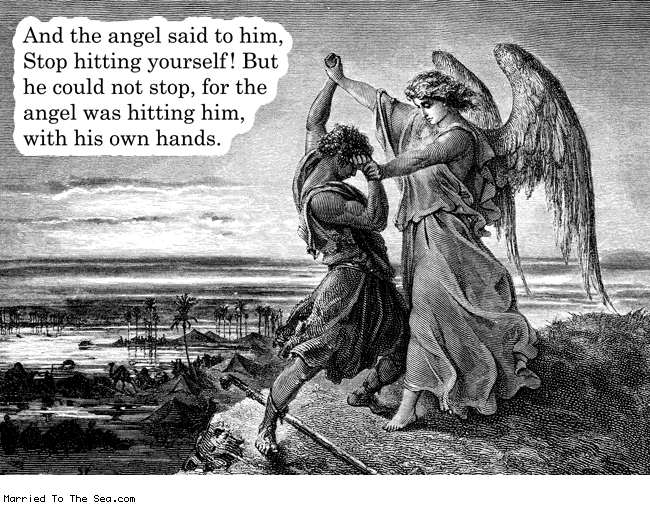
7 Why are you hitting yourself? Part 8: extra credit questions

  • November 7, 2011
  • by Crommunist
  • · blog · critical thinking · crommunism · psychology · science

This is part 8 of an ongoing discussion of a paper by Jost, Banaji and Nosek discussing System Justification Theory. Read Part 1. Read Part 2. Read Part 3. Read Part 4. Read Part 5. Read Part 6. Read Part 7.

Having summed up my lengthy exploration of System Justification Theory, I teased you this morning with the question that you’ve likely been asking youself from the beginning: now that we know about system justification, what can we do to correct for it? Are we doomed to keep making the same mistakes, or can we overcome our terrible mammal brains and become better critical thinkers?

In order to answer this question, I must first re-iterate a point that I’ve been making for almost as long as this blog has been in existence: we can overcome cognitive biases by becoming more aware of them. Just like we, as skeptics, have learned to recognize faulty arguments like straw men and fallacies like appeal to authority, we can also learn to recognize when we (or others) base their arguments on streotypes instead of evidence. System justification lives on stereotype – confronting those will go a long way on its own to reduce the amount of system justifying we do.

There is also something important to be learned from Part 6, which is that system justification is directly connected to the level of inequality present in a society. As we reduce gaps between groups – be they through legislative policies like pay equity or through changing the social stigma associated with being in the minority – we reduce our tendency to ‘explain away’ disparities as being part of the natural order of things. By engineering societies that are more fundamentally equal, we simultaneously rob fuel from the system justifying machine.

Finally, and perhaps most crucially (or just my preferred method), we can reduce system justification by talking about it. The more people are aware that they have a tendency to do this kind of backfilling, the more likely they are to notice themselves doing it in the future. Successes in my own ongoing struggle to become less misogynistic suggests to me that awareness (and acceptance) of the fact that we all have cognitive demons operating below the level of conscious awareness will help us police our own attitudes better. We may never become perfect at it, but we can certainly become better.

Now, I would be a really crummy scientist if I didn’t use this opportunity to raise some research questions of my own that this paper did not address. … Continue Reading

3 Why are you hitting yourself? Part 7: Summary

  • November 7, 2011
  • by Crommunist
  • · blog · conservativism · critical thinking · privilege · psychology · science

This is part 7 of an ongoing discussion of a paper by Jost, Banaji and Nosek discussing System Justification Theory. Read Part 1. Read Part 2. Read Part 3. Read Part 4. Read Part 5. Read Part 6.

So on Thursday I finished up with the last sections of the paper, but I didn’t get to do the wrap-up post that I wanted to (time crunch – abstract submission deadline followed by dinner immediately after work, with friend who then asked for a full explanation of the entire OWS movement… it was a long day for my brain). So I’m going to take this opportunity to bring this series to a conclusion.

Why System Justification Theory?

Older psychological models to explain human behaviour focussed on the relationship between individual ego motivation, and group allegiance. The central understanding was that people would tend to demonstrate in-group favouritism and out-group hostility. In the same way we tend not to see ourselves as bad people but vilify the actions of others, we would do the same for groups with whom we did and did not feel allegiance.

The problem with this theory is that it fails to explain a common and seemingly-inexplicable finding: that people often tend to demonstrate an asymmetric bias toward people in high-status groups, even to the point of abhorring their own group. If it was a rare occurrence, we could just chalk it up to “well some folks is crazy”, but when it’s consistently observed in many different populations under experimental conditions, it becomes something that needs looking at. … Continue Reading

4 Why are you hitting yourself? Part 6: SJT writ large

  • November 3, 2011
  • by Crommunist
  • · blog · critical thinking · gender · privilege · psychology · race · religion · science · skepticism

This is part 5 of an ongoing discussion of a paper by Jost, Banaji and Nosek discussing System Justification Theory. Read Part 1. Read Part 2. Read Part 3. Read Part 4. Read Part 5.

We left off exploring the consequences of conflicts between how we see ourselves in context of a group, and of how we see the society we live in. There is, the authors suggest (and demonstrate as described in the previous 5 installments of this series), a strong drive within us to reconcile our self of self-worth, in-group approval, and societal outlook. It has the somewhat idiosyncratic effect of causing us to harbour ideas that may work directly to our detriment, but allow us to align these three desires (through the use of stereotyped thinking). Aside from resulting in the advantaged staying at the top, it also leaves those at the bottom with increased psychological issues.

Up until now, our exploration of the specific hypotheses stemming from System Justification Theory has been focussed on individual-level attitudes and effects. In the final section of the paper, the authors explore some of the larger themes that are explained, at least in part, by the desire to approve of the status quo. Most skeptics will be familiar with the concept of cognitive dissonance – it refers generally to a brain state in which we are trying to reconcile two contradictory beliefs. Believers in a deity have pioneered a wide variety of methods to resolve cognitive dissonance – the most popular is the notion of “faith”: recognizing that something is logically impossible but believing it anyway. Throughout this whole discussion, but particularly in the previous installment, we see cognitive dissonance being a key component of the wacky outcomes of SJT. … Continue Reading

5 Why are you hitting yourself? Part 5: this post is entitled

  • November 3, 2011
  • by Crommunist
  • · blog · critical thinking · health · privilege · psychology · science

This is part 5 of an ongoing discussion of a paper by Jost, Banaji and Nosek discussing System Justification Theory. Read Part 1. Read Part 2. Read Part 3. Read Part 4.

We left off last week discussing the relationship between where one stands in the power dynamic, and how we see those at the top. If we are part of the high-status group, we have an implicit bias toward ourselves, where as those in the low-status group have an out-group – which also favours those at the top. When pressure is high to justify the status quo, we reach for stereotypes and facile explanations to rationalize why things are the way they are. Interestingly, insofar as this effect (called system justification) is identical to political conservativism, we see these biases exacerbated in people who confess to being conservative.

One of the advantages of having the kind of education I did (broad-based – a hard science candy shell with a delicious nougaty humanities core) is that I can draw on a variety of analogies when trying to impart unfamiliar concepts. Most of you have taken at least some science courses, so you will perhaps be familiar with Boyle’s Law which states, among other things, that gas will expand to fill its container. It’s that concept I want percolating in the back of your mind as we charge forward through our exploration of System Justification Theory. … Continue Reading

Page 37 of 67
  • 1
  • …
  • 35
  • 36
  • 37
  • 38
  • 39
  • …
  • 67

  • SoundCloud
  • Twitter
  • Facebook
  • YouTube
  • Subscribe Subscribed
    • Crommunist
    • Join 82 other subscribers
    • Already have a WordPress.com account? Log in now.
    • Crommunist
    • Subscribe Subscribed
    • Sign up
    • Log in
    • Report this content
    • View site in Reader
    • Manage subscriptions
    • Collapse this bar