Crommunist
  • Blog
  • Music
    • Video
    • Audio
  • Media
    • Audio
    • Video
  • Events
  • Twitter
  • Ian Cromwell Music
  • Soundcloud

Category: civil rights

4 Let’s call this what it is…

  • March 16, 2011
  • by Crommunist
  • · blog · civil rights · health · politics · racism · religion

Those accommodationists among us (I am not calling them “diplomats” here – there is nothing diplomatic about being a coward) will say that one ought not to use mean words or phrases against our opponents. Rational discussion is, they say, based on both sides maintaining a respectful stance – a stance which is impossible if people use words or phrases that put the other side on the defensive. When confronted, people will put their fingers in their ears and refuse to hear your side.

If the protests in the Arab world have taught us anything, it’s that the accommodationist position is full of shit. Standing up and calling out your opponents is an effective method of achieving change, provided you can mobilize those who agree with you. This has long been my suspicion, but it’s nice of the Arab world to prove it for me.

So, in the spirit of not pretending that bullshit arguments have merit in order not to offend the bullshitters, I invite everyone to call these anti-Muslim “hearings” what they are: straight up racism

A U.S. congressional hearing on homegrown terrorism has been labelled “shameful” and “un-American” by prominent Muslim leaders. A Republican-led Homeland Security committee began hearing testimony Thursday in Washington on radicalization in the U.S. Muslim community. Representative Peter King, the New York Republican who organized the hearing, has stirred controversy by accusing Muslims of refusing to help law enforcement with the growing number of terrorists and extremists.

Muslim Americans, according to Peter King, aren’t licensed to simply exist as law-abiding citizens. No, that’s too good for ‘those people’. They also have to help law enforcement do its job, I suppose by acting as sleeper agents. You know, just like how white Christians flocked to aid law enforcement crack down on anti-abortion terrorist groups. Oh wait… that never happened, did it? You know why? Partially because it’s not a group’s collective responsibility to do law enforcement’s job for them, partially because terrorists are a tiny fraction of the overall population of white Christians, but also because they’re white! White people don’t get scapegoated – it’s in their contract.

I wish I could accuse Mr. King of being shockingly ignorant of American history, but I am not so sure that he doesn’t know who Joe McCarthy was and what his legacy is. Considering the number of people making the explicit comparison between the two, I will simply take a step back now that I’ve planted the seed and let you read on your own (if you care to).

If this were a more popular blog, and we had more American Conservatives(tm) commenting (or indeed, any American Conservatives), I’m sure I’d be flooded with comments like this one:

Nobody is “targetting” the entirety of American Muslims. That being said, an overwhelming majority of terrorist incidents in the United States within the past two years have been perpetrated by Muslims. These are FACTS – not biases or racist screeds – duly recognized by Congress, and the executives within the Obama administration.

It’s not racism, guys! Really! It’s just that those durn Mooslims keep blowin’ stuff up! Well, unless you actually bother to count:
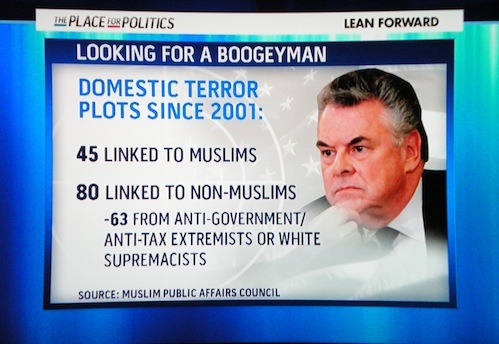
But even if it was Muslims who are predominantly committing acts of terror (and it isn’t – I can’t stress this enough), that doesn’t empower Mr. King to put the Muslim community on trial for those acts. If Mr. King was really interested in getting to the bottom of this issue rather than just demonizing a minority group, he’d be inviting experts and members of the community, talking to law enforcement specialists, consulting statistics.

But he’s not:

Consider, for example, that so far at least, King’s witness list does not contain the name of Charles Kurzman, a professor of sociology of the University of North Carolina. A non-Muslim, Kurzman has produced a report for the university’s Triangle Centre on Terrorism and Homeland Security that actually uses statistics and facts to examine the question posed in the report’s opening paragraph: “Are Muslim-Americans turning increasingly to terrorism?” Kurzman examines things like the number of Muslim-Americans who perpetrated or were suspected of perpetrating attacks since 9/11: 24 in 2003, 16 in 2006, 16 in 2007, a spike of 47 in 2009, and a drop to 20 in 2010. A total of 161 over nearly 10 years.

In a few cases, Muslim groups have even turned in provocateurs urging jihad who turned out to be undercover police agents.

This isn’t a concerned citizen looking to find the solution to a serious problem – this is an opportunist who is cashing in on the rampant anti-Muslim sentiment of the populace to make hay and brand himself as a patriot. Considering his hypocritical stance on state-sponsored terrorism – defending the IRA in the 90s when they were perpetrating acts of terrorism in Ireland – it’s patently obvious that Mr. King’s motivation here is to demonize the “other”. In this case, in this day and age, that “other” is the Muslim community.

And why do I care (and, by extension, why should you)? I’m certainly no friend of Islam, and am suspicious of all religious people, particularly those whose religion requires extraordinary levels of piety and compliance with arcane rules. Why should I defend people I disagree with so vociferously? First of all, I care because it’s the right thing to do. Innocent people are being scapegoated by the U.S. government, and that’s a violation of their rights. Second, any time a minority group is made an example of, every person should become immediately uneasy. As an atheist and a black person, two groups that have received its unfair share of negative attention from governments and social institutions, I am standing up for myself here too.

There is no virtue in pretending that Mr. King has a noble purpose in these witch hunts. It is not diplomatic to try and hear his side – his side is built on lies, hypocrisy and thinly-veiled racial animosity. The virtue here is in calling this exactly what it is, and refusing to stop naming it until Mr. King is shamed into obscurity.

Like this article? Follow me on Twitter!

0 Freedom: it’s contagious

  • March 15, 2011
  • by Crommunist
  • · blog · civil rights · news · politics

Something important is still happening. It’s still happening, and it’s spreading.

Egypt struggles with constitutional reform

Mohammed ElBaradei, the Nobel laureate and former head of the UN nuclear watchdog agency, has said on a privately owned TV channel that he intends to run for president in Egypt’s 2011 presidential election. “When the door of presidential nominations opens, I intend to nominate myself,” ElBaradei said on ONTV channel on Wednesday. ElBaradei also said that suggested constitutional amendments to move Egypt toward democracy are ‘superficial.’ He appealed to the military rulers to scrap them or delay a scheduled March 19 referendum on them.

These protests have been somewhat akin to life-saving heart surgery, or perhaps limb-saving removal of gangrene from a wound. All the drama happens at the beginning – the dramatic removal of damaged and dying tissue, the machine that goes “ping!” – and there is a flurry of activity. However, once the problem has been removed, there remain the several hours of tissue salvage and repair. You see, just because you get rid of a corrupt government (to put the metaphor aside for a second), it doesn’t result in good government springing up overnight. The people of Egypt have a long road ahead of them if they want to move toward a true representative government.

Any state that overthrows its government has to deal with the aftermath, and this is even more challenging in countries that have been ruled by autocrats for decades – most of the citizenry doesn’t remember life any other way. To return to the metaphor for a final moment, after the surgery is done and the patient is stitched up, there still remains months of painful rehabilitation and physiotherapy – these uprisings will have implications that will resound for decades to come.

Gaddafi’s forces fight back

Forces loyal to Libyan leader Col Muammar Gaddafi are reported to have made gains against anti-government rebels in two key areas. Western journalists in the city of Zawiya, west of Tripoli, confirmed the Gaddafi regime’s claims that the city had fallen after days of bombardment. Rebels are reported to have fled from the oil port of Ras Lanuf to the east.

Whereas the protests in Tunisia, Egypt and Oman were (mostly) peaceful, Libya’s revolution has devolved into a civil war, with two separate factions vying for control. There is a non-centralized (but soon to be centralized) rebel “government”, and the forces loyal to the deposed Muammar Gaddafi. This state of bilateral conflict was made official when the French government formally recognized the rebel force as the legitimate governing regime in Libya. This recognition was, in my mind, premature and stupid. No elections have been called, no official leadership has been formed, and the situation is still incredibly volatile.

There have been repeated calls for the establishment of a “no fly zone”, including a petition from Avaaz. For the record while I am usually directly on board with Avaaz’s causes, they got this one dead wrong. A “no fly zone” means that foreign military aircraft will be patrolling Libya’s airspace and shooting down any Libyan military aircraft. However, in order to do this without being shot themselves, the foreign powers would have to disable Libya’s anti-aircraft capabilities, which necessitates the deployment and active combat engagement of ground troops. Yes, this means declaring war on Libya. Considering that a) the African Union has explicitly denounced the plan, b) the Arab Union would not look kindly upon Western military involvement in their territory, and c) military intervention by the West is what started all of these problems in the first place, I am opposed to the idea of getting more involved than trade sanctions and the seizing of foreign holdings.

However, that means I have to stand impotently by and watch as Libyans are slaughtered by their own military. This is one of those times where we have to go with the lesser of two evils – foreign involvement in this conflict will only make things worse.

Saudi Arabia gets bitten by freedom bug

Hundreds of police have been deployed in the Saudi capital, Riyadh, ahead of anti-government rallies planned for after Friday prayers. Security forces have blocked roads and set up checkpoints, while reports suggest some protesters have begun to gather in the eastern town of Hofuf. On Thursday, police opened fire at a rally in the eastern city of Qatif, with at least one person being injured. Activists have been inspired by a wave of popular revolt across the region.

Saudi Arabia is an unlikely place for such widespread protests, given the disproportionate wealth and absolute power of the ruling class. However, the fact that there are protests is testament to the fact that once people get a taste of their collective power they are willing to use it to improve their standing in life. Egypt showed us that protests can work to effect change even in autocracies. Libya showed us that people are willing to fight and risk death for their freedom, and Saudi Arabia is showing us that no matter how oppressed a people are, they will rise up and fight when given the opportunity. These protests are also happening in Iraq, Kuwait, Bahrain, and Yemen – this is no isolated thing.

The irony in all of this is that the United States devoted billions of dollars to wage war, with the ostensible goal of promoting democracy and freedom in this very region. History will eventually decide, but it seems today that that war only succeeded in increasing resentment toward the West and retarding the cause of democracy. Now, while the western world is cracking down on the rights of people in Europe and North America, it seems as though the Arab and North African world is giving us a lesson in how to wage freedom.

Like this article? Follow me on Twitter!

1 Why I care, and why you should too

  • March 14, 2011
  • by Crommunist
  • · blog · civil rights · crommunism · feminism · gender · racism

Jeez, it seems like forever since I did one of these.

Regular readers may have noticed a significant up-tick in the number of times I’ve talked explicitly about women’s issues in these past couple of weeks. Really regular readers will have noticed that I often go to bat on behalf of the ladies, even on issues that have nothing to do with race, free speech or religion. The same goes for LGBT issues, actually – it seems as though I can’t stay away from women and gay shit.

It may seem somewhat antithetical, or at least counterproductive, to spend the amount of time and energy that I do talking about issues facing communities to which I have little-to-no connection. Sure, I have sort of a vested interest in women’s issues – many of my friends are women. However, I don’t really have any close gay friends (a fact that has baffled me for years), nor do I think that blogging about women’s issues will somehow impress or mollify my female friends (the women I am friends with are smart enough to judge someone based on his/her actions, rather than his/her blog). Why then do I put so much effort into pointing out women’s and LGBT issues?

First of all, I defend those positions because it’s the right thing to do. Not having a selfish interest in an issue is not license to simply ignore it. To be sure, there are a number of issues that I don’t talk about (quick list: genocide in Sudan, global warming, third world exploitation, naval piracy in Somalia, loss of the manufacturing sector… the list goes on). These topics are all worthy of intense discussion, but there are only so many hours in a day and, as callous as it sounds, there are things I am more passionate about. It doesn’t mean that I don’t care, so much as it means that I have different priorities. I am glad that there are people out there who care more about world hunger than they do about race issues – both are problems that need passionate advocates. I’ve chosen my fight.

Second, I actually do have a selfish interest in the advancement of women. As the rights of women improve, so too does the standard of living for the entire society. From the moment we are conceived, the health of our mother is of direct impact to our physical health. The better educated both of our parents are, the better chance we have of receiving education ourselves. Our interactions with women in the workplace or out in society generally give us a wider viewpoint than we’d expect in a male-dominated society, which allows for cultural progression and growth. From the moment we are born to the moment we die, the welfare of women is directly tied to our own well-being, regardless of our sex.

Thirdly, and perhaps most selfishly, when I speak on behalf of women I am actually speaking on behalf of myself as well. While I may not be a woman, women are a political minority that face generations of prejudice and antiquated attitudes. They are marginalized, and have been for so long that it has simply become the norm – so much so that sometimes it is other women who are doing the marginalizing. Women in North America face economic disparity, are more likely to be victims of crime, and face a disembodied and largely invisible series of obstacles that seem, without discernible effort, to put them at the bottom of the ladder.

The above description could have just as easily been written about black people. The cultural establishment has been, for years, stacked against the advancement of black people, to the point where our standing in the social ladder is thought to be essentially inevitable. The forces we struggle against are no longer concerted efforts by a shadowy cabal of active racists who are trying to disenfranchise the black population, but if one takes a step back, the outcomes are identical – black people are pushed as though by active effort into the margins of society. Being a minority within a minority (black atheist), this kind of cultural pressure is even more palpable to me.

So wherefore the gays? Well it shouldn’t be too difficult to piece together the fact that the same kind of ancient hatred and exclusion that has faced women and black people is currently shouldered by the gay community. The absurd taboo about same-sex attraction is older than the scriptures that are used to justify it. We have begun, as a society, to recognize that gay people are part of the human population and have been since time immemorial. There is no reasonable justification for the way they are treated, or to curtail their civil rights.

So even though Glenn Beck has forever ruined the quote for me (and he gets it wrong in that clip, which I wouldn’t bother watching unless you enjoy the paranoia-stoking ravings of a carefully-cultivated clown act), it does remind me of the old adage:

First they came for the communists, and I didn’t speak out because I wasn’t a communist.
Then they came for the trade unionists, and I didn’t speak out because I wasn’t a trade unionist.
Then they came for the Jews, and I didn’t speak out because I wasn’t a Jew.
Then they came for me and there was no one left to speak out for me.

Or perhaps even better expressed by Martin Luther King Jr.

Injustice anywhere is a threat to justice everywhere

I speak about women’s issues, LGBT issues, atheist issues, race issues – all of these and more – because they are all the same thing. The forces stacked against women and against gay people are also stacked against me, and they’re stacked against you too regardless of who you are. It is only by recognizing the shared threat that we all face that we can struggle against them, and prevail.

Like this article? Follow me on Twitter!

0 U.S. shows its hypocrisy over free speech

  • March 10, 2011
  • by Crommunist
  • · blog · civil rights · crapitalism · free speech · hate · law · news · politics

Sadly, with this whole free speech thing, sometimes this is what it looks like when your side wins:

The Supreme Court ruled Wednesday that a grieving father’s pain over mocking protests at his Marine son’s funeral must yield to First Amendment protections for free speech. All but one justice sided with a fundamentalist church that has stirred outrage with raucous demonstrations contending God is punishing the military for the nation’s tolerance of homosexuality. The 8-1 decision in favor of the Westboro Baptist Church of Topeka, Kan., was the latest in a line of court rulings that, as Chief Justice John Roberts said in his opinion for the court, protects “even hurtful speech on public issues to ensure that we do not stifle public debate.”

Yeah… fuck. Possibly the worst scum of the earth, Fred Phelps, has been granted a landslide license from the Supreme Court of the United States to picket military and private funerals, spreading his ludicrous doctrine. In the name of free speech, he’s allowed to cause widespread suffering to grieving families who have done nothing to deserve such hateful condemnation from a group of people they’ve never met.

I’ve never been less happy to win.

Nate Phelps, estranged son of Fred Phelps and director of Centre For Inquiry’s Calgary branch is, understandably, opposed to this ruling:

It has been my contention all along that protesting at a funeral is unconscionable. For the Court to give greater consideration to Free Speech, at the expense of a citizen’s right to bury a loved one in peace, is a dangerous travesty of justice… If ever there was a just reason to limit the time and place that a person can exercise their First Amendment right to free speech, this would be it.

I admire Nate a great deal, and his journey away from his family cannot have been an easy one. Forever being known as the son of that crazy hate preacher must be incredibly tiresome. It is therefore with some trepidation that I must disagree with him in principle. First of all, there is no law in the national constitution or any state constitution that grants an explicit right to bury a loved one in peace. To be sure, privacy isn’t a guaranteed or delineated right in the US Constitution either, so there is an argument that can be made over explicit and implicit rights. However, an implicit right cannot trump an explicit one, and the right of free speech is an explicit one. While it is certainly not a good thing to picket funerals, the rule of law dictates that we must prioritize rights that are codified over those that we wish were codified.

Secondly, there are far better reasons to curtail the right of free expression. From the government’s perspective, vibrant and wholesale protestation of the actions of government officials is dangerous. It could in fact be dangerous to the safety of citizens to have certain ideas made public or encouraged openly. Curtailing that kind of free speech would be far more justified than telling a tiny group of zealots that they’re not allowed to wave ugly signs at a funeral. However, the government is specifically enjoined from banning such demonstrations of lawful speech, and so by the literal interpretation of the law, the WBC slides in.

That being said, since the United States government is more than happy to curtail even legitimate free speech, it seems incredibly hypocritical of them to give the WBC a pass. Apparently it doesn’t violate the constitution to lock political protesters into fenced-off areas, but when those protesters are only harassing innocent civilians, it’s an 8-1 matter for the SCOTUS? Not to mention that since the content of the protests are personal in nature, a legitimate argument could be made that these protests are tantamount to criminal harassment, which is against the law. Not to mention the fact that even if they are not harassment, they are certainly disturbing the peace (another crime). It seems as though these protests can be moved on other legal grounds.

But of course, it is definitely too much to expect consistency from the United States. Free speech is a fundamental right! Well, unless it’s speech we don’t like:

The US army has filed 22 new charges against the soldier accused of leaking thousands of classified documents published by the whistleblower website, WikiLeaks. Bradley Manning is facing life in prison if found guilty to the charges which include aiding the enemy. Manning, 23, had previously faced a host of charges including downloading and transmitting to an unauthorised person a classified video of a 2007 helicopter attack that killed a dozen people in Iraq, including two Reuters employees.

I am well aware that Private Manning has broken military law and is subject to prosecution as a result. However, his ongoing imprisonment and his treatment as a hostile combatant is both cruel and unusual (there’s that pesky constitution again!). Considering that “the enemy” hasn’t been defined, and that Private Manning didn’t release the information to any specific foreign government or terrorist group, the charge of “aiding the enemy” is as ridiculous as it is transparently a ploy to torture someone who caught the US government with its pants down.

While politics, particularly (it seems) in the United States, is a breeding ground for hypocrisy, this kind of double-speak is particularly egregious. Free speech is important to uphold for hate groups who persecute grieving families, but speak against the government and your rights under the constitution are shredded. Land of the free and home of the brave indeed…

Like this article? Follow me on Twitter!

0 Flirting with free speech

  • March 10, 2011
  • by Crommunist
  • · blog · Canada · civil rights · critical thinking · free speech · news · politics

There’s an interesting wrinkle in the debate over free speech, which has to do with the issue of truth. If I say that Stephen Harper is the worst Prime Minister we’ve ever had, that falls under the category of political criticism and opinion, which is protected speech. However, if I say that Stephen Harper raped a 12 year-old girl in 1997, that falls under the auspices of defamation and is punishable under law (where I would have to produce some evidence or face a legal repercussion). Both of these things are reasonable statutes – while we should be allowed to criticize our political leaders (and each other), it would certainly be harmful to society as a whole if people were allowed to level damaging accusations at each other without restraint.

There is, however, a large middle ground where the line between these two things blurs. If I say, for example, that Stephen Harper seems to me like a guy who would rape a 12 year-old child, that’s still my opinion, but it’s definitely defamatory. What if someone tells me that they heard that Stephen Harper did something like that, and I repeat their lie based on faulty information? Is that my fault? What if I am a prominent public figure? Does my position as an opinion leader impart on me some responsibility to check into the factuality of claims that I make before I repeat them?

What about if instead of being a singular opinion leader, I am a news organization? Do I have a duty, both to the public and to the rule of law, to ensure that the things that I report are based in fact? The CRTC seems to think so:

The CRTC has withdrawn a controversial proposal that would have given TV and radio stations more leeway to broadcast false or misleading news. Indeed, the broadcast regulator now says it never wanted the regulatory change in the first place and was only responding to orders from a parliamentary committee. The committee last week quietly withdrew its request for regulatory amendments in the face of a public backlash.

The CRTC has been in the news quite a bit recently for its approach to telecommunications, the Fox News North issue, and now once again for its withdrawal of its own proposal over false news.

There are two issues to consider with this move. First, it is notoriously difficult to establish a standard for “truth” outside the realm of science. If we look at what is happening in Libya right now, it is both a populist uprising against a brutal dictator, and a band of anti-government rebels using unlawful force against the legitimate ruler of the country. Both of those completely contradictory claims are completely true, depending on the editorial position one takes. How could one determine which of these claims, if made from a media outlet, would be considered “false or misleading”? Are the Democrats in Wisconsin bravely refusing to capitulate to an over-reaching and clearly corrupt governor, or are they fleeing the legitimate government and abdicating the legislative role they vowed to uphold? Again, these are both completely true claims, and if station A adheres to the first, while station B trumpets the second, which one is lying? Both? Neither?

The second issue to keep in mind is that, thus far, this has never been an issue in Canada. The CRTC has never had to prosecute or fine a television or radio station for broadcasting false or misleading news. There’s a great diversity of opinion among the various outlets, save for the fact that we don’t have an outlet that specifically caters to the bizarro-nut right wing (we also don’t have one that caters specifically to the bizarro-nut left wing, if that helps). It’s a sort of non-issue that, if the CRTC is to be believed, was raised about 10 years ago (before the days of the Harper government) and was quietly shelved for most of that time. Given that there’s never been a challenge to the ruling, it’s hard to claim that this is an unreasonable restriction of free speech.

These two issues aside, there is still an underlying conflict at the centre of free speech when it comes to truth. Since truth is always a shifting target outside of science, banning false or misleading news is a tricky issue. By any objective standard of truth that we could agree on as a society, religious statements are all false and misleading, as are ghost stories and UFO sightings. Clearly we are not comfortable banning those statements. What do we do when someone does make a blatantly false claim in a news outlet, given that we have no precedent? While we can trumpet “extraordinary claims require extraordinary evidence” until the cows come home, can we turn that into a general rule for the state to follow? Or must we let the liars continue to lie, with our only recourse being to counter their false speech with true speech?

Like this article? Follow me on Twitter!

0 What does religious oppression look like?

  • March 9, 2011
  • by Crommunist
  • · blog · civil rights · forces of stupid · free speech · law · news · religion

I’ve spoken at length before about how, in this country at least, claims of “religious persecution” is more often than not just a complaint based on loss of privilege. To be sure, occasionally there is actual oppression that happens on religious grounds (I have an example of that going up for Movie Friday), and that is certainly deplorable. However, most of the crying that happens over “religious persecution” in Canada doesn’t even glancingly resemble actual persecution.

So what does religious persecution look like?

This:

Pakistani Minorities Minister Shahbaz Bhatti has been shot dead by gunmen who ambushed his car in broad daylight in the capital, Islamabad. He was travelling to work through a residential district when his vehicle was sprayed with bullets, police said. Mr Bhatti, the cabinet’s only Christian minister, had received death threats for urging reform to blasphemy laws.

To be clear, Mr. Bhatti was not killed because he is a Christian. Mr. Bhatti was killed because he has spoken in opposition to Pakistan’s blasphemy law – the same law that claimed the life of another minister. Mr. Bhatti was not killed because he blasphemed against Islam (which, despite being a stupid thing to have a law about, is still law in Pakistan), but because he had the temerity to point out the fact that the blasphemy law was used to persecute religious minorities and settle political scores.

Tehrik-i-Taliban told BBC Urdu they carried out the attack. “This man was a known blasphemer of the Prophet [Muhammad],” said the group’s deputy spokesman, Ahsanullah Ahsan. “We will continue to target all those who speak against the law which punishes those who insult the prophet. Their fate will be the same.”

While I hate the all-too-easy conflation of Islam and terrorism, this is undeniably a case where Muslim religious orthodoxy is being used to fuel terror. This isn’t a group making a political point and using religion as an excuse, which is the default go-to excuse of people who wish to excuse religious fundamentalism; this is a group executing people and promising to execute more until their religious beliefs carry the force of law. This is terrorism, pure and simple.

If this wasn’t enough of a reason to oppose blasphemy laws, Indonesia is reminding us of the principal reason:

Authorities in Indonesia’s West Java have issued a decree which severely limits the activities of a small Islamic sect called the Ahmadiyah. Members will not be able to publicly identify themselves and are being urged to convert to mainstream Islam… Lawyers for the Ahmadiyah say the decree violates a law protecting people’s rights to worship how they choose. But hardline Islamic groups say the order is perfectly legal, claiming that the sect’s beliefs deviate from the tenets of Islam and therefore violate the country’s rules against blasphemy.

Consider for a moment the torturous contradiction of the idea of a country that simultaneously a) promotes freedom of religion, and then b) outlaws a group for deviating from religious tenets on grounds of blasphemy. Religious heterodoxy is an inevitable product of a religiously tolerant society – belief can only be constrained through use of force, and allowing people to believe what they want means that you may not force anyone to believe as you do. By telling the Ahmadiyah (who Christians would probably like since a lot of their diversions from mainstream Islam have to do with Jesus) that their beliefs are illegal, Indonesia is putting to the lie any claim they might have of being religiously tolerant.

Blasphemy laws, like any law banning freedom of speech or expression, will always lead to human rights abuses. When the religious establishment commands state power, blasphemy laws are a thin veil that fails to mask the naked ambitions of the orthodox to punish anyone who thinks differently. As I’ve said before, freedom of religion is good for everyone, not just the non-religious. I am incredibly saddened by the death of Mr. Bhatti, and am depressed by the continued stupidity of the people of Indonesia. I am, conversely, more impressed with Canada’s ability to forebear from actual religious persecution (by and large).

Like this article? Follow me on Twitter!

0 I so very much want to believe!

  • March 8, 2011
  • by Crommunist
  • · blog · civil rights · news · politics · secularism

The title alone probably caused a few heart attacks from the atheists who visit the site from Twitter or Facebook – please rest assured I am not talking about a deity. No, I am referring once again to the important thing that is happening. The Middle East and northern Africa are still up in arms over the protests and changes in power, and we are starting to see some of the political fallout of these actions.

Libya is still on fire

At least 30 civilians have been killed after security forces loyal to Muammar Gaddafi, Libyan leader, attempted to retake the rebel-held town of Az Zawiyah, near the capital Tripoli, that has for days been defying his rule, witnesses have said. The rebellion in Az Zawiyah – the closest rebel-held territory to the capital and also the site of an oil refinery – has been an embarassment to the Libyan authorities who are trying to show they control at least the west of the country. Eastern regions of the country, around the city of Benghazi, have already fallen out of Gaddafi’s control after a popular revolt against his four decades of rule.

Widespread fighting is happening all across Libya. What makes the situation in Libya much different from Egypt or Tunisia is the fact that the pro-government forces (including part of the military) are unashamedly attacking Libyan civilians, and the anti-government forces are responding in kind. This has the potential to turn into a civil war (although MSNBC’s Richard Engel points out that a civil war is really defined by civilian forces attacking other civilian forces, which is not really the case here… yet), with the “People’s Army” arming itself and rising violently against the government. Attempts by the government to retake eastern cities has been largely unsucessful, and the anti-government protests appear to have hit Gaddafi’s stronghold in Tripoli.

While I would very much like to believe that once the army has overthrown Gaddafi they will divest themselves of their arms and stand for peaceful elections. There is not a lot of precedent for “people’s armies” doing anything other than installing themselves as a new regime, and perpetrating the same evils of the old regime on a different group of people. One can only hope that the international community shows some uncharacteristic restraint and doesn’t listen to idiots like Joseph Liebermann and John McCain, who want to arm and train the rebels. Yeah, because that strategy’s never failed before…

Egypt’s new Prime Minister is pledging democratic reform

Egypt’s new Prime Minister, Essam Sharaf, has pledged to meet the demands for democratic change sought by protesters, and to resign if he fails. He made the comments in an address before thousands gathered at Cairo’s Tahrir Square before Friday prayers. The former transport minister told the crowds that he drew his “will and determination” from the people. Mr Sharaf replaced Ahmed Shafiq, who was appointed in the dying days of the regime of Hosni Mubarak.

Essam Sharaf is an interesting guy, who I have some hope for. Unlike many of his contemporaries in Egypt, Tunisia, Libya, and Yemen, Sharaf didn’t just suddenly discover his taste for democratic reform once the people began calling for politicians’ heads on pikes. He’s been a critic of the Mubarak government for a few years, which lends him a great deal of credibility in my eyes. The trick to democratic reform is that you cannot guarantee that the outcome will be what you like. Sharaf seems to understand this, and is pressing for democratic reform anyway. However, a lot can happen in between now and August, when the current provisional government has been ordered to step down.

I would very much like to believe that Egypt, a state with a strong secular history and many Western ties, can implement a real democratic state following constitutional reforms. The forbearance of the army during the popular uprising strongly suggests to me that they are not interested in grabbing power from the people, but instead are invested in returning Egypt to a state of relative peace and stability. Only time will tell though.

Tunisia is talking about elections

Tunisia’s interim president Fouad Mebazaa has announced details of new elections promised after the overthrow of President Zine al-Abidine Ben Ali. Mr Mebazaa said voting for a council of representatives to rewrite the constitution would be held by 24 July. He said a new interim government would run the country until then.

This is even more encouraging, because an actual date has been set. I react viscerally and negatively to any “plans” that are made without concrete details. When someone says “we should hang out sometime” or “someone should do this” or “yeah, Ian, best sex ever, I’ll call you sometime”, I immediately write off that statement (and, sometimes, the person making it). President Mebazaa has made a definitive date for new governmental elections. Good thing, right? Well…

The political confusion has been compounded by the constitutional provision limiting a caretaker president to 60 days in office, he adds. Mr Mebazaa has argued that, since the current constitution no longer has any credibility, he will stay in office beyond the limit. In his speech, he said the constitution “no longer reflects the aspirations of the people after the revolution”.

This, this, this, THIS is how it starts. First, a politician says that he is taking “temporary” power. Second, he claims to represent the will of “the people”. Third, he says that the rules of the constitution (or whatever document) do not apply in this unique situation. Fourth, he declares himself to have emergency powers until the state of _________ has been resolved, after which he will call for free elections. Fifth, the state of emergency is constantly renewed, meaning that no elections ever take place. Sixth, free speech criticizing the seizing of power is branded as seditious and treasonous, and political opposition is therefore outlawed. Seventh, meet the new boss; same as the old boss.

I want very much to believe that democratic states can foster in the Middle East and northern Africa. I’d love to see the same spirit of peaceful and organized protest carry forward into a secular state that respects free speech and individual human rights. But, as with all things, I am extremely skeptical.

Like this article? Follow me on Twitter!

20 In defense of the “weaker sex”

  • March 3, 2011
  • by Crommunist
  • · blog · Canada · civil rights · crapitalism · culture · feminism · gender · law · sex

Note: This article first appeared on Monday, February 28th on Canadian Atheist. While it is CA policy not to cross-post, I felt that this case needed to be made on as many outlets as I could.

A good friend of mine posted a story on my Facebook wall last week about a police officer who fell victim to the arch-stupidity of the “she was asking for it” argument:

A police officer who suggested women can avoid sexual assault by not dressing like “sluts” has apologized, saying he is “embarrassed” by the remark and that assaulted women are “not victims by choice.”

“I made a comment which was poorly thought out and did not reflect the commitment of the Toronto Police Service to the victims of sexual assaults,” Const. Michael Sanguinetti wrote on Thursday to Osgoode Hall Law School where he made the comment. “Violent crimes such as sexual assaults can have a traumatizing effect on their victims. . . . My comment was hurtful in this respect.”

It’s a tired trope that is almost guaranteed to come up in any discussion of women and sexuality – if women didn’t make themselves so open to sexual predators then they’d be safer. It is due to the privilege of being male that this argument offends me only intellectually, since I will never be the target of a sexual assault. I will never appreciate the visceral part of the feminist response to this argument, try as I might. The reason this particular friend posted the link on my wall is that she and I have gone 9 rounds on it in the past, with me articulating the “personal responsibility” position. Don’t worry – I got better.

However, a second friend of mine saw this and posted what he thought was an entirely reasonable response. His response (I’ll call him “Billy” just so we can avoid pronoun confusion) was that the story failed to take the police officer’s side into account. It is a fact, said Billy, that women will be less inviting targets for assault if they are dressed more conservatively and hide their sexuality. Billy didn’t understand why this was such a controversial statement, and was taken aback with Sheila’s (again, for the same of pronoun confusion) full-throated and confrontational response. Billy messaged me afterward to apologize for starting a fight on my wall, and confessing that he couldn’t really understand what he had said that was so inflammatory.

The problem with this “she was asking for it” argument, aside from the fact that it isn’t true (sexual assault is just as common in Muslim countries where women have to stay covered and none of them dress sexy for fear of being arrested, beaten, or scalded with acid), is that it completely misses the point, and tries to derive an “ought” from an “is”. The mere fact that a woman is more likely to be assaulted if she wears certain types of clothing does not make it right. The solution to the problem is not for women to “dress less slutty” (a phrase which is provocative enough on its own), but for men to realize that a woman’s choice of dress is not an open invitation to sexual assault.

It seems as though this seemingly-obvious (once explained) argument still has yet to suffuse through common consciousness:

A University of Manitoba law professor has concerns about a judge’s comments at a sexual assault sentencing. Karen Busby said the remarks by Justice Robert Dewar are a legal throwback to the time when how a woman dressed or acted could be treated as implied consent to sex. Dewar said “sex was in the air” when he spared a man jail time by handing him a two-year conditional sentence instead and allowing him to remain free in the community.

During the sentencing, Dewar also commented on the way the woman was dressed and her actions the night she was forced to have sex in the woods along a dark highway outside Thompson in 2006. The man and a friend met the 26-year-old woman and her girlfriend earlier that night outside a bar under what the judge called “inviting circumstances.” He pointed out the victim and her friend were dressed in tube tops, no bras, and high heels and noted they were wearing plenty of makeup. Dewar called the man a “clumsy Don Juan” who may have misunderstood what the victim wanted.

On a Facebook wall, the kind of statement that Billy made (although, to be sure, he didn’t intend to suggest that it is a rape victim’s fault for being assaulted and he went out of his way to say so) is merely annoying. When it comes from a judge’s mouth, it carries behind it the force of law. I do not wish to derogate Justice Dewar’s abilities as a jurist – perhaps he would have handed down an identical sentence if the victim’s clothing had not been a factor. One cannot guarantee that this would have been the case for all judges, although it certainly should be.

And certainly, this kind of cavalier attitude toward sexual assault does appear in other places:

Reports that women are being sexually assaulted at a Downtown Eastside shelter are being ignored, a coalition of women and women’s groups is charging. But the agency that oversees the First United Church co-ed shelter at Gore and Hastings says it has had meetings with both police and women’s groups on the matter and is actively working to address it. “The safety and security of people using provincially funded shelters are our top priority,” said a statement from BC Housing, which funds and has an operation agreement with the shelter. “We will continue working together to make sure the shelter is a safe place to stay.” But Harsha Walia, a coordinator at the Downtown Eastside Women’s Shelter, said women have reported sexual abuse to front-line workers, police and staff at the shelter, and nothing has been done about it.

When it is a woman’s fault for being assaulted, when her mere presence is provocation enough to justify some kind of violence against her, we know something has gone terribly wrong. When we turn a blind eye to women being assaulted, we cannot call ourselves a society where women enjoy equal or sufficient rights under the law. And because language like “she was asking for it” or “don’t dress like a slut” only serves to reinforce the casual tolerance of violence against women that leads to assault, it is the job of every feminist to speak out against it whenever it comes up. It will forever be a source of chagrin for me that I didn’t always speak this way, but I bloody well will from now on.

Like this article? Follow me on Twitter!

10 Freedom of religion: that’s not what it means

  • March 3, 2011
  • by Crommunist
  • · blog · civil rights · news · religion

Yeah, I’m back on this subject again. It seems as though the phrase “freedom of religion” is a commonly misunderstood construct whereby those with religious beliefs think that they can do whatever they like as long as they believe in it hard enough. As I said two weeks ago, freedom of conscience and religion means that it is unlawful to prohibit the practice of religion, or compel someone to engage in a religious act. It does not mean that anything done in the name of religion is your legal right.

To use an extreme example, preventing someone from stoning their disobedient child to death is not infringing on that person’s religious rights. Telling someone that she cannot cut the hands off of a thief is not infringing upon her religious rights. Telling someone that they cannot import 12 year-old children to enslave through compulsory marriage is not infringing upon his religious rights:

Two fathers from Bountiful, B.C., smuggled their 12-year-old daughters across the border to marry an accused pedophile and fugitive intent on increasing a harem that already included 57 wives. MacRae and Spencer Blackmore were part of a 2005 scheme to sneak their daughters from Bountiful into the United States to marry Warren Jeffs, the prophet of the Fundamentalist Church of Jesus Christ of Latter Day Saints, according to Jeffs’ diaries.

There are a great many diverse religious beliefs, and some of them, like those of the FCJCLDS, are monstrously evil and destructive. A child cannot possibly consent to something like marriage, and it is destructive to that child’s psychological development to bind them to an old paedophile. There is a clear harm in this kind of behaviour. In the light of a clear harm, the right to religious expression becomes secondary.

This testimony came to light as part of an ongoing case before the Supreme Court of British Columbia testing the constitutionality of polyamorous marriages. While I doubt very much that a ban on the right to marry multiple adult, consenting people can stand up to fair constitutional scrutiny, it cannot be struck down or held up on religious grounds. Whether or not someone believes in their right to marry multiple people (which, for now, is against the law) has nothing to do with their right to practice their religion.

No matter how fucking creepy your religion might be:

A boss who frequently hugged two young sisters to dispel negative energy from them and the cart they worked on has been found guilty of sexual harassment and ordered to pay them $10,000 by the B.C. Human Rights Tribunal. Algebra and Aja Young complained that Clint Petres, of Victoria, hugged them for up to 10 seconds, sometimes rocking back and forth.

Algebra testified that the hugs made her uncomfortable. But when she declined to hug Petres, “he would stand with his arms extended until she gave in, which she did because he was her boss,” tribunal member Barbara Humphreys wrote in a judgment released Thursday.

I’m not particularly inclined to complain about my boss. He’s nice to me, he’s fair, he gives me quite a bit of freedom, and has never once demanded that I hug him to dispel my negative energy. I don’t think (and neither does the Human Rights Tribunal) that Petres’ wacky mish-mash of pseudoscientific beliefs reaches the level of religion, nor can one claim that having to put up with religious iconography infringes on someone’s right to disbelief (the two women are atheists). However, when in the workplace, that kind of externalization of what are supposed to be personal beliefs are inappropriate. Making unwelcome physical contact with your employees is definitely inappropriate.

It would certainly be wildly inappropriate to compel your employees to participate in a religious service:

A Tulsa police captain who refused to require that some of his subordinates attend a Law Enforcement Appreciation Day at a Tulsa mosque filed a federal lawsuit Wednesday, claiming that his First Amendment rights have been violated. Capt. Paul Fields also claims that Deputy Chief Daryl Webster — the sole defendant in the case at this point — retaliated against him for his “exercise of his First Amendment rights” and singled out Fields for disparate treatment.

The Law Enforcement Appreciation Day is scheduled to be held at the mosque of the Islamic Society of Tulsa on March 4. Police Chief Chuck Jordan has said the society scheduled the event to show its appreciation for the officers’ response to a threat against them.

I am loath to comment on this story because it is missing one vital piece of information: was the event held at the mosque religious in nature? If it was held at the mosque because it was a community site (i.e. for reasons of convenience rather than worship), then the objection to attendance cannot be founded on the First Amendment. However, if the police were being invited to be preached to, then refusing to participate is a reasonable objection; however, it should be noted that you don’t have the right to not be exposed to ideas that conflict with your beliefs. Regardless of whether or not the objection was reasonable, singling someone out for punitive treatment because they’re either a) xenophobic or b) unwilling to be proselytized to is a dick move.

Whatever the resolution to these stories, the fact remains that freedom of religion has a specific meaning that does not give you license to do whatever you like so long as you can find some kind of supernatural justification for it. The corollary to this is that your right to think and believe as you like ends where my rights begin, whether that be my right to security, my right to be free of sexual harassment, or my right to object to evangelism.

Like this article? Follow me on Twitter!

0 The more things change…

  • March 1, 2011
  • by Crommunist
  • · blog · civil rights · news · politics

For someone with a more than passing interest in politics, religion and human rights, my cup doth overflow this week with stuff to talk about. I am hoping to group this week’s posts thematically so as not to completely drown you in my random thoughts, but if my threads aren’t clear please forgive me – I am doing my best.

I am not an expert in international law or foreign relations (“and the ‘Understatement of the Year’ award goes to…“), but I knew that the protests in Egypt were going to be a big deal. What I didn’t for a moment suspect is that they would explode in the way they have, turning much of the Arab world on its heels in a way that, to my knowledge, has no precedent. Of course my attention, along with the rest of the world’s, has moved from Egypt to Libya where things have taken a much more frantic and vitriolic turn. However, when I got a chance to step back from the rah-rah pro-democracy feeling I had about what’s happening, I realized that there’s a much more interesting picture happening.

The more things change…

For those of you who haven’t been paying attention (and you really should be), Libya has been completely turned upside down:

Muammar Gaddafi, Libya’s long-standing ruler, has reportedly lost control of more cities as anti-government protests continue to sweep the African nation despite his threat of a brutal crackdown. Protesters in Misurata said on Wednesday they had wrested the western city from government control. In a statement on the internet, army officers stationed in the city pledged “total support for the protesters”. Much of the country’s east also seemed to be in control of the protesters, and an Al Jazeera correspondent, reporting from the city of Tobruk, 140km from the Egyptian border, said there was no presence of security forces

Libya has an interesting political layout. In the stereotypical style of a warlord, Gaddafi was able to unite a number of tribes under one banner that was formerly ruled by a monarch. Libya has no constitution per se, instead purportedly relying on the general will of the people to govern itself. However, in reality it has been a dictatorship that is only egalitarian on paper. There is a significant east/west divide, based on historical tribal affiliations, now punctuated by the dictator’s strongholds in the western city of Tripoli standing in opposition to the bastion of the anti-government movement based in the eastern city of Benghazi.

The take-home message of all of this is that eastern Libya (which, perhaps coincidentally, shares a border with Egypt) is out of government control. Not only has Gaddafi lost control of the eastern cities, but his power base is rapidly crumbling:

Libyan diplomats across the world have either resigned in protest at the use of violence against citizens, or renounced Gaddafi’s leadership, saying that they stand with the protesters. Late on Tuesday night, General Abdul-Fatah Younis, the country’s interior minister, became the latest government official to stand down, saying that he was resigning to support what he termed as the “February 17 revolution”

While I have to express a little bit of skepticism at the true motivation behind these resignations and sudden allegiance to the protesters, the short-term result is that Gaddafi is finding himself more and more without allies.

Libya isn’t the only place facing major changes as result of protest:

Algeria’s cabinet has adopted an order to lift a 19-year-old state of emergency in a concession designed to avoid the tide of uprisings sweeping the Arab world, but protesters said the measure did not go far enough. A draft law approved by the cabinet would repeal the emergency law as soon as it is published in the government’s official journal, the official Algerie Presse Service reported on Wednesday. Ending the emergency powers was one of the demands voiced by opposition groups which have been staging weekly protests in the Algerian capital that sought to emulate uprisings in Egypt and neighbouring Tunisia.

These “emergency powers” are nearly always problematic, especially in countries with a weak opposition party. To exist in a state of emergency for 19 years is essentially the government’s way of cracking down on all opposition and adopting a sort of “l’état, c’est moi” approach to governance wherein the political rulers conflate themselves with the entire country – political dissent thereby becomes treason. Seemingly inspired by what’s been happening in neighbouring countries, Algerians have pushed the government to release their grip in an effort to save their state control. They’ve also passed a number of economic measures designed to stimulate the private sector (which makes my inner capitalist very happy). We’ll see if it goes far enough to placate the people, who may not stop until they have achieved the same kind of wholesale change being demanded in Tunisia, Egypt, Libya, and their other African neighbours.

…the more they stay the same

It is incredibly tempting to see these protests as the dawning of a new era of Western-style democracy in the Middle East, but such a conclusion would be incredibly naive. The region doesn’t have a history of democratic rule, and has far too much foreign entanglement to simply start afresh. One of the most sensitive entanglements is that of the United States:

In finally supporting the Tahrir experiment, President Obama was, in effect, pledging to end decades of American hypocrisy in its policies towards the Middle East and larger Muslim world. But in order to live up to this promise he will have to develop one set of policies for all the peoples and countries of the region. And doing that will demand an even more costly break with the past, putting old allies at arm’s length until they respect the rights of their peoples while embracing, however tentatively, groups that once seemed more easily characterised as, if not quite foes, then at least untrustworthy partners in securing American interests.

Unless the United States (and the West in general) suddenly becomes uncharacteristically non-interventionalist and allows these protests to reach their equilibrium on their own, there is a real risk that after a brief and bloody insurrection, the status quo will simply re-emerge and the region will simply exchange one set of dictatorial rulers for another. This, sadly, seems to be the case in Egypt:

Egypt’s key portfolios of defence, interior, foreign, finance and justice were unchanged in a cabinet reshuffle, state television confirmed. The list of new ministers that was presented on Tuesday included changing the veteran oil minister, as well as introducing politicians who had been opposed to the rule of Hosni Mubarak, who stepped down from office after widespread protests. Field Marshal Mohamed Hussein Tantawi, who leads the ruling military council and has been defence minister for about 20 years, took the new ministers’ oaths of office.

But the Muslim Brotherhood, the country’s biggest opposition group, said the new cabinet showed that Mubarak’s “cronies” still controlled the country’s politics. “This new cabinet is an illusion,” Essam el-Erian, a senior Brotherhood member, said. “It pretends it includes real opposition but in reality this new government puts Egypt under the tutelage of the West.”

One must be aware of the fact that these criticisms come from the Muslim Brotherhood, which does not support democratic rule, and any pro-democracy politicians could be considered “under the tutelage of the West”. Given that the entire direction of this movement is balancing on a knife edge, the only way to ensure there is no backlash against Europe and America is to stay the hell away from the whole situation, and encourage the protesters to decide their own path.

Like this article? Follow me on Twitter!

Page 9 of 16
  • 1
  • …
  • 7
  • 8
  • 9
  • 10
  • 11
  • …
  • 16

  • SoundCloud
  • Twitter
  • Facebook
  • YouTube
  • Subscribe Subscribed
    • Crommunist
    • Join 82 other subscribers
    • Already have a WordPress.com account? Log in now.
    • Crommunist
    • Subscribe Subscribed
    • Sign up
    • Log in
    • Report this content
    • View site in Reader
    • Manage subscriptions
    • Collapse this bar