Crommunist
  • Blog
  • Music
    • Video
    • Audio
  • Media
    • Audio
    • Video
  • Events
  • Twitter
  • Ian Cromwell Music
  • Soundcloud

Posts By Crommunist

1 Special post: Crommunist goes to America

  • March 28, 2011
  • by Crommunist
  • · blog · feminism · First Nations · history · race

So this whole past week I was visiting two of my good friends in the Northeastern United States. One, a friend from graduate school, lives in Philadelphia, Pennsylvania. The other, a friend I’ve known since I was a kid, lives in Cambridge, Massachusetts. I talk about things in Canada quite a bit, and was excited to get a bit of a perspective on the differences between living in Vancouver and being in a major American city.

Philadelphia

I’ve never been to Philadelphia before, and I wasn’t really sure what to expect. My preconception was to think of Philadelphia as a mostly white industrial city, but I was surprised to learn that it has one of the oldest black communities in the country. In our touring around town we came across the African American Museum of Philadelphia, which had a very cool interactive display that detailed some of the stories that comprise the history of Philadelphia. I was happy to see a number of couples of various ages and racial backgrounds there (at 2:00 on a Wednesday afternoon). It was particularly eye-opening to hear some of the stories of how black entrepreneurs, politicians and activists had to struggle simply to achieve basic human recognition.

Because of its lengthy black history, Philadelphia has a huge black population. In fact, the city has roughly an even number of white and black residents. There is a thing that is common among black people (at least in places where there aren’t a lot of black people) where we will recognize each other with a reverse head tilt (also known as “the black guy nod”). I kept catching myself having to inhibit my instinct to perform this action every 5 or 6 seconds, as I’m sure I would look like a total spaz.

Here’s me at the Liberty Bell:

The bell is a profound symbol of liberty and was used by the Abolition, Suffrage and Native rights movements alike. There is a certain irony present in the fact that a nation founded on liberty took more than 100 years to recognize the equal status of women, and another 50 to recognize certain ethnicities:

I really enjoyed my time in Philadelphia, minus the fact that the city seemed to be completely bereft of people having any fun (except the gay bars). It was then off to Boston for the second half of the trip.

Boston

I’ve been to Boston once before, back in 2008. The city has a feel that is not very dissimilar to being in a Canadian city – it’s clean, people are friendly, and there is government-funded health care. There were far fewer people of colour in the city, but more than I expected and definitely more than I see in Vancouver. The “black guy nod” might have made an appearance once or twice in a moment of distraction when I forgot I wasn’t at home.

Boston has a deep connection to the history of the United States. The whole city is structured to allow even casual tourists the opportunity to connect with history. As I might have mentioned before, I find cemeteries fascinating. Boston has old cemeteries in the middle of the city that you can visit. It was there that I learned that one of the first victims to be shot in the Boston Massacre was a black former slave named Crispus Atticus. We also saw a tomb marked with the name “Freeman” – usually the name of a freed slave (but not necessarily a black slave).

Part of tourism in Boston is what is called the “Freedom Trail” – a self-guided footpath through the city that highlights a number of sites of historical interest. Part of the trail is the Black Heritage Trail – a side-trip that showcases a few sites of import to the African-American community in Boston, one of which is the Abiel Smith School:
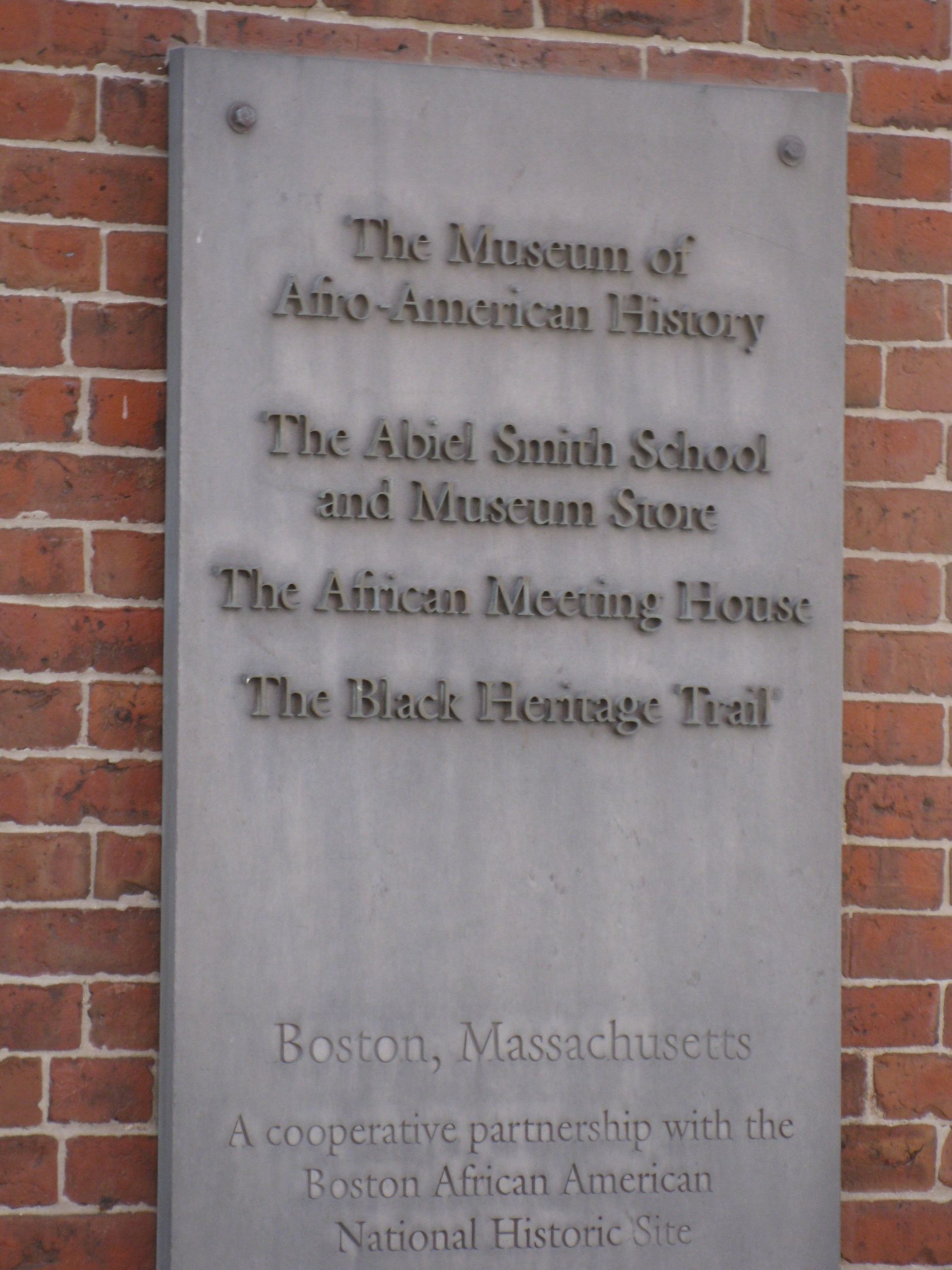
Sadly, I didn’t have time to go inside the museum, so I’ll have to save that for either a later trip or a few afternoons spent poking around with Google to see what I can see.

Anyway, for a history nerd like myself, walking through Boston was great. Philadelphia too. While my agenda was to party (hence last Wednesday’s post… for which I apologize), I’m glad I was able to learn something and get to connect physically with sites that marked major events in world history. As I said, it will take me a couple of days to get back into my groove, but expect me to go back to my regular post quantity and quality starting next week.

Like this article? Follow me on Twitter!

0 Movie Friday: Protect yourself with censorship

  • March 25, 2011
  • by Crommunist
  • · blog · critical thinking · free speech · funny · movie

Still on vacation. Brief writeup of some relevant stuff on Monday. Until then, enjoy this hilarious video by Mr. Sharp

Like this article? Follow me on Twitter!

0 Secularism isn’t pro-Islam

  • March 24, 2011
  • by Crommunist
  • · blog · news · religion · secularism

Crommunist is on vacation this week, so blogging will be spotty. I’m going to make sure there’s at least SOMETHING up every day, but they’ll be short. Things should be back to normal by April.

An argument that is commonly leveled against pro-secular activists is that Christianity is the only thing preventing the Western world from being overrun by Islamists. The reasoning (if you can call it that) is that when secularism knocks Christianity out of its privileged position, there will be nothing to stem the creeping tide of Islam from overrunning Western civilization. It belies a worldview that places Islam and Christianity as dueling forces, battling for world domination. In the dichotomous view of good and evil, Christianity is the reason why western civilization exists, while Islam is threatening to tear down our freedoms and impose and international caliphate.

Egypt is showing us that this is not true:

The founding committee of the first Coptic secular party in Egypt, dubbed The Free National Coalition Party and presided over by a Muslim legal expert, is to convene its initial meeting in Alexandria on Saturday to discuss recently proposed constitutional amendments The committee will also discuss the latest sectarian violence against Copts in the wake of a church burning in the village of Sol, located in Helwan, south of Cairo. The attendees will also hash over the bloody clashes between Muslims and Christians in the Moqattam area where at least 13 people were killed and scores injured in recent days.

Secularism is equally intolerant of all forms of religious domination. In Egypt, a country dominated by Islamic traditions, secular forces are aligning to protect the Copts from systematic discrimination. Secularism is inherently friendly to minority groups, since those groups are almost invariably made minorities through systematic discrimination. At the moment in Western countries, Muslims are minorities whose rights are consistently infringed upon by an unfriendly majority. Secularists defend Muslims because of this fact, not because secularism is inherently anti-Christian or pro-Muslim.

To make the claim that secularists are contributing to an eventual Muslim takeover is to set up a dichotomy between Christianity on one side and Islam on the other. This view completely obscures the fact that both Christianity and Islam are worldviews that are fundamentally opposed to individual freedom and the dignity of human persons. The fact that contemporary Western secularists are defending Muslims at the (seeming) expense of Christians has more to do with how Christians treat Muslims than any sympathy that they (we) might have for Islam.

Besides, if we’re strong enough to overthrow centuries of Christian domination, we can definitely handle an influx of Islam. We’re dealing with single-digit percentages here. Let’s try to keep some sense of perspective.

Like this article? Follow me on Twitter!

0 Yeah because THAT’S fair…

  • March 23, 2011
  • by Crommunist
  • · blog · civil rights · LGBT · news · politics

Crommunist is on vacation this week, so blogging will be spotty. I’m going to make sure there’s at least SOMETHING up every day, but they’ll be short. Things should be back to normal by April.

Fair warning – this post was written whilst VERY drunk.

A revised citizenship study guide for new Canadians released Monday contains a single sentence on gay and lesbian rights, which is a sentence more than in the first version of the book published a year and a half ago. The added material on gay rights — a topic completely absent from the first release of the federal government’s guide in November 2009 — was among several notable additions to the document unveiled by Immigration Minister Jason Kenney, including denunciations of violent extremism and forced marriage.

I am usually fluent in the English language. In the state I am currently in, I would barely pass the citizenship test that is the subject of this news post. I am trying to marshall all the cognitive ability at my disposal. Fuck Jason Kenney. Fuck the Conservative Party of Canada.

While it is commendable that  SOME mention of Canada’s gay population made it into the citizenship guide, considering the fact that Canada was one of the first countries to bite the bullet and recognize that gay people are PEOPLE, this should be a selling point; not a shameful thing to sweep under the rug. The CPC is wearing its cross on its sleeve.

Sooo not sober. I blame society.

Like this article? You’re clearly not a fan of the English language.

1 Dispatches from the gender gap

  • March 22, 2011
  • by Crommunist
  • · blog · Canada · civil rights · feminism · gender

Crommunist is on vacation this week, so blogging will be spotty. I’m going to make sure there’s at least SOMETHING up every day, but they’ll be short. Things should be back to normal by April.

If there is one thing that science can do for us, it’s challenging our assumptions and the resulting underlying myths that they propagate. While we are mostly blind to the narrative that we tell ourselves on a day-to-day basis, we can at least test the truth of those assumptions through the scientific method:

Despite its relative wealth, Canada is tied with Australia as the sixth best place in the Commonwealth to have been born a girl, a new study has found. New Zealand took the top spot in 54-country ranking, released Monday, followed by Barbados, Trinidad and Tobago, Dominica and Seychelles. Sierra Leone, Nigeria, Tonga, the Solomon Islands, Pakistan, Gambia and Bangladesh were among the lowest-ranked countries.

We have an amazing, wonderful country in which women do better than in most places in the world. We should not take for granted the fact that women in Canada are among the most privileged in the history of the world. We as a society worked hard (women particularly) to ensure that women have a greater level of opportunity than any woman has had as long as human society has existed.

However, going hand in hand with not taking the advances of women for granted comes not being complacent about the progress that has been made. Are we doing better by women than we have done in the past? Absolutely. Is that enough? Absolutely not.

Canadian girls, she added, report that gender-based violence remains pervasive in schools, on dates, in workplaces and over the Internet. They complain that girls remain under-represented in science and technology and that the problems are even worse for aboriginal girls, girls with disabilities and visible minorities.

This is the age-old problem of the downward comparison. Just because we are doing better than other places – countries that cannot compare to us in terms of economic power or political stability – does not mean that we can lean back and rest on our laurels when it comes to the rights and treatment of women.

The great strength of the scientific method is that it allows us to challenge the assumptions that lead to our gender complacency. We can make specific, targeted observations about the differential treatment of the disadvantaged sex, allowing us to investigate specific discrepancies in how we treat our vulnerable groups, of which women are one. It is this ability to ask specific, targeted questions – rather than simply relying on our cultural prejudices – that  allows us to ensure that all people are treated fairly, regardless of the circumstances of their birth.

Like this article? Follow me on Twitter!

3 I get e-mail

  • March 21, 2011
  • by Crommunist
  • · blog · race

From Greta Christina, apparently:

Hi, fellow atheist bloggers/activists. Greta Christina here. I’ve gone ahead and compiled a list of prominent atheists of color — as well as atheist organizations predominantly focused on/ participated in by people of color. It’s on my blog here:

Atheists of Color – A List

If you can help publicize this list in any way you can — on your blog, your Facebook page, your Twitter feed, your email list, whatever — I think it might make a big difference to our movement. And if you’re in touch with other movers and shakers in the movement (conference organizers, organization leaders, bloggers, etc.) who you think would or should be interested in this information, can you please let them know about it as well?

There’s a common perception in our community that there just aren’t that many non-white people in it. I think getting more people (especially more movement leaders) familiar with this list, and other lists like it, could go a long way to helping diversify our movement and making it more welcoming to a wider range of people. And if we can publicize the existence of organizations specifically (or largely) devoted to supporting atheists of color, I think it could go a long way to making people of color who are on the fence about religion — as well as people of color who are already non-believers but aren’t out about it — feel more welcomed and included in the godless community.

Also, if you see any errors in the list, or any names/ organizations that should be on it and aren’t, I’d very much appreciate hearing about it. And if you’re on this list yourself and don’t want to be — or if you’re happy to be but need your information corrected — please let me know. Thanks!

-Greta Christina
Greta Christina’s Blog

P.S. In case you’re not already familiar with it, Jen McCreight has compiled a similar list of female atheists: A large list of awesome female atheists http://www.blaghag.com/2010/01/large-list-of-awesome-female-atheists.html

So requested, so done.

80 The embedded assumptions of belief

  • March 21, 2011
  • by Crommunist
  • · blog · critical thinking · crommunism · religion

I recently had an old acquaintance of mine contact me over Facebook for a status update. I had opined that homeopaths deserve to burn in a “non-existent hell” for stoking hysteria over the Japanese nuclear crisis to sell their snake oil. My friend (who I will hereafter refer to as “Janice”) felt that it was of the utmost importance to contact me and assure me that hell is indeed a real place, and that the earthquake was part of a currently-unfolding Biblical prophecy.

Janice and I haven’t spoken in a number of years, and so it’s not surprising to me that she was unaware of my atheism. It was surprising to me that she didn’t just ignore my heathenism, instead preferring to blindly assert to me that she had special insight into the mind of the Creator of the Universe. In the interest of avoiding a completely unnecessary fight, I thanked Janice for her concern, and suggested that she probably didn’t want to have ‘the religion talk’ with me. After all, I spend a good number of hours every week exploring the bankruptcies of religious arguments, whereas she in all likelihood has never really crossed swords with a Gnu Atheist before.

Janice, not willing to pass up an opportunity to educate me about how great her god is, kept pressing me. She told me that she believed in the 100% truth of the Bible, and that if I only believed as she did, I would also be able to foresee the end of the world by volcanic cataclysm and world war. I won’t go through the entire back-and-forth between us – it was overflowing with the usual atheist responses to tired theist clichés – but suffice it to say I was unconvinced.

The way I left it with Janice (and, assuming I have succeeded in dissuading her from bringing this topic up with me again, the way this conversation has completely left off) was to list some of the several reasons why her assertions about the Biblical forecast of impending armageddon would never be even in the least bit convincing to me.

First Assumption: the universe was created by a conscious, intentional force of some kind.

Despite creationist and other theist protestations to the contrary, the universe shows very little sign of intentional creation. Aside from the fact that the physical laws of the universe permit stability and predictability (a fact that is not as complicated to explain as has been repeatedly claimed), there is nothing at all in the universe that suggests intentionality. There are hundreds of billions of stars in our galaxy alone, with another 100 billion galaxies in the observable universe. Only arrogance or ignorance (or some combination thereof) could lead someone to believe that this fact points to Earth as being a unique product of specific creation, or to achieve some specific purpose in which human beings play any part.

This assumption has insufficient evidence to demonstrate its truth, and doesn’t even have the appearance of being likely.

Second Assumption: the conscious, intentional force involves itself in human affairs.

Even if we simply grant the above assumption for the sake of argument, there is a second embedded assumption. Not being content with simply creating the universe and then remaining absent and abstract, this creative force (who I will for the sake of clarity call ‘Phil’) has chosen one specific species on one specific planet in one specific galaxy to reveal itself to. Phil is intimately concerned with the behaviours, actions and thoughts of this one species – so much so that it has created an eternal destination of paradise, and another of unimaginable horror specifically for this species to experience forever.

Looking around at the pattern of belief (and public expressions thereof), there does not appear to be any reason to accept this assumption. Prayers to Phil don’t seem to grant any favours or special treatment – Phil seems almost entirely indifferent to the successes or failures of his special creation. It doesn’t even seem that Phil is particularly interested in convincing us of its existence. There is, once again, no real reason to suspect that this assumption is merited.

Third Assumption: Phil has contacted humans and revealed its plan

Again granting the above assumptions, we have to again assume that Phil has expressed its wishes to humankind. Not only does Phil have a plan for humans, but it has told specific individuals this plan at various points throughout history. Phil has interacted with specific people, rather than the entire species, to convey its wishes. Phil does this communication in ways that are largely indistinguishable from mental illness or some other kind of psychological frailty, common in the species.

It is trivially easy to imagine a method of communication that is far superior to the way in which Phil has supposedly chosen. In fact, humans have developed a multitude of methods for mass communication of ideas. Phil has used none of these. There’s no real reason to suspect that this assumption is worth granting either.

Fourth Assumption: of the multitude of groups that have claimed special communication from Phil, the claim by the Israelites is genuine

There are literally thousands of groups that, throughout history, have claimed to have a special insight from Phil. Each of them claims that their insight is real, whereas those others that conflict are incorrect. There is no real reason to suspect that this one particular group, from this particular time period, in this particular area of the world, has the genuine article while all others are simply worshiping “false gods”. Even if it was genuine, it is highly suspicious that there have been no further communications from Phil (at least any that concur with the Israelites’ initial claim), especially in a time when mass communication of information is trivially simple to achieve.

Fifth Assumption: the Israelites, a non-literate group of nomads, were able to accurately transcribe the original communications of Phil into one book

Once again granting the above assumptions for the sake of argument, the contents of the Bible pre-date a time when Israelite scholars were able to write down the stories that had been spread by word of mouth. Having read a smattering of mythology that comes from oral retelling (the works of Homer, other Greek myths, Roman and Norse mythology, African and Caribbean creation storytelling, First Nations mythology), I immediately recognize the stamp of oral transcription whenever I read the old testament. The new testament has a very well-documented history of human origin, with various councils assembled to decide (by popular vote) which passages and books are the work of Phil and which are apocryphal.

Reality is not decided by vote, and as a direct result I cannot accept the fifth assumption as having any merit.

Sixth Assumption: Janice’s particular interpretation of the words of Phil is the correct one

Janice has asked me to just grant the first 5 assumptions, each without any convincing evidence, not just for the sake of argument, but to accept them as truth. She then goes on to demand that I also accept this final assumption with the justification that she has the Holy Spirit™. Now far be it from me to question Janice’s sincerity or her honesty – she is a great person who I hold in high personal esteem. However, there have been millions of contradictory interpretations of the bible, all from people who claim the same divine inspiration. Even if I were to grant the several particular assumptions (separate from the above 5) that would be required for me to accept the existence of such a spirit, I could not be less persuaded by Janice’s claim to have exclusive access to it.

While I was content to debate with Janice having granted the truth of the first 5 assumptions, I was not really interested in prolonging the discussion. Janice’s beliefs are strong, and completely irrational. She is not a random denizen of the internet, but a personal friend who I do not wish to alienate. However, it is incumbent upon me to be honest and open with her in my objections to being harangued for not believing in her version of the biblical account. I’d rather preempt a long and potentially fractious argument by laying out the many reasons why a discussion that is based on the truth of the bible is basically a waste of time for both of us.

Like this article? Follow me on Twitter!

2 Movie Friday: Tim Wise and the illusion of “post-racial”

  • March 18, 2011
  • by Crommunist
  • · blog · conservativism · critical thinking · history · liberalism · movie · politics · privilege · race · skepticism

I am depressed.

I am depressed for two reasons. First, I am depressed that no matter how hard I work, I will likely never get as good at talking about issues of race and racism, history and the importance of advocacy as Tim Wise is:

The second reason I am depressed is that it seems like the forces of reason are losing the fight to the forces of revisionist history, post-hoc rationalization and short-sighted self-interest. I realize this post is much longer than what I usually post for Movie Friday (and has fewer jokes), but if you’ve found any of my posts on “the good old days” or the importance of recognizing black history, or really anything that I’ve said about race to be interesting (and the numbers suggest that at least some of you do), then you’ll absolutely love this clip.

Any of you who have watched any black beat poetry or other forms of spoken word, you’ll recognize that Tim uses a lot of their cadence and punctuated rhythm to get his points across. It’s not just a lecture – it’s verbal poetry. Amazing stuff, and I really really hope you watch it.

Like this article? Follow me on Twitter!

2 Conservative Party of Canada is against science

  • March 17, 2011
  • by Crommunist
  • · blog · Canada · conservativism · critical thinking · politics · science

There is a surefire way to ensure tyranny – undermine the education of the populace. When the people don’t have the tools required to determine truth from lies or to obtain their information from a variety of sources, they become dependent on the state to tell them “the Truth™”. We can see this currently happening in the Arab world, where state television in Libya is still being used to broadcast misinformation that is (perhaps fatally) undermining the cause of the pro-democracy rebellion.

One way to ensure a religious tyranny is to ensure that the populace doesn’t have access to adequate scientific information. Science is inherently hostile to religion, since the two are very different methods at arriving at answers. The scientific method involves testing repeated observations and inferring rules and laws from trends within those observations. The religious method involves arriving at a conclusion and then finding observations that support the a priori position. The problem with the latter method is that it is trivially easy to arrive at false conclusions and then justify them afterward. By ensuring that the public doesn’t have access to scientific knowledge, you can erode the cause of science and replace it with whatever system you like.

Enter the Conservative Party of Canada:

The public has lost free online access to more than a dozen Canadian science journals as a result of the privatization of the National Research Council’s government-owned publishing arm. Scientists, businesses, consultants, political aides and other people who want to read about new scientific discoveries in the 17 journals published by National Research Council Research Press now either have to pay $10 per article or get access through an institution that has an annual subscription.

Now this on its own is an incredibly minor development. The vast majority of people who access the scientific literature are scientists working at institutions that can afford to buy subscriptions. Furthermore, the lay public get most of their scientific information from people who interpret the studies that are now behind a paywall, so most people won’t notice the difference. This is not the straw that breaks the camel’s back by any stretch of the imagination.

However, erosion doesn’t work in giant leaps – it occurs gradually over time. One of the strengths of science is the ability of anyone who is curious to go back and investigate the source material. Someone tells you that a drug works to treat diabetes, you can go to the paper and check it for yourself. Someone tells you that homeopathy cures warts, you can go check it out for yourself. Someone tells you that the universe was created in the Big Bang, you can go read the papers. This process encourages skepticism and critical thinking, while increasing the trust that the public has in the scientific community (by increasing transparency).

By placing additional barriers between lay Canadians and the products of Canadian scientific researchers, the privatization of the National Research Council is inherently anti-transparent and anti-science. It discourages scientific scrutiny and question-asking, which are two things that the CPC really doesn’t like in the first place. If Harper can’t get a majority right now, at least he can do as much damage as possible with the limited powers he wields.

Like this article? Follow me on Twitter!

2 My cup of dissonance overfloweth

  • March 17, 2011
  • by Crommunist
  • · blog · civil rights · ethics · free speech · politics

As a thoughtful person with strong convictions, it is inevitable that I find myself conflicted over some issues. For example, I’m not 100% confident in my stance on free speech, I sometimes have trouble  drawing the line in racial issues, and I continue to struggle with my feelings about Anonymous.

This story doesn’t help:

A U.S. military base is the latest target of the online activist group known as Anonymous, which has taken up the cause of Bradley Manning, the U.S. army private accused of leaking classified information to WikiLeaks. The group’s objective is to “harass” the staff and disable the computer systems at the Quantico, Va., marine base where Manning is being held, Anonymous spokesperson Barrett Brown said in an interview with MSNBC. The group plans to reveal personal information about base officials and disable the base’s communication networks in protest against how Manning is being treated at the base, Brown said.

Here’s my issue. On the one hand, I abhor what the United States military and government are doing in response to what is being called “Cablegate”*. Bradley Manning broke the law, and I do not dispute that (although it hasn’t been demonstrated in the court of law yet, let’s just stipulate that he didn’t confess to a crime he didn’t commit). As a result of breaking the law, it is entirely right to try him and punish him. Furthermore, hacking the U.S. military is no joke, particularly when they have active agents in the field. If such actions were undertaken by a foreign government, it would surely be interpreted as an incitement to war.

However, Manning has not been formally tried, but has been kept in solitary confinement. He is not a danger to anyone; he’s only threatening to the careers of politicians. The level of punishment far outweighs the crime. Considering that soldiers that are accused of war crimes have more freedom and privileges than Private Manning, his arbitrarily-harsh sentence reflects what the clear priorities of the military are – protecting their own asses. Considering also that the United States has set itself up as the ‘shining example of freedom’ for the rest of the world, their blatant hypocrisy in dealing with their military’s shortcomings and human rights violations is also a matter of national security. Also in light of the fact that freedom of speech is being suppressed by autocratic governments worldwide (and being met with overwhelming protest), it is entirely in the spirit of the Jasmine Revolution for a group to lodge protest against the suppression of free speech here in America.

So is Anonymous a cyber-terror organization, or a staunch advocate of free speech and a punisher of the iniquitous? At the present moment, I’m inclined to lean toward the latter definition. Their targets have been, up to now, unfailingly deserving of the negative attention. And it seems that their particular brand of internet policing is coming none to soon:

Last year on May 21, the United States Cyber Command (USCYBERCOM) reported reaching initial operational capability, and news stories abound of US soldiers undergoing basic cyber training, which all point to the idea that traditional super powers are starting to explore this arena. Recent activities with one government contractor and Anonymous, however, show clearly that cyber operations have been going on for a long while, and that the private sector has been only too ready to fill the cyber mercenary role for piles of cash.

While I am wary of a disorganized mob of vigilantes hacking various websites, I am far more threatened by the collusion of government and private interests conspiring behind closed doors to spy on computer systems. Anonymous’ activities are done in the open, with a reasoned and defensible justification posted for all to read. The government and military have shown their duplicity for decades when it comes to covert operations. The strength of democratic government is predicated on its openness – the people must know exactly what they are voting for so they can know when a regime must be voted out.

Nobody voted for Anonymous, and it seems as though they/it are/is self-policed and limited only by its own ambition and the complicity of its individual members. There is no auditing Anonymous, no way to check its power, no way to punish it for abuse. In that sense I prefer government. I can show up at my MPs office and voice my displeasure. If I try to do that to Anonymous, I am likely to have my e-mail accounts flooded with child porn. There is no mechanism by which one can defend her/himself from a headless organization – no courts can protect you, no lawsuits can be filed, no restraining order can be put out. As we know, humans given great power and no mechanism for controlling it almost inevitably abuse it.

And so my mind is still not made up. I applaud Anonymous for making the U.S. military deal with the consequences of their treachery and their betrayal of human rights, but I fear what may happen if Anonymous decides that fighting the good fight no longer provides the necessary amount of lulz.

Like this article? Follow me on Twitter!

*The -gate suffix is really stupid. The Watergate scandal, upon which all other ‘-gates’ are based, was based on a hotel called “The Watergate”. It was not a scandal that was related to water, and adding the suffix is therefore completely nonsensical
Page 111 of 151
  • 1
  • …
  • 109
  • 110
  • 111
  • 112
  • 113
  • …
  • 151

  • SoundCloud
  • Twitter
  • Facebook
  • YouTube
  • Subscribe Subscribed
    • Crommunist
    • Join 82 other subscribers
    • Already have a WordPress.com account? Log in now.
    • Crommunist
    • Subscribe Subscribed
    • Sign up
    • Log in
    • Report this content
    • View site in Reader
    • Manage subscriptions
    • Collapse this bar
 

Loading Comments...