Crommunist
  • Blog
  • Music
    • Video
    • Audio
  • Media
    • Audio
    • Video
  • Events
  • Twitter
  • Ian Cromwell Music
  • Soundcloud

Category: politics

3 Systematic abuse? Not our problem…

  • April 14, 2011
  • by Crommunist
  • · blog · history · law · politics

I’ve spoken before about the value of official apologies for historical wrongdoing. While those on the right will squawk that it’s just a drummed-up excuse to make (group X) feel guilty for being (X), the real consequence of apologies is to take an opportunity to own one’s past. There is the old aphorism that “those who do not learn from history are doomed to repeat it” – basically the longer we continue to deceive ourselves about what is in our history, or try to pave over the bad things, the more likely we are to make the same mistakes again.

But then there are those times when we actively refuse to deal with history:

The government cannot be held legally liable for abuses during the Mau Mau rebellion against British colonial rule in Kenya, a court has heard. Ministers want a claim for compensation from four elderly Kenyans struck out by the High Court in London. The claimants say they were assaulted between 1952 and 1961 by British colonial officers in detention camps. The Foreign Office says Kenya had its own legal colonial government, which was responsible for the camps.

This is the kind of legal jiu-jitsu that only a mob lawyer could really feel good about. The court did not deny the abuse took place, or that the men were victims of the abuse. They just think that the men should go after the real culprit – the colonial government that no longer exists. Never mind that the colonial government was established by the British Empire, for the sole purpose of stripping Kenyans from the right to self-government. Never mind that it is impossible to sue the colonial government since Britain relinquished control of the colony. No, these aren’t relevant details to the case.

What is relevant is that England can avoid having to own up for its shocking history of colonial atrocities committed against military and civilians alike. It’s like something out of The Shawshank Redemption, where Andy Defresne creates a legal identity for a fake person that can never be prosecuted, because he never existed. The colonial government, under the direction of Britain (I can’t, in this context, bring myself to refer to them as Great Britain), committed abuses and was then dissolved at the end of the colonial era. Nice and tidy way of evading culpability, innit?

The judge heard Mr Mutua and Mr Nzili had been castrated, Mr Nyingi was beaten unconscious in an incident in which 11 men were clubbed to death, and Mrs Mara had been subjected to appalling sexual abuse.

Not relevant.

David Anderson, professor of African politics at Oxford University, who has examined some of the withheld documents, said the files proved Whitehall not only knew what was being done to Mau Mau suspects but also had a part in sanctioning their ill-treatment.

Not relevant.

The government says too much time has elapsed since the alleged abuses.

Ah, now see that’s a reasonable argument! Crippling and ongoing psychological trauma? Not our problem – that shit’s old news! Oh wait, you want an apology? Yeah… take it up with the colonial government – that’s who did it, right?

Oh wait, they don’t exist?

Not relevant.

Like this article? Follow me on Twitter!

0 There’s no justice, there’s just us

  • April 11, 2011
  • by Crommunist
  • · blog · critical thinking · crommunism · liberalism · psychology

There is a concept in psychology called the “just world hypothesis”, also known as the “just world fallacy”. In its essence, this concept refers to our tendency to infer that the world operates as it should – goodness is rewarded and iniquity is punished. Where the fallacious component of this phenomenon crops up is when we allow this thought process to operate in reverse – those who are punished or rewarded must have deserved it, because the world just works that way.

This is a particularly attractive heuristic for a number of reasons. First, it is reassuring to think that we live in a universe where things exist in a state of balance – chaos is unsettling and potentially dangerous. Second, and perhaps most compellingly, it gives us a sense of satisfaction to think that the hard work we put in will be rewarded. It gives us even more satisfaction to think that those who do wrong will get their come-uppance in the end, a phenomenon called schadenfreude.

There is no place in which the just world fallacy is more obvious than in theology. Regardless of which deity we are talking about, there is always a balance between the forces of good and the forces of evil, with the good guys eventually winning out in the end. Christianity falls down this path most egregiously, with an accounting of a final battle and judgment that is the stuff of great myth; however, all the great religious traditions put great faith in the idea of ultimate balance. The very concept of an afterlife is an implicit reward for a good life or punishment for a life used for ill.

This fallacy pops up outside the realm of religion, however. It is this fallacy that allows us to look at the horrendous disparity between the living conditions of First Nations people, of women, of people living in starvation in southeast Asia and Africa, and rationalize it. Take a look at the comments section of any news report from that region (particularly about what is currently happening in the Ivory Coast), and you’ll undoubtedly come across someone with a brilliant statement like “well all of those African leaders are corrupt – what do they expect?”

It’s nice to be able to explain away injustice with such a simple wave of the hand. Doing so removes any sense of responsibility you might feel for the way corporations from which we purchase goods exploit and devastate those countries, destabilizing them to a point where corruption becomes de rigeur. It removes any feelings of guilt for the fact that our cities are built on First Nations land, much of which was obtained through dishonest treaty processes. It prevents us from having to feel remorse for propping up a misogynistic system that rewards men for fictitious “superiorities” that we have been told to believe we have. We can then go about our lives without having to constantly examine our every thought and assumption, which is an exhausting process that can prevent anything from actually getting accomplished.

The problem with belief in the just world hypothesis is that it blinds us from seeing the world as it truly is. Consider this figure for a moment:

Anyone who has studied classical mechanics (called ‘physics’ in high school) will immediately recognize this as a free body diagram. The various forces at work on the rectangular object are presented. When we can identify the direction and magnitude of these forces, we can make meaningful predictions about the behaviour of the object. However, if we neglect one of the forces either in how strong it is or where it’s going, our predictions – indeed, our very understanding of the object – are fundamentally flawed (e.g., if we forget about friction, we would expect the block to slide down the ramp – friction may keep it exactly where it is).

Society and the people of which it is comprised can be thought of in much the same way. When we neglect to take into account the forces that are at work on us, our predictions and understanding of the world is meaningfully misconstrued. If we add in other forces that aren’t actually there, then we’re realy in trouble. The just world fallacy is just such an addition – it postulates the existence of an outside influence that inherently balances other forces that may result in unjust disparity. We are then relieved from any sense of responsibility to correct injustices.

The ultimate manifestation of this is the bromide “everything happens for a reason”. Starving kids in Ethiopia? Illegal wars? Abuse and deprivation? Exploitation of vulnerable peoples? Don’t worry, everything happens for a reason. Justice will win out in the end, without any need for action from you, safe behind your wall of fallacy.

It’s not exactly difficult to see why this view of the world is fundamentally dangerous. The world is not a fair place. In fact, “fairness” is an essentially human construction – sometimes animals are predated into extinction, sometimes entire ecosystems are destroyed by natural disasters, it’s entirely possible that entire planetary civilizations were wiped out by a supernova in some far-flung corner of the galaxy. These things are only “unfair” to human eyes – as far as the universe is concerned, them’s the breaks. I suppose there is some truth to the statement that “everything happens for a reason” – it’s just that this reason is that we live in a random, uncaring universe.

If we wish to live in a fair world – and I’d like to hope that we do – then it is incumbent upon us to make it that way. The only force for justice that exists is in the hands of human beings, and the only strength behind that force is the level of responsibility we feel to make it so. It is of no use to cluck our tongues and say “well that’s the way it goes” or “things will work out” – making statements like that is the same as saying “I don’t care about the suffering of those people”. If that’s the case (and oftentimes it is), we should at least be honest with ourselves and say it outright.

It is for this reason that I identify as a liberal – I am not content to let the universe sort things out. The universe doesn’t care, and there’s no reason to believe that the unfairness of random chance will result in justice for those that centuries of neglect have left behind. If we care about justice, then it’s up to us to make it happen.

Like this article? Follow me on Twitter!

TL/DR: The world is not a fair place, although we like to try and convince ourselves that it is. If we want to live in a fair world, then we have to make it that way.

4 Well India is apparently stupid too

  • April 7, 2011
  • by Crommunist
  • · blog · Canada · crapitalism · forces of stupid · free speech · history · news · politics

In case you were wondering, it turns out that India is also stupid:

A controversial book on Mahatma Gandhi has been banned by the government in his native state of Gujarat. Chief Minister Narendra Modi said that its contents were “perverse and defamed the icon of non-violence”. The book by Pulitzer Prize winning author Joseph Lelyveld contains evidence that India’s independence hero had a homosexual relationship.

I’m not a fan of religion. I am irritated by conservatism. I detest racism, sexism and homophobia. I hate book bans. They have got to be the least useful, most reactionary response to an idea in existence. The entire span of human history is testament to the fact that book bans are a horrible idea. Especially for such petty and transparently ridiculous reasons.

Those of you who know me well know that I am a huge fan of a show called Clone High. It was a one-season Canadian show that caricatured teen shows, through the lens of a high school populated by clones of famous historical characters. The humour of the show came from its completely irreverent humour and fast-paced weirdness:

One of the main characters was a clone of Mohindas Gandhi, re-imagining him as an extremely hyperactive, self-aggrandizing misfit whose entire driving force was to be accepted despite his zany behaviour. Anyone with even faint knowledge of the life of Gandhi knows that this characterization is completely opposite from the actual living person, wherein lies the funny. However, when the show left Canadian television and was rebroadcast around the world, Indians were up in arms over the desecration of their national hero.

And now someone said he was GAY! OMG U GUYZ!

Here’s the thing: as much as India likes to behave as though it is a secular country, many parts of India cling strongly to “traditional values”, meaning hatred of gays and other strog out-group hostility. While we think of India as a single country, it is perhaps better understood as analogous to ancient Greece – a collection of nation-states that are affiliated but by no means homogeneous. Understanding this fact perhaps gives some insight as to why suggesting that Gandhi was anything less than a macho macho man is likely to raise some eyebrows. The fact that they’re talking about Gandhi, someone whose hero worship goes beyond the man himself and takes on a religious fervor just compounds this.

So fine, I can understand people being upset. I can understand people being so upset that they don’t buy the book, or they protest the book, or they produce scathing critiques that show the poor workmanship and revisionist history that went into writing the book. Instead, they chose to try and ban it.

Now I’ve said that banning is a stupid idea, but I haven’t bothered explaining why. Quick show of hands: who would have heard about this if the government hadn’t banned it? Okay, you can put your hands down now – I can’t actually see you. The point is that elevating this book to the level of controversy that it begins to make international headlines only serves to accomplish the exact opposite of what you’re hoping to do with the ban. If the goal of banning the book is to keep people from hearing about the idea, it is an epic level of fail – one of hundreds of biographies of Gandhi has now jumped to the top of several reading lists.

The worst part of this story, incidentally, is the fact that the author actually didn’t say any such thing:

The author of a book on Mahatma Gandhi has said it is “shameful” that it has been banned in India’s western state of Gujarat. Pulitzer Prize-winning author Joseph Lelyveld said the book was banned on the basis of newspaper reviews. He said the reviews had sensationalised his account of Gandhi’s friendship with a German man, who may have been homosexual.

And it seems like the family doesn’t care, even if he did:

Indian writers and relatives of Mahatma Gandhi have protested against the ban. Gandhi’s great grandson Tushar Gandhi said he was against banning of books, and that it did not matter “if the Mahatma was straight, gay or bisexual”. “Every time he would still be the man who led India to freedom”.

Writer Namita Gokhale said she was saddened by the ban. “Every time a book is banned, it saddens me because you simply cannot ban ideas, you cannot ban thoughts.” she said. “In India a democratic space for ideas is a gift and I think banning a book is the most pointless exercise.”

Book bans not only violate the principle of freedom of expression, they also don’t fucking work. It is basically just setting up a giant flag that says “warning: moron approaching”.

And it seems that Canadians are just as stupid:

A Saskatchewan First Nation has banned performances of an acting troupe’s adaptation of an ancient Greek tragedy because one of the characters in the play is a corrupt chief. She said she believes her adaptation of the 2,500-year-old Greek tragedy Antigone offended the leadership of the Poundmaker First Nation.

Psst… Chief Antoine… want to know how to make people suspect that you are corrupt? Take global criticisms of corrupt chiefs personally! I’ve performed an adaptation of Antigone (many many years ago), and done some literary analysis of it. It’s a great story that well encapsulates many of the issues of governance and how personal conflict enters into discussions of principle. It’s a literary classic that has lots of parallels to band governance, regardless of whether or not a given chief is corrupt. However, standing up and banning it is a glaring sign that the criticism hits too close to home, and elevates that criticism to the national level.

Book bans – they do the exact opposite of what you want. Learn it, remember it.

Like this article? Follow me on Twitter!

9 Anyone but Harper

  • April 6, 2011
  • by Crommunist
  • · blog · Canada · politics

If you’re planning on voting strategically (i.e., vote for the non-Conservative candidate to make sure you don’t split the vote and usher in a Conservative candidate), then check out this resource.

Type in your postal code, and it gives you an idea of who has a chance to beat the Conservative candidate in your riding.

Remember, if you live in a riding where there’s no way a Conservative can lose, then vote your conscience. If it’s going to be competitive, then bite the bullet and realize that ANYONE is better than Stephen Harper.

h/t to Jen!

N.B. If this doesn’t work for you, try logging into Facebook first. If you don’t have Facebook, then I’m not sure if it will work for you.

Like this article? Follow me on Twitter!

5 There’s an election coming up!

  • April 5, 2011
  • by Crommunist
  • · blog · Canada · politics

In case you are completely disconnected from what is going on around you (as too many of my friends are, sadly), there is a federal election happening next month in Canada. I gather that the majority of my readers are Canadian, but I know a lot of you aren’t. Right now we have Canada’s equivalent of the Republicans in power, so I am obviously not too thrilled about that. Polls show that they will win this next election, possibly gaining seats in the process, which depresses me to no end.

Anyway, if you wanted to know where Crommunism sits on the political spectrum, CBC has helpfully provided an Electoral Compass:

Click on the image to try it out for yourself and see where you fall. Some of the positions are Canada-specific, so if you don’t know about a particular policy issue, just skip it.

If you live in Canada, vote!

N.B. Pat Dixon has made a good point, one that I meant to put in the article. You should be voting for whatever party has the best chance of beating the Conservatives in your riding. Sadly, we live in a country that has 3 left-wing parties (although I doubt the Green Party would consider themselves as such), and only one right-wing party. This results in vote splitting that allows the minority group to enjoy majority rule. Vote for whoever is likely to beat the Conservatives.

Like this article? Follow me on Twitter!

0 Unopposed hypocrisy

  • March 31, 2011
  • by Crommunist
  • · blog · liberalism · news · politics

I am what libertarians would describe as a ‘statist’. I believe that the government can and should play an active role in maintaining the stability of the society, as well as being actively involved in the economy. Of course, the word ‘statist’ has a bunch of other baggage that doesn’t apply to me at all, and I certainly have some libertarian leanings that my more liberal brethren disagree with, but suffice it to say I am not in favour of a completely hands-off approach to governing, nor do I necessarily think that the private sector will do a better job than the public sector in controlling costs or delivering high-quality services.

The only way that the democratic process can work well for the people is if there is a strong and effective opposition. The government’s interests should be to best represent the people, but as history shows us, it tends to become self-serving. Regular elections help balance that out, but an effective opposition can bring light and voter attention to issues that might otherwise escape notice. In the absence of a powerful opposition, or when the opposition has power but cannot wield it effectively, the government has a free hand to indulge in its favourite pastime: soul-crushing corruption and hypocrisy.

US state department spokesman PJ Crowley has resigned from his post following controversial comments involving the whistleblowing website WikiLeaks. The news on Sunday came three days after Crowley was reported to have criticised the Pentagon’s treatment of detained US soldier Bradley Manning. Crowley said the defence department’s handling of Manning, who is accused of leaking thousands of confidential US documents to WikiLeaks, was “stupid” and “counterproductive”.

So… let’s get this straight. A non-violent, non-enemy military person leaks non-mission-critical information to a journalistic outlet that makes the info available to the world. That person is locked in a maximum-security prison, deprived of his civil rights, humiliated and held without trial. This, according to the Obama administration, is in no way cause for anyone to be fired. Despite repeated violations of the constitution and basic decency, there are no deleterious consequences for the way in which Manning is being treated.

Someone within the administration voices a perfectly reasonable criticism of this atrocity, and he’s pushed out. Someone, incidentally, with years of experience in a time when experienced state officials are sorely needed. And the rabbit hole of hypocrisy and self-immolation doesn’t stop there:

Of course, it’s also the case in Barack Obama’s world that those who instituted a worldwide torture and illegal eavesdropping regime are entitled to full-scale presidential immunity, while powerless individuals who blow the whistle on high-level wrongdoing and illegality are subjected to the most aggressive campaign of prosecution and persecution the country has ever seen. So protecting those who are abusing Manning, while firing Crowley for condemning the abuse, is perfectly consistent with the President’s sense of justice.

Also, remember how one frequent Democratic critique made of the Right generally and the Bush administration specifically was that they can’t and won’t tolerate dissent: everyone is required to march in lockstep? I wonder how that will be reconciled with this.

This, from a Republican president, would be a not-so-shocking example of executive overreach. From a Democratic president who campaigned on changing the way politics is done in America, this is a disgusting betrayal not only of the trust of those who voted for him, but of liberal democratic principals and basic human decency.

So where, pray tell, is the outrage over this issue? Where are the Republicans to stand up for the constitution, for civil rights, for open and transparent government? Oh right, the Republicans are more concerned over stripping the rights of workers to stand up to their employers and the rights of women to sexual self-determination to bother with something as trivial as the rule of law.

An effective, well-coordinated and disciplined political opposition is crucial to the health of a democratic state. No matter who is in power, she/he will invariably become corrupt and begin abusing her/his power. A political opposition provides a check on that power, to ensure that corruption is exposed. When your opposition is completely incompetent, then the interests of absolutely nobody are represented, and everyone loses.

Like this article? Follow me on Twitter!

2 Psychology beats “bootstraps”

  • March 30, 2011
  • by Crommunist
  • · blog · conservativism · critical thinking · privilege · psychology · science

Crommunist is back from vacation, at least physically. I will be returning to full blogging strength by next week. I appreciate your patience with my travel hangover.

Here’s a cool thing:

You don’t have to look far for instances of people lying to themselves. Whether it’s a drug-addled actor or an almost-toppled dictator, some people seem to have an endless capacity for rationalising what they did, no matter how questionable. We might imagine that these people really know that they’re deceiving themselves, and that their words are mere bravado. But Zoe Chance from Harvard Business School thinks otherwise.

Using experiments where people could cheat on a test, Chance has found that cheaters not only deceive themselves, but are largely oblivious to their own lies.

Psychology is a very interesting field. If I wasn’t chasing the get-rich-quick world of health services research, I would have probably gone into psychology. One of the basic axioms of psychology, particularly social psychology, is that self-report and self-analysis is a particularly terrible method of gaining insight into human behaviour. People cannot be relied upon to accurately gauge their motivations for engaging in a given activity – not because we are liars, but because we genuinely don’t know.

Our consciousness exists in a constant state of being in the present, but making evaluations of the past and attempting to predict the future. As a result, we search for explanations for things that we’ve done, and use those to chart what we’d do in the future. However, as careful study has indicated, the circumstances under which we find ourselves is far and away a more reliable predictor of how we react to given stimuli than is our own self-assessment. This isn’t merely a liberal culture of victimhood, or some kind of partisan way of blaming the rich for the problems of the poor – it is the logical interpretation of the best available evidence that we have.

Part of the seeming magic of this reality of human consciousness is the fact that when we cheat, we are instantaneously able to explain it away as due to our own skill. Not only can we explain it away, but we instantly believe it too. A more general way of referring to this phenomenon is internal and external attribution – if something good happens it is because of something we did; conversely, bad things that happen are due to misfortune, or a crummy roll of the dice. When seen in others, this kind of attitude is rank hypocrisy. When seen in ourselves, it is due to everyone else misunderstanding us. This is, of course, entirely normal – everyone would like to believe the best about themselves, and our minds will do what they can to preserve that belief.

The researchers in this study explored a specific type of self-deception – the phenomenon of cheating. They were able to show that even when there was monetary incentive to be honest about one’s performance and cheating, people preferred to believe their own lies than to be honest self-assessors. However, the final result tickled me in ways that I can only describe as indecent:

This final result could not be more important. Cheaters convince themselves that they succeed because of their own skill, and if other people agree, their capacity for conning themselves increases.

There is a pervasive lie in our political discourse that people who enjoy monetary and societal privilege do so because of their own hard work and superior virtue. This type of thinking is typified by the expression “pulled up by her/his bootstraps” – that rich people applied themselves and worked hard to get where they are. The implication is that anyone who isn’t rich, or who has the galling indecency to be poor, is where they are because of their own laziness and nothing more. It does not seem to me to be far-fetched at all that these people are operating under the same misapprehension that plagued the study’s participants – they succeed by means that are not necessarily due to their own hard work, and then back-fill an explanation that casts themselves in the best possible light.

Please do not interpret this as me suggesting that everyone who is rich got their by illegitimate means. If we ignore for a moment anyone who was born into wealth, there are a number of people who worked their asses off to achieve financial success – my own father is a mild example of that (although he is not rich by any reasonable measure). However, there are a number of others who did step on others, or use less-than-admirable means to accumulate their wealth. However, they are likely to provide the same “up by my bootstraps” narrative that people who genuinely did build their own wealth would, and they’ll believe it too! When surrounded by others who believe the same lie, it becomes a self-sustaining ‘truth’ that only occasionally resembles reality.

The problem with this form of thinking is that it does motivate not only attitudes but our behaviours as well. It becomes trivial to demonize poor people as leeches living off the state, and cut funding for social assistance programs as a result. People who live off social assistance programs often believe this lie too, considering themselves (in the words of John Steinbeck) to be “temporarily embarrassed millionaires” who will be rich soon because of their furious bootstrap tugging. While it is an attractive lie, it is still a lie that underlies most conservative philosophy – which isn’t to say that liberals aren’t susceptible to the same cognitive problems; we just behave in a way that is more consistent with reality, so it doesn’t show as much.

Like this article? Follow me on Twitter!

8 The hypocrisy of the religious right

  • March 29, 2011
  • by Crommunist
  • · blog · Canada · civil rights · conservativism · hate · LGBT · politics · religion

Crommunist is back from vacation, but still slowly putting his life back together. I will be posting something every day, but don’t expect it to be up to my usual standard until next week.

So obviously this title will raise exactly zero eyebrows among those who have read my previous discussions of religion. I find so many aspects of religious expression hypocritical (accusing atheists of arrogance whilst insisting that the universe is created specifically for them, accusing others of immorality whilst maintaining a hideous behavioural track record), there is one form of hypocrisy that I find unique among the political right wing:

A florist in Riverview, N.B., is refusing to provide wedding flowers to a same-sex couple, according to the event’s planner. After agreeing to provide the flowers for a wedding, Kim Evans of Petals and Promises Wedding Flowers sent an email last month to the couple, saying she didn’t know it was a same-sex wedding and would have no part of the ceremony. “I am choosing to decline your business. As a born-again Christian, I must respect my conscience before God and have no part in this matter,” the email said.

The religious right has two gods: their own perverted vision of Yahweh as some kind of doting father cum eternally judgmental asshole, and free market capitalism. If one takes even a fleeting glance at the agenda of the Republican party of the United States (and anyone who thinks that Canadian Conservatives are functionally different from Republicans, or that the evangelical wing of the Christian faith is anything other than CPC boosters needs to pull her/his head firmly from her/his asshole and take a look around), one cannot help but be inundated by people who’ve never cracked Friedmann in their lives talking about “common sense economics” and the virtues of small government.

It is certainly defensible to hold these two positions in concert, although it should be fairly obvious that neither one is contingent upon the other. It does not follow, for example, that limited government is necessary because Yahweh deems it so. Conversely, being a laissez faire capitalist who believes in allowing the chips to fall as they may does not lead one down the path to accepting the supremacy of Jesus Christ. The conflation of the two non-overlapping positions is a carefully constructed marriage, match-made by the Republican party in an attempt to get a single-issue voting bloc.

Laissez-faire capitalism dictates that someone should attempt to make as much money from a potential customer as possible, provided that doing so does not break the law (well, strictly speaking it doesn’t, but I’ve never encountered a libertarian or conservative who believes that people should flout the law to make money). Considering that gay marriage is legal in Canada, Ms. Evans is behaving in a decidedly anti-capitalist way by refusing to provide a service to a law-abiding person.

Now I have no proof that Ms. Evans is a conservative. My suspicion in this matter stems from the fact that I have yet to meet any evangelical who does not also immediately grant the superiority of unregulated free markets. If she is not a conservative, she should be strongly condemned by conservatives for being anti-capitalist. However, the comments section overfloweth with supportive comments from her CPC brethren.

Dollars to donuts this is going to soon end up on a Christian website as a “prime example” of religious persecution against Christians.

Like this article? Follow me on Twitter!

1 Special post: Crommunist goes to America

  • March 28, 2011
  • by Crommunist
  • · blog · feminism · First Nations · history · race

So this whole past week I was visiting two of my good friends in the Northeastern United States. One, a friend from graduate school, lives in Philadelphia, Pennsylvania. The other, a friend I’ve known since I was a kid, lives in Cambridge, Massachusetts. I talk about things in Canada quite a bit, and was excited to get a bit of a perspective on the differences between living in Vancouver and being in a major American city.

Philadelphia

I’ve never been to Philadelphia before, and I wasn’t really sure what to expect. My preconception was to think of Philadelphia as a mostly white industrial city, but I was surprised to learn that it has one of the oldest black communities in the country. In our touring around town we came across the African American Museum of Philadelphia, which had a very cool interactive display that detailed some of the stories that comprise the history of Philadelphia. I was happy to see a number of couples of various ages and racial backgrounds there (at 2:00 on a Wednesday afternoon). It was particularly eye-opening to hear some of the stories of how black entrepreneurs, politicians and activists had to struggle simply to achieve basic human recognition.

Because of its lengthy black history, Philadelphia has a huge black population. In fact, the city has roughly an even number of white and black residents. There is a thing that is common among black people (at least in places where there aren’t a lot of black people) where we will recognize each other with a reverse head tilt (also known as “the black guy nod”). I kept catching myself having to inhibit my instinct to perform this action every 5 or 6 seconds, as I’m sure I would look like a total spaz.

Here’s me at the Liberty Bell:

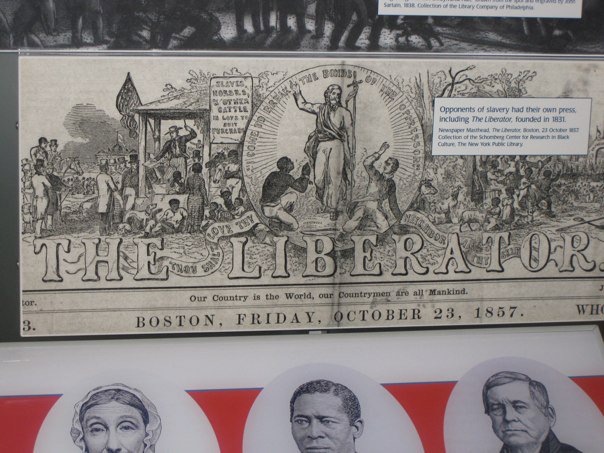
The bell is a profound symbol of liberty and was used by the Abolition, Suffrage and Native rights movements alike. There is a certain irony present in the fact that a nation founded on liberty took more than 100 years to recognize the equal status of women, and another 50 to recognize certain ethnicities:

I really enjoyed my time in Philadelphia, minus the fact that the city seemed to be completely bereft of people having any fun (except the gay bars). It was then off to Boston for the second half of the trip.

Boston

I’ve been to Boston once before, back in 2008. The city has a feel that is not very dissimilar to being in a Canadian city – it’s clean, people are friendly, and there is government-funded health care. There were far fewer people of colour in the city, but more than I expected and definitely more than I see in Vancouver. The “black guy nod” might have made an appearance once or twice in a moment of distraction when I forgot I wasn’t at home.

Boston has a deep connection to the history of the United States. The whole city is structured to allow even casual tourists the opportunity to connect with history. As I might have mentioned before, I find cemeteries fascinating. Boston has old cemeteries in the middle of the city that you can visit. It was there that I learned that one of the first victims to be shot in the Boston Massacre was a black former slave named Crispus Atticus. We also saw a tomb marked with the name “Freeman” – usually the name of a freed slave (but not necessarily a black slave).

Part of tourism in Boston is what is called the “Freedom Trail” – a self-guided footpath through the city that highlights a number of sites of historical interest. Part of the trail is the Black Heritage Trail – a side-trip that showcases a few sites of import to the African-American community in Boston, one of which is the Abiel Smith School:

Sadly, I didn’t have time to go inside the museum, so I’ll have to save that for either a later trip or a few afternoons spent poking around with Google to see what I can see.

Anyway, for a history nerd like myself, walking through Boston was great. Philadelphia too. While my agenda was to party (hence last Wednesday’s post… for which I apologize), I’m glad I was able to learn something and get to connect physically with sites that marked major events in world history. As I said, it will take me a couple of days to get back into my groove, but expect me to go back to my regular post quantity and quality starting next week.

Like this article? Follow me on Twitter!

0 Yeah because THAT’S fair…

  • March 23, 2011
  • by Crommunist
  • · blog · civil rights · LGBT · news · politics

Crommunist is on vacation this week, so blogging will be spotty. I’m going to make sure there’s at least SOMETHING up every day, but they’ll be short. Things should be back to normal by April.

Fair warning – this post was written whilst VERY drunk.

A revised citizenship study guide for new Canadians released Monday contains a single sentence on gay and lesbian rights, which is a sentence more than in the first version of the book published a year and a half ago. The added material on gay rights — a topic completely absent from the first release of the federal government’s guide in November 2009 — was among several notable additions to the document unveiled by Immigration Minister Jason Kenney, including denunciations of violent extremism and forced marriage.

I am usually fluent in the English language. In the state I am currently in, I would barely pass the citizenship test that is the subject of this news post. I am trying to marshall all the cognitive ability at my disposal. Fuck Jason Kenney. Fuck the Conservative Party of Canada.

While it is commendable that  SOME mention of Canada’s gay population made it into the citizenship guide, considering the fact that Canada was one of the first countries to bite the bullet and recognize that gay people are PEOPLE, this should be a selling point; not a shameful thing to sweep under the rug. The CPC is wearing its cross on its sleeve.

Sooo not sober. I blame society.

Like this article? You’re clearly not a fan of the English language.

Page 32 of 41
  • 1
  • …
  • 30
  • 31
  • 32
  • 33
  • 34
  • …
  • 41

  • SoundCloud
  • Twitter
  • Facebook
  • YouTube
  • Subscribe Subscribed
    • Crommunist
    • Join 82 other subscribers
    • Already have a WordPress.com account? Log in now.
    • Crommunist
    • Subscribe Subscribed
    • Sign up
    • Log in
    • Report this content
    • View site in Reader
    • Manage subscriptions
    • Collapse this bar
 

Loading Comments...