Crommunist
  • Blog
  • Music
    • Video
    • Audio
  • Media
    • Audio
    • Video
  • Events
  • Twitter
  • Ian Cromwell Music
  • Soundcloud

Category: history

0 Movie Friday: The Greatest Story Ever Told

  • April 15, 2011
  • by Crommunist
  • · blog · history · movie

Someone back in the time when there weren’t a lot of phrases that had been popularly coined began calling the Bible “the Greatest Story Ever Told”, and it caught fire. Despite the fact that the Bible is not a story at all (unless you consider it a bizarre, rambling and bloody one that delves into non-sequiturs every chapter or so), it’s far from the greatest. There is much more insight into the human condition from reading Les Miserables or Roots or even some of the better sci-fi/fantasy titles out there than there is to be found in the Torah. Even if you want to stay in the realm of religion, the Bhagavad Gita is breathtakingly beautiful, or even Milton’s Paradise Lost or Dante’s Divine Comedy is better told story than the Bible.

However, there is some appeal to a story that tries to explain the existence of the world, humankind, and to explain how we got here. The Bible gives us a narrative of how that happened – the problem being that it is all either outright fable or sexed-up oral history. David Christian has a much better story:

This one has the added bonus of being true. While it lacks heroes and struggles between good and evil, it does a very good job of both explaining how we got here, and putting our monstrous self-importance in a context that is sorely needed.

Like this article? Follow me on Twitter!

3 Systematic abuse? Not our problem…

  • April 14, 2011
  • by Crommunist
  • · blog · history · law · politics

I’ve spoken before about the value of official apologies for historical wrongdoing. While those on the right will squawk that it’s just a drummed-up excuse to make (group X) feel guilty for being (X), the real consequence of apologies is to take an opportunity to own one’s past. There is the old aphorism that “those who do not learn from history are doomed to repeat it” – basically the longer we continue to deceive ourselves about what is in our history, or try to pave over the bad things, the more likely we are to make the same mistakes again.

But then there are those times when we actively refuse to deal with history:

The government cannot be held legally liable for abuses during the Mau Mau rebellion against British colonial rule in Kenya, a court has heard. Ministers want a claim for compensation from four elderly Kenyans struck out by the High Court in London. The claimants say they were assaulted between 1952 and 1961 by British colonial officers in detention camps. The Foreign Office says Kenya had its own legal colonial government, which was responsible for the camps.

This is the kind of legal jiu-jitsu that only a mob lawyer could really feel good about. The court did not deny the abuse took place, or that the men were victims of the abuse. They just think that the men should go after the real culprit – the colonial government that no longer exists. Never mind that the colonial government was established by the British Empire, for the sole purpose of stripping Kenyans from the right to self-government. Never mind that it is impossible to sue the colonial government since Britain relinquished control of the colony. No, these aren’t relevant details to the case.

What is relevant is that England can avoid having to own up for its shocking history of colonial atrocities committed against military and civilians alike. It’s like something out of The Shawshank Redemption, where Andy Defresne creates a legal identity for a fake person that can never be prosecuted, because he never existed. The colonial government, under the direction of Britain (I can’t, in this context, bring myself to refer to them as Great Britain), committed abuses and was then dissolved at the end of the colonial era. Nice and tidy way of evading culpability, innit?

The judge heard Mr Mutua and Mr Nzili had been castrated, Mr Nyingi was beaten unconscious in an incident in which 11 men were clubbed to death, and Mrs Mara had been subjected to appalling sexual abuse.

Not relevant.

David Anderson, professor of African politics at Oxford University, who has examined some of the withheld documents, said the files proved Whitehall not only knew what was being done to Mau Mau suspects but also had a part in sanctioning their ill-treatment.

Not relevant.

The government says too much time has elapsed since the alleged abuses.

Ah, now see that’s a reasonable argument! Crippling and ongoing psychological trauma? Not our problem – that shit’s old news! Oh wait, you want an apology? Yeah… take it up with the colonial government – that’s who did it, right?

Oh wait, they don’t exist?

Not relevant.

Like this article? Follow me on Twitter!

4 Well India is apparently stupid too

  • April 7, 2011
  • by Crommunist
  • · blog · Canada · crapitalism · forces of stupid · free speech · history · news · politics

In case you were wondering, it turns out that India is also stupid:

A controversial book on Mahatma Gandhi has been banned by the government in his native state of Gujarat. Chief Minister Narendra Modi said that its contents were “perverse and defamed the icon of non-violence”. The book by Pulitzer Prize winning author Joseph Lelyveld contains evidence that India’s independence hero had a homosexual relationship.

I’m not a fan of religion. I am irritated by conservatism. I detest racism, sexism and homophobia. I hate book bans. They have got to be the least useful, most reactionary response to an idea in existence. The entire span of human history is testament to the fact that book bans are a horrible idea. Especially for such petty and transparently ridiculous reasons.

Those of you who know me well know that I am a huge fan of a show called Clone High. It was a one-season Canadian show that caricatured teen shows, through the lens of a high school populated by clones of famous historical characters. The humour of the show came from its completely irreverent humour and fast-paced weirdness:

One of the main characters was a clone of Mohindas Gandhi, re-imagining him as an extremely hyperactive, self-aggrandizing misfit whose entire driving force was to be accepted despite his zany behaviour. Anyone with even faint knowledge of the life of Gandhi knows that this characterization is completely opposite from the actual living person, wherein lies the funny. However, when the show left Canadian television and was rebroadcast around the world, Indians were up in arms over the desecration of their national hero.

And now someone said he was GAY! OMG U GUYZ!

Here’s the thing: as much as India likes to behave as though it is a secular country, many parts of India cling strongly to “traditional values”, meaning hatred of gays and other strog out-group hostility. While we think of India as a single country, it is perhaps better understood as analogous to ancient Greece – a collection of nation-states that are affiliated but by no means homogeneous. Understanding this fact perhaps gives some insight as to why suggesting that Gandhi was anything less than a macho macho man is likely to raise some eyebrows. The fact that they’re talking about Gandhi, someone whose hero worship goes beyond the man himself and takes on a religious fervor just compounds this.

So fine, I can understand people being upset. I can understand people being so upset that they don’t buy the book, or they protest the book, or they produce scathing critiques that show the poor workmanship and revisionist history that went into writing the book. Instead, they chose to try and ban it.

Now I’ve said that banning is a stupid idea, but I haven’t bothered explaining why. Quick show of hands: who would have heard about this if the government hadn’t banned it? Okay, you can put your hands down now – I can’t actually see you. The point is that elevating this book to the level of controversy that it begins to make international headlines only serves to accomplish the exact opposite of what you’re hoping to do with the ban. If the goal of banning the book is to keep people from hearing about the idea, it is an epic level of fail – one of hundreds of biographies of Gandhi has now jumped to the top of several reading lists.

The worst part of this story, incidentally, is the fact that the author actually didn’t say any such thing:

The author of a book on Mahatma Gandhi has said it is “shameful” that it has been banned in India’s western state of Gujarat. Pulitzer Prize-winning author Joseph Lelyveld said the book was banned on the basis of newspaper reviews. He said the reviews had sensationalised his account of Gandhi’s friendship with a German man, who may have been homosexual.

And it seems like the family doesn’t care, even if he did:

Indian writers and relatives of Mahatma Gandhi have protested against the ban. Gandhi’s great grandson Tushar Gandhi said he was against banning of books, and that it did not matter “if the Mahatma was straight, gay or bisexual”. “Every time he would still be the man who led India to freedom”.

Writer Namita Gokhale said she was saddened by the ban. “Every time a book is banned, it saddens me because you simply cannot ban ideas, you cannot ban thoughts.” she said. “In India a democratic space for ideas is a gift and I think banning a book is the most pointless exercise.”

Book bans not only violate the principle of freedom of expression, they also don’t fucking work. It is basically just setting up a giant flag that says “warning: moron approaching”.

And it seems that Canadians are just as stupid:

A Saskatchewan First Nation has banned performances of an acting troupe’s adaptation of an ancient Greek tragedy because one of the characters in the play is a corrupt chief. She said she believes her adaptation of the 2,500-year-old Greek tragedy Antigone offended the leadership of the Poundmaker First Nation.

Psst… Chief Antoine… want to know how to make people suspect that you are corrupt? Take global criticisms of corrupt chiefs personally! I’ve performed an adaptation of Antigone (many many years ago), and done some literary analysis of it. It’s a great story that well encapsulates many of the issues of governance and how personal conflict enters into discussions of principle. It’s a literary classic that has lots of parallels to band governance, regardless of whether or not a given chief is corrupt. However, standing up and banning it is a glaring sign that the criticism hits too close to home, and elevates that criticism to the national level.

Book bans – they do the exact opposite of what you want. Learn it, remember it.

Like this article? Follow me on Twitter!

1 Special post: Crommunist goes to America

  • March 28, 2011
  • by Crommunist
  • · blog · feminism · First Nations · history · race

So this whole past week I was visiting two of my good friends in the Northeastern United States. One, a friend from graduate school, lives in Philadelphia, Pennsylvania. The other, a friend I’ve known since I was a kid, lives in Cambridge, Massachusetts. I talk about things in Canada quite a bit, and was excited to get a bit of a perspective on the differences between living in Vancouver and being in a major American city.

Philadelphia

I’ve never been to Philadelphia before, and I wasn’t really sure what to expect. My preconception was to think of Philadelphia as a mostly white industrial city, but I was surprised to learn that it has one of the oldest black communities in the country. In our touring around town we came across the African American Museum of Philadelphia, which had a very cool interactive display that detailed some of the stories that comprise the history of Philadelphia. I was happy to see a number of couples of various ages and racial backgrounds there (at 2:00 on a Wednesday afternoon). It was particularly eye-opening to hear some of the stories of how black entrepreneurs, politicians and activists had to struggle simply to achieve basic human recognition.

Because of its lengthy black history, Philadelphia has a huge black population. In fact, the city has roughly an even number of white and black residents. There is a thing that is common among black people (at least in places where there aren’t a lot of black people) where we will recognize each other with a reverse head tilt (also known as “the black guy nod”). I kept catching myself having to inhibit my instinct to perform this action every 5 or 6 seconds, as I’m sure I would look like a total spaz.

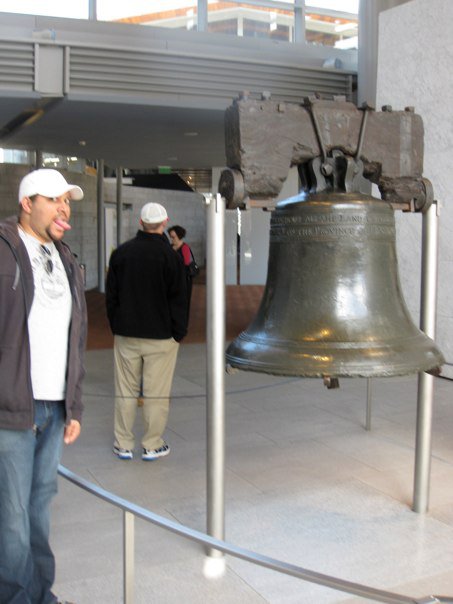
Here’s me at the Liberty Bell:

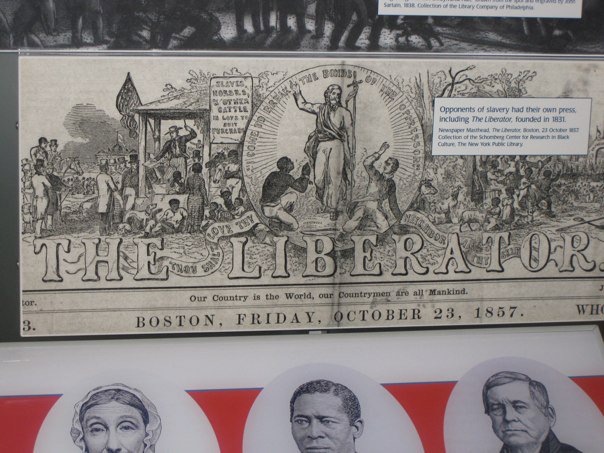
The bell is a profound symbol of liberty and was used by the Abolition, Suffrage and Native rights movements alike. There is a certain irony present in the fact that a nation founded on liberty took more than 100 years to recognize the equal status of women, and another 50 to recognize certain ethnicities:

I really enjoyed my time in Philadelphia, minus the fact that the city seemed to be completely bereft of people having any fun (except the gay bars). It was then off to Boston for the second half of the trip.

Boston

I’ve been to Boston once before, back in 2008. The city has a feel that is not very dissimilar to being in a Canadian city – it’s clean, people are friendly, and there is government-funded health care. There were far fewer people of colour in the city, but more than I expected and definitely more than I see in Vancouver. The “black guy nod” might have made an appearance once or twice in a moment of distraction when I forgot I wasn’t at home.

Boston has a deep connection to the history of the United States. The whole city is structured to allow even casual tourists the opportunity to connect with history. As I might have mentioned before, I find cemeteries fascinating. Boston has old cemeteries in the middle of the city that you can visit. It was there that I learned that one of the first victims to be shot in the Boston Massacre was a black former slave named Crispus Atticus. We also saw a tomb marked with the name “Freeman” – usually the name of a freed slave (but not necessarily a black slave).

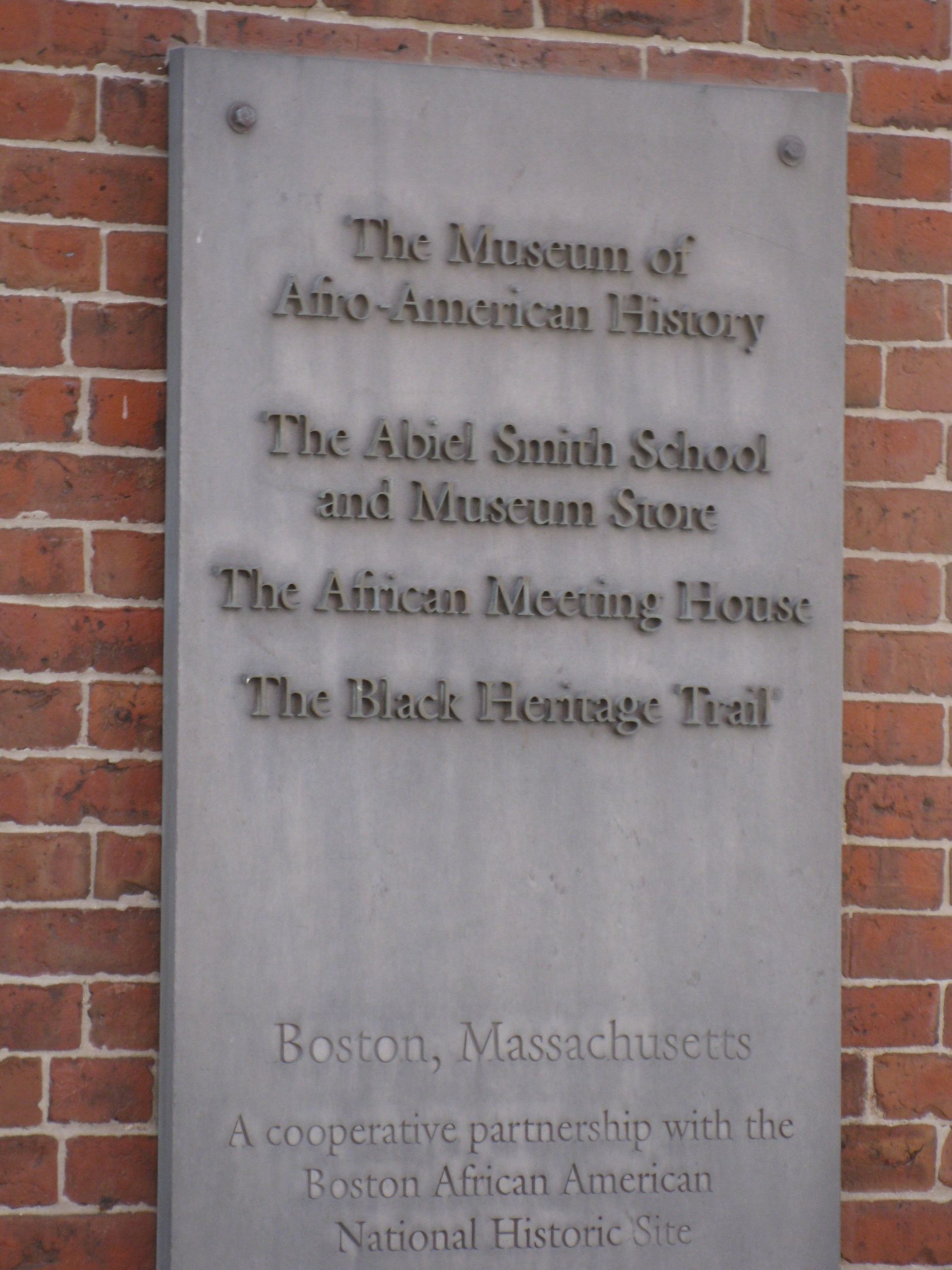
Part of tourism in Boston is what is called the “Freedom Trail” – a self-guided footpath through the city that highlights a number of sites of historical interest. Part of the trail is the Black Heritage Trail – a side-trip that showcases a few sites of import to the African-American community in Boston, one of which is the Abiel Smith School:

Sadly, I didn’t have time to go inside the museum, so I’ll have to save that for either a later trip or a few afternoons spent poking around with Google to see what I can see.

Anyway, for a history nerd like myself, walking through Boston was great. Philadelphia too. While my agenda was to party (hence last Wednesday’s post… for which I apologize), I’m glad I was able to learn something and get to connect physically with sites that marked major events in world history. As I said, it will take me a couple of days to get back into my groove, but expect me to go back to my regular post quantity and quality starting next week.

Like this article? Follow me on Twitter!

2 Movie Friday: Tim Wise and the illusion of “post-racial”

  • March 18, 2011
  • by Crommunist
  • · blog · conservativism · critical thinking · history · liberalism · movie · politics · privilege · race · skepticism

I am depressed.

I am depressed for two reasons. First, I am depressed that no matter how hard I work, I will likely never get as good at talking about issues of race and racism, history and the importance of advocacy as Tim Wise is:

The second reason I am depressed is that it seems like the forces of reason are losing the fight to the forces of revisionist history, post-hoc rationalization and short-sighted self-interest. I realize this post is much longer than what I usually post for Movie Friday (and has fewer jokes), but if you’ve found any of my posts on “the good old days” or the importance of recognizing black history, or really anything that I’ve said about race to be interesting (and the numbers suggest that at least some of you do), then you’ll absolutely love this clip.

Any of you who have watched any black beat poetry or other forms of spoken word, you’ll recognize that Tim uses a lot of their cadence and punctuated rhythm to get his points across. It’s not just a lecture – it’s verbal poetry. Amazing stuff, and I really really hope you watch it.

Like this article? Follow me on Twitter!

2 Black history in Canada moment: the maritimes

  • February 28, 2011
  • by Crommunist
  • · blog · Canada · culture · history · race

This year for Black History Month, I have decided to do a bit of research into black history in my home and native land, Canada. Since there are 4 Mondays in February, I am going to focus on 4 different regions of the country. Last week I looked at black history in Ontario. This week I will be concluding this series with a look at black history in the maritime provinces: Nova Scotia, New Brunswick, Newfoundland and Prince Edward Island.

It’s somewhat psychologically satisfying to conclude this series on the east coast. I say that because one of the very first things I ever talked about on this blog, and something I have made repeated reference to, is a hate crime that occurred in that region. At the time, I pointed to the complicated history of the region:

Nova Scotia is home to a surprisingly large number of black people – that is, surprising unless you know some of the history. Africville is an area in Halifax that was home to hundreds of recently-freed slaves and imports from Africa. Some black families in Nova Scotia can trace their lineage back hundreds of years. However, due to overt racism in the 1800s and early 20th century, and more subtle systemic (“polite”) racism in the latter half of the 1900s, black people in Canada have rarely been able to move into the upper middle class. Since race and class are closely related, and given the economic fortunes of the maritime provinces (largely agricultural, less industrial, economic decline in recent years due to fisheries changes), black people have commonly got the short end of the stick.

The maritime region of Canada has a long and storied racial history. With Nova Scotia and New Brunswick both joining confederation as one of the original provinces, much of the foundational history of these provinces is tied inextricably to Irish immigrants. In fact, even a brief period spent in Halifax or St. John will immediately call that lineage forth. However, in addition to British, Irish, Scottish and Welsh, a large population of black immigrants were instrumental in building the territories even before confederation in 1867.

The first group of black New Brunswickers were Loyalists – black men and women loyal to the British Empire who left America following the war of independence. Despite being given land to farm by the government, there was little by way of instructional assistance available to these Loyalists, meaning that they struggled to raise enough to live off of from their land. Given that they were barred from voting, essentially banned from living or practicing a trade within the St. John city limits (something that’s been mentioned on this blog before), and could be kept in unofficial slavery as indentured servants, life was not exactly pleasant for black Loyalists well into the 19th century.

One fascinating chapter of Canadian history that is unique in the world is our role in the country of Sierra Leone. This country enjoys the somewhat backhanded distinction of being an experiment in the “back to Africa” concept – returning the children of slaves back to Africa to return to their roots. 1200 escaped slaves and freemen who had given up on living in Canada were loaded onto transports and shipped back to Africa to establish a place for themselves. Of course, the interests of the colonial powers and foreign corporations undermined any attempt for the newly-relocated settlers to gain any kind of economic independence (a practice that still persists to this day), and the welfare of the relocated black people wasn’t much improved. Much of this process has been described in Lawrence Hill’s novel The Book of Negroes.

In addition to the Loyalists, another group of black immigrants landed in Nova Scotia following the war of 1812. These refugees, largely from Virginia and Maryland, were also given land. Many of them were relegated to ghettoes, the most famous of which being called Africville in Halifax. Despite having land and the right to trade within the city of Halifax, it was exceedingly difficult for black Nova Scotians to secure employment, due to a variety of factors which include lack of access to education, and the pervasive racism of the time. That employment that was available was mostly manual labour, working in shipyards or processing the imports and fisheries.

Africville was always considered a ghetto – while the rest of Halifax was kept modern with infrastructure, Africville lacked plumbing or sewage systems. Home ownership was low, meaning that the accumulation of wealth by black families was next to impossible. After a huge explosion in 1917, the city of Halifax was rebuilt and updated – Africville was not. The city began relocating whatever unsightly detritus they didn’t want in the nicer parts of the city into the Africville area, including sewage treatment plants, garbage dumps, and prisons. Advocates of a “chez nous” approach to social services will be interested to know that the churches provided most of the types of services that we would currently expect from the government. However, being consistently and purposefully excluded from the larger Halifax community meant that these approaches were limited in their effectiveness.

In the 1960s, the government decided (in their enduring wisdom) that Africville was an eyesore that could not be allowed to stand any longer. Residents were forcibly evicted (remember that most did not own their homes – those who did have ownership title were given a tiny stipend and forcibly relocated to housing projects) and the area was bulldozed. The matter would not be investigated, and an apology would not be forthcoming, until 2004 – 40 years too late to do anything about it. The CBC has a film archive of the history of the area and its eventual destruction.

It is perhaps unsurprising, given the context of this history, that there is a great deal of racial tension in Nova Scotia and New Brunswick today. Social norms and attitudes about racism don’t change overnight, and much of the history was swept under the carpet for many years. Black immigration into the eastern provinces would all but stop in the early 20th century. Despite the fact that black people helped build the maritimes, they were never granted a place there. The story of the maritimes reflects well the story of black people in the rest of Canada – we’ve been here forever, but have never been welcome.

Summarizing thoughts

The stereotypical refrain of the put-upon hight school history student is “why do we have to learn this stuff? It’s just names and dates!” A knowledge of history is crucial if we want to understand why things are the way they are now. Historical ignorance breeds contemporary ignorance – one of the many bones I have to pick with those who would clamor to “take our country back“: more likely than not there were real problems for major groups of people at any point in history you’d like to point to, and members of those groups do not particularly want to go back.

Black history in Canada is not merely a subject thrown in people’s faces to make up for historical injustices, or to remind us that black people used to be slaves a million years ago – it serves to remind us that the daily reality of being black in Canada is built on an ancient foundation of hatred, distrust, exclusion, and intentional suppression. From the east to the west coast, every black Canadian carries that heritage on her/his shoulders, regardless of how long or short her/his family has been here. I was born into this history, despite the fact that my father was not born Canadian.

You were born into this history too, regardless of what your feelings toward it are. We are all products of our society, which is itself a product of our history. Understanding the historical forces at work provides us with much-needed context with which to colour our daily experiences. To understand our history is to understand ourselves, and it is only when we are armed with that kind of understanding that we can take the steps necessary to walk into the future together.

Like this article? Follow me on Twitter!
0 Movie Friday: Blackstronauts

  • February 25, 2011
  • by Crommunist
  • · blog · funny · history · racism

A friend posted this on his Facebook, and it made me laugh pretty hard

Sometimes these videos don’t have a point. This is one of those times. Enjoy!

Like this article? Follow me on Twitter!

2 Black history in Canada moment: Ontario

  • February 21, 2011
  • by Crommunist
  • · blog · Canada · conservativism · history · race · racism · religion

This year for Black History Month, I have decided to do a bit of research into black history in my home and native land, Canada. Since there are 4 Mondays in February, I am going to focus on 4 different regions of the country. Last week I looked at black history in the prairies. This week, I am focusing on the Ontario, Canada’s oldest and most populous province. This summary will intentionally exclude Toronto – black history in Toronto is so long and complex that any attempt to summarize it in ~1000 words would be doing it a grave disservice.

I was born in British Columbia, living in the interior until I was ten years old. My family moved to the Toronto area in 1994 so that my father could complete his graduate degree in social work at the University of Toronto. I lived in various parts of southern and eastern Ontario over 15 years, including two years in Kingston, Ontario (which was Canada’s first capital and where first Prime Minister John A. MacDonald resided) while I completed my own graduate degree. While I call British Columbia home, I am just as entitled to consider myself a native son of Ontario, having spent my formative years there.

Black history also has long and deep roots in the province of Ontario. After the United States passed the Fugitive Slave act of 1850 which, among other things, compelled people to return runaway slaves to their owners, the northern United States were no longer a safe haven where a slave could find her/his own life. As a result, emigration (flight, really) of black Slaves into Canada began in earnest. Because of where the borders were located, their proximity to major American urban centres, and the difficulty of moving people across the prairies in the United States, Ontario became a prime location to smuggle in freed slaves. As with most displaced peoples, blacks settled and tried to build lives for themselves as soon as they had the opportunity, which means that black settlement in Ontario dates back hundreds of years – prior, in fact, to much of any group settling in the prairies.

One of the earliest such settlements was the farming community of Buxton. Buxton is famous among buffs of the history of slavery, as it was considered the “last stop” on the Underground Railroad that brought escaped slaves from the United States to Canada. The land was purchased and made available to the fugitives by Reverend William King – a fact that should not be overlooked when considering the role of Christians and white abolitionists in the movement to aid slaves. Despite the availability of land and a means of cultivating it, things were obviously not all roses and smiles for freed men in the new “promised land”, as this quote from A NorthSide View of Slavery. The Refugee: or the Narratives of Fugitive Slaves in Canada. Related by themselves, with an account of the history and condition of the colored population of Upper Canada will attest:

Among some people here, there is as much prejudice as in the States, but they cannot carry it out as they do in the States: the law makes the difference. I am acquainted with many of the colored families here, and they are doing well. We have good schools here.

Once again, this fact cannot be overlooked by those who would claim that Canada was a racism-free land of milk and honey, or those who would claim that passing laws against discrimination or other prejudice are ineffectual.

I’ve been to Buxton, Ontario. There are in fact several Buxtons with similar histories – one in Nova Scotia, and another in Grenada in the West Indies. The Buxton I went to has a graveyard, which is perhaps the oldest and best-kept black historical site in Canada. There are Cromwells buried in the cemetery at Buxton, Ontario, but these are likely no relation to me – our name is a bastardization of a Dutch surname. Near Buxton is the small town of Chatham, which has its own distinct historical significance. Perhaps chief among its contributions is the fact that it was used as the staging ground for the famous raid on Harper’s Ferry by the American abolitionist John Brown.

In my pokings around doing research for this article, I was struck with a bit of history I had never even heard hinted at before. Reading books by Lawrence Hill (a great Canadian author who you should definitely look into if you get a chance), I learned that Oakville, Ontario has a long black history. This is a particularly outrageous suggestion, given the nearly monochromatic makeup of Oakville currently. I was looking for some information to corroborate this, when I discovered that the Niagara Movement has a Canadian origin.

The Niagara Movement was a political group devoted to antisegregation and the improvement of the plight of black people in the United States, founded by black intellectuals under the supervisory auspices of W.E.B. Du Bois – himself a prominent and influential black intellectual whose life history is an amazing story that is chronicled in the book Up From Slavery (n.b. – Up From Slavery was written by Booker T. Washington, not Du Bois. Du Bois has written several autobiographies, the most recent of which was published in 1968, and which I apparently need to read post-haste). The Niagara Movement laid down the foundation of what would become the prevailing attitude towards the improvement of black people’s lives, and eventually lead to the foundation of the National Association for the Advancement of Colored People (NAACP) which is, of course, still in existence. The inaugural meeting took place in Fort Erie, Ontario near Niagara Falls. Interestingly, the advancement of women was part of the foundation of this movement, working in concert with and anticipating the suffrage movement that was to define the next few decades.

It was at their meeting in Fort Erie that they (mostly Du Bois) built the basis of their foundational document that called for, among many other things, equal and desegregated schools, the protection of trade unions, anti-discrimination statues, and a number of other things that would make any decent conservative wake up in a cold sweat. They also criticized the institution of the Christian churches, particularly their complicity in racial prejudice. Once again, these facts speak against the attempt to re-brand the abolition movement as being in line with conservativism or Christianity, as is often attempted.

As I stated in the header, there is far more to black history in Ontario than I can comfortably address here, and more conscientious scholars than your humble narrator have done much more thorough jobs of chronicling it. The “take home message” of this piece (indeed, all of these pieces) is that black history is closely tied to Canadian history. The prosperity and stability of the territory of Upper Canada (the early name for Ontario) owes a good portion of its existence to the contributions made by black people – freed slaves and their descendants alike. To fail to recognize this is to rewrite history and neglect an important and interesting narrative.

Like this article? Follow me on Twitter!

3 Movie Friday: Stewart Lee – Political Correctness

  • February 18, 2011
  • by Crommunist
  • · blog · conservativism · funny · history · movie · racism

A friend put me on to a new standup comedian:

There is a general misunderstanding that pervades the society we live in, and it comes from a grating lack of historical awareness. I’ve made somewhat oblique reference to it before, but the problem arises when we look at conditions today and assume that they were ever thus. For example, the words “political correctness” have taken on an almost pejorative connotation, implying an over-sensitive “culture of victims” where every word you say must be scrutinized and agonized over. What this view necessarily neglects is the reasons why those practices came to be in the first place. Whatever your feelings on welfare are, for example, there was once a time when there was no state welfare and poverty was a death sentence. Abolishing welfare isn’t an answer to anything, and suggesting otherwise is being criminally ignorant of history.

Stewart Lee points this out in a very dry way:

“…if political correctness has achieved one thing, it’s to make the Conservative party cloak its inherent racism behind more creative language.”

Racism, in a de facto sense, is inherent in conservative ideology and cannot simply be whitewashed over. When we forget our history and the struggles that it took for us to get here (however your feelings might be of “here”), we expose ourselves to the possibility of looking at the world today and crying “injustice” over issues where the alternative is far worse.

Like this article? Follow me on Twitter!
2 Black history in Canada moment: the prairies

  • February 14, 2011
  • by Crommunist
  • · blog · Canada · history · race

This year for Black History Month, I have decided to do a bit of research into black history in my home and native land, Canada. Since there are 4 Mondays in February, I am going to focus on 4 different regions of the country. Last week I looked at British Columbia. This week, I am focusing on the prairie provinces: Alberta, Saskatchewan and Manitoba.

Anyone who has been to the prairie provinces knows that they are a place unlike any other in the world. Canada’s early history is inextricable from the frontier and mass settlement across its middle territory. Canada’s present, certainly, relies heavily on its ability to produce abundant agriculture including grains, vegetables, soy products, corn, and cattle. Worn almost completely flat by glacial retreat, the prairie provinces are rich in soil, but sparsely populated. Even casual students of Canadian history know that none of this development would have been possible without the federal government’s policy of actively courting immigrants to settle on nearly free land.

Once again, our casual history of the prairie provinces overlooks the contribution and longevity of the black population.

Perhaps somewhat unsurprisingly, black history in the prairie provinces seems to be sparked by events in the United States. When the state of Oklahoma was created in 1907, strong segregation laws were passed that marginalized black Oklahomans. This act, coupled with the Canadian government’s policy of trying to attract immigrants from the United States to the fertile and largely uncultivated prairies, inspired black Oklahomans to migrate north and settle in Canada. Between 1907 and 1911, more than 1000 African-American settlers moved into Alberta and Saskatchewan.

Of course, no good thing goes unpunished. Frank Oliver, federal minister of the interior, passed the Immigration Act in 1911, granting the government powers to restrict immigration to certain ethnicities. This policy goes a long way to explain the ethnic makeup of Canada – ethnicities can be traced like tree-rings to “date” when families probably arrived in Canada. As was the case everywhere, black immigrants were not welcomed with open arms, many forced to pay something akin to the Chinese “head tax”. The Immigration Act would essentially choke off black settlement in the prairie provinces for the next 60 years until Caribbean countries were declared “desirable”, and a large wave of Trinidadian, Guyanese, Jamaican, and other West Indian immigrants entered Canada.

It is interesting to note that black families who settled in Alberta were able to maintain their homesteads at a rate significantly higher than average. One potential explanation for this phenomenon is that families that were prepared to endure the hardships involved in getting there in the first place were both more resilient and more stubborn than people whose passage was easier. However, the small number of black settlers meant that the black presence in the prairies was then, and continues to be, small. Calgary is a notable exception, with a black population of 2.2% (slightly below the national average, but much higher than in most other Canadian cities).

A friend of mine pointed me toward a black pioneer of a different stripe – Dr. Alfred Shadd. Born in Raleigh, Ontario in 1870, Shadd was one of those multi-talented and dedicated individuals that kind of makes you feel bad every time you spend a Friday on the couch eating Cheetos. Doctor, teacher, farmer, editor, and politician, all in one amazing black package. It is important to remember that after the outset of Confederation, the prairies were much like the Wild West – a largely untamed area that was far removed from a centralized government and many steps behind in the level of technology that was enjoyed by the major cities in the east. As a result, it was possible for men like Shadd to achieve a greater level of success out of sheer necessity.

This same friend knew about Shadd because an ancestor of hers ran against him in Kinitsino in Saskatchewan’s first federal election. A strong supporter of decentralized government and greater chez nous provincial control, Shadd ran as a conservative. He lost the election by fewer than 60 votes (a result my friend attributes at least in part to a campaign by racists to ensure that a black man didn’t hold office), but still led a remarkable life. It is interesting to note that Shadd and the man who defeated him (one Thomas Sanderson) were actually great friends and remained so after the election.

Anyone in the area of Edmonton who cares to do so should visit the Shiloh Baptist Church Cemetery, one of the few established historical burial places for black settlers in early Canada. There is a similar cemetery in Chatham, Ontario that I have visited myself (more about that next week), although the Shiloh site is not as rigorously maintained. Sadly, because black history was not (and still is not by many) considered worthy of preservation, it has declined greatly and is more totemic than informative. However, it remains an indelible link to the real contributions that black Canadians made to the foundation of Canada.

Like this article? Follow me on Twitter!
Page 8 of 10
  • 1
  • …
  • 6
  • 7
  • 8
  • 9
  • 10

  • SoundCloud
  • Twitter
  • Facebook
  • YouTube
  • Subscribe Subscribed
    • Crommunist
    • Join 82 other subscribers
    • Already have a WordPress.com account? Log in now.
    • Crommunist
    • Subscribe Subscribed
    • Sign up
    • Log in
    • Report this content
    • View site in Reader
    • Manage subscriptions
    • Collapse this bar
 

Loading Comments...