Crommunist
  • Blog
  • Music
    • Video
    • Audio
  • Media
    • Audio
    • Video
  • Events
  • Twitter
  • Ian Cromwell Music
  • Soundcloud

Category: critical thinking

0 There’s no justice, there’s just us

  • April 11, 2011
  • by Crommunist
  • · blog · critical thinking · crommunism · liberalism · psychology

There is a concept in psychology called the “just world hypothesis”, also known as the “just world fallacy”. In its essence, this concept refers to our tendency to infer that the world operates as it should – goodness is rewarded and iniquity is punished. Where the fallacious component of this phenomenon crops up is when we allow this thought process to operate in reverse – those who are punished or rewarded must have deserved it, because the world just works that way.

This is a particularly attractive heuristic for a number of reasons. First, it is reassuring to think that we live in a universe where things exist in a state of balance – chaos is unsettling and potentially dangerous. Second, and perhaps most compellingly, it gives us a sense of satisfaction to think that the hard work we put in will be rewarded. It gives us even more satisfaction to think that those who do wrong will get their come-uppance in the end, a phenomenon called schadenfreude.

There is no place in which the just world fallacy is more obvious than in theology. Regardless of which deity we are talking about, there is always a balance between the forces of good and the forces of evil, with the good guys eventually winning out in the end. Christianity falls down this path most egregiously, with an accounting of a final battle and judgment that is the stuff of great myth; however, all the great religious traditions put great faith in the idea of ultimate balance. The very concept of an afterlife is an implicit reward for a good life or punishment for a life used for ill.

This fallacy pops up outside the realm of religion, however. It is this fallacy that allows us to look at the horrendous disparity between the living conditions of First Nations people, of women, of people living in starvation in southeast Asia and Africa, and rationalize it. Take a look at the comments section of any news report from that region (particularly about what is currently happening in the Ivory Coast), and you’ll undoubtedly come across someone with a brilliant statement like “well all of those African leaders are corrupt – what do they expect?”

It’s nice to be able to explain away injustice with such a simple wave of the hand. Doing so removes any sense of responsibility you might feel for the way corporations from which we purchase goods exploit and devastate those countries, destabilizing them to a point where corruption becomes de rigeur. It removes any feelings of guilt for the fact that our cities are built on First Nations land, much of which was obtained through dishonest treaty processes. It prevents us from having to feel remorse for propping up a misogynistic system that rewards men for fictitious “superiorities” that we have been told to believe we have. We can then go about our lives without having to constantly examine our every thought and assumption, which is an exhausting process that can prevent anything from actually getting accomplished.

The problem with belief in the just world hypothesis is that it blinds us from seeing the world as it truly is. Consider this figure for a moment:
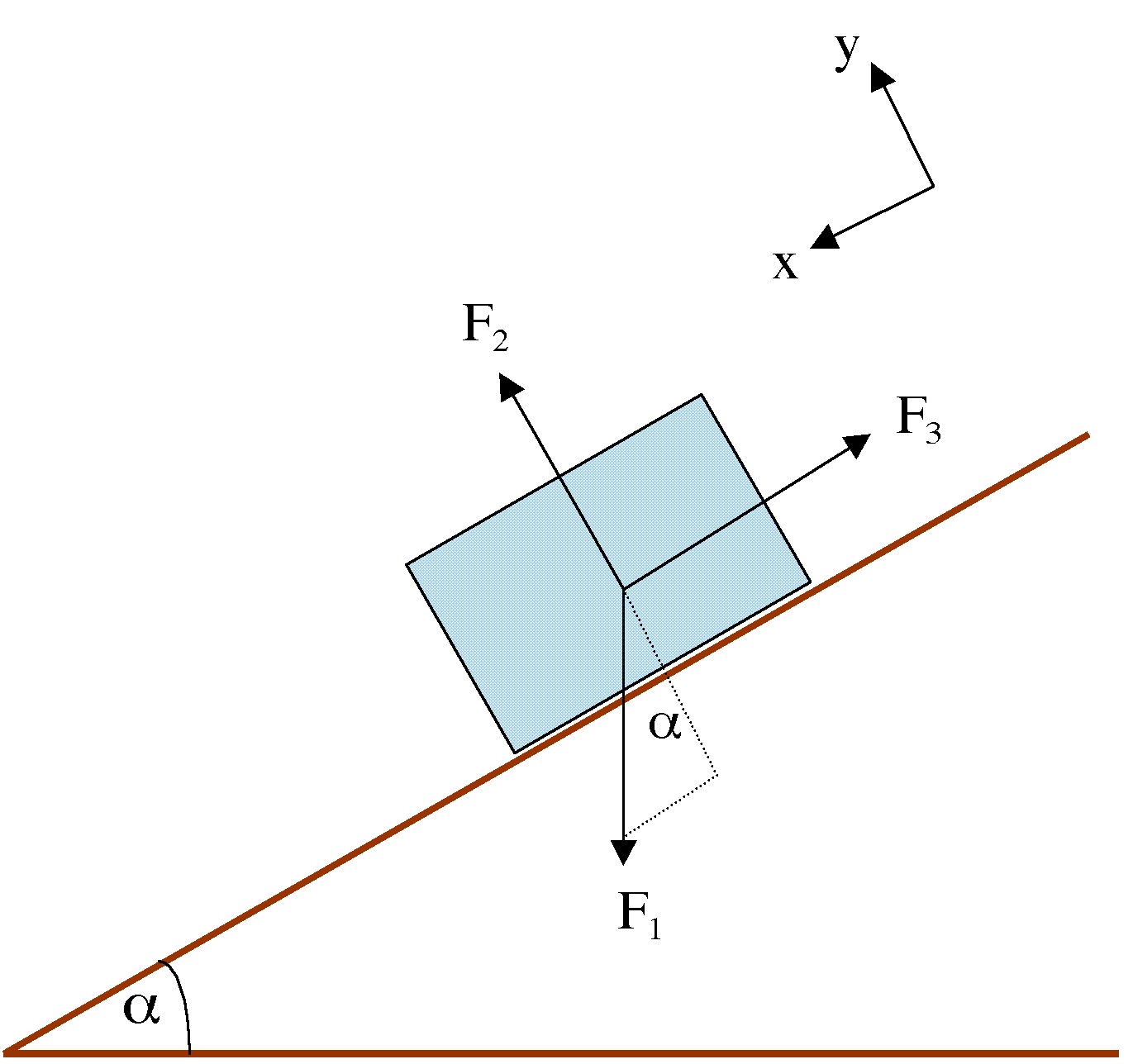
Anyone who has studied classical mechanics (called ‘physics’ in high school) will immediately recognize this as a free body diagram. The various forces at work on the rectangular object are presented. When we can identify the direction and magnitude of these forces, we can make meaningful predictions about the behaviour of the object. However, if we neglect one of the forces either in how strong it is or where it’s going, our predictions – indeed, our very understanding of the object – are fundamentally flawed (e.g., if we forget about friction, we would expect the block to slide down the ramp – friction may keep it exactly where it is).

Society and the people of which it is comprised can be thought of in much the same way. When we neglect to take into account the forces that are at work on us, our predictions and understanding of the world is meaningfully misconstrued. If we add in other forces that aren’t actually there, then we’re realy in trouble. The just world fallacy is just such an addition – it postulates the existence of an outside influence that inherently balances other forces that may result in unjust disparity. We are then relieved from any sense of responsibility to correct injustices.

The ultimate manifestation of this is the bromide “everything happens for a reason”. Starving kids in Ethiopia? Illegal wars? Abuse and deprivation? Exploitation of vulnerable peoples? Don’t worry, everything happens for a reason. Justice will win out in the end, without any need for action from you, safe behind your wall of fallacy.

It’s not exactly difficult to see why this view of the world is fundamentally dangerous. The world is not a fair place. In fact, “fairness” is an essentially human construction – sometimes animals are predated into extinction, sometimes entire ecosystems are destroyed by natural disasters, it’s entirely possible that entire planetary civilizations were wiped out by a supernova in some far-flung corner of the galaxy. These things are only “unfair” to human eyes – as far as the universe is concerned, them’s the breaks. I suppose there is some truth to the statement that “everything happens for a reason” – it’s just that this reason is that we live in a random, uncaring universe.

If we wish to live in a fair world – and I’d like to hope that we do – then it is incumbent upon us to make it that way. The only force for justice that exists is in the hands of human beings, and the only strength behind that force is the level of responsibility we feel to make it so. It is of no use to cluck our tongues and say “well that’s the way it goes” or “things will work out” – making statements like that is the same as saying “I don’t care about the suffering of those people”. If that’s the case (and oftentimes it is), we should at least be honest with ourselves and say it outright.

It is for this reason that I identify as a liberal – I am not content to let the universe sort things out. The universe doesn’t care, and there’s no reason to believe that the unfairness of random chance will result in justice for those that centuries of neglect have left behind. If we care about justice, then it’s up to us to make it happen.

Like this article? Follow me on Twitter!

TL/DR: The world is not a fair place, although we like to try and convince ourselves that it is. If we want to live in a fair world, then we have to make it that way.

2 Movie Friday: Outnumbered

  • April 8, 2011
  • by Crommunist
  • · blog · critical thinking · funny · movie · religion

I had a discussion/debate with Scary Fundamentalist about the strength of kids’ “bullshit detectors”. My basic stance was that, given the opportunity and a set of unbiased facts, kids are pretty good at sorting out what is real and what isn’t. However, when you tell them that something is real, they tend to believe you because… well… they’re kids. Today’s video illustrates that:

*Mutter* another video with embedding disabled. Sorry.

While this is played for laughs, it is an incredibly tragic state of affairs that kids are indoctrinated in environments where they aren’t given the skills to evaluate the truth of the axioms they are taught. Sure, I was raised in a religious household (kinda) and was taught to believe in a deity, but I was also taught skills of appraisal of facts, and exposed to dissenting opinions. It’s all well and good to say “let the kids decide for themselves”, but when you insulate people from dissenting opinions, there’s really not much of a decision to make.

Like this article? Follow me on Twitter!

4 Well India is apparently stupid too

  • April 7, 2011
  • by Crommunist
  • · blog · Canada · crapitalism · forces of stupid · free speech · history · news · politics

In case you were wondering, it turns out that India is also stupid:

A controversial book on Mahatma Gandhi has been banned by the government in his native state of Gujarat. Chief Minister Narendra Modi said that its contents were “perverse and defamed the icon of non-violence”. The book by Pulitzer Prize winning author Joseph Lelyveld contains evidence that India’s independence hero had a homosexual relationship.

I’m not a fan of religion. I am irritated by conservatism. I detest racism, sexism and homophobia. I hate book bans. They have got to be the least useful, most reactionary response to an idea in existence. The entire span of human history is testament to the fact that book bans are a horrible idea. Especially for such petty and transparently ridiculous reasons.

Those of you who know me well know that I am a huge fan of a show called Clone High. It was a one-season Canadian show that caricatured teen shows, through the lens of a high school populated by clones of famous historical characters. The humour of the show came from its completely irreverent humour and fast-paced weirdness:

One of the main characters was a clone of Mohindas Gandhi, re-imagining him as an extremely hyperactive, self-aggrandizing misfit whose entire driving force was to be accepted despite his zany behaviour. Anyone with even faint knowledge of the life of Gandhi knows that this characterization is completely opposite from the actual living person, wherein lies the funny. However, when the show left Canadian television and was rebroadcast around the world, Indians were up in arms over the desecration of their national hero.

And now someone said he was GAY! OMG U GUYZ!

Here’s the thing: as much as India likes to behave as though it is a secular country, many parts of India cling strongly to “traditional values”, meaning hatred of gays and other strog out-group hostility. While we think of India as a single country, it is perhaps better understood as analogous to ancient Greece – a collection of nation-states that are affiliated but by no means homogeneous. Understanding this fact perhaps gives some insight as to why suggesting that Gandhi was anything less than a macho macho man is likely to raise some eyebrows. The fact that they’re talking about Gandhi, someone whose hero worship goes beyond the man himself and takes on a religious fervor just compounds this.

So fine, I can understand people being upset. I can understand people being so upset that they don’t buy the book, or they protest the book, or they produce scathing critiques that show the poor workmanship and revisionist history that went into writing the book. Instead, they chose to try and ban it.

Now I’ve said that banning is a stupid idea, but I haven’t bothered explaining why. Quick show of hands: who would have heard about this if the government hadn’t banned it? Okay, you can put your hands down now – I can’t actually see you. The point is that elevating this book to the level of controversy that it begins to make international headlines only serves to accomplish the exact opposite of what you’re hoping to do with the ban. If the goal of banning the book is to keep people from hearing about the idea, it is an epic level of fail – one of hundreds of biographies of Gandhi has now jumped to the top of several reading lists.

The worst part of this story, incidentally, is the fact that the author actually didn’t say any such thing:

The author of a book on Mahatma Gandhi has said it is “shameful” that it has been banned in India’s western state of Gujarat. Pulitzer Prize-winning author Joseph Lelyveld said the book was banned on the basis of newspaper reviews. He said the reviews had sensationalised his account of Gandhi’s friendship with a German man, who may have been homosexual.

And it seems like the family doesn’t care, even if he did:

Indian writers and relatives of Mahatma Gandhi have protested against the ban. Gandhi’s great grandson Tushar Gandhi said he was against banning of books, and that it did not matter “if the Mahatma was straight, gay or bisexual”. “Every time he would still be the man who led India to freedom”.

Writer Namita Gokhale said she was saddened by the ban. “Every time a book is banned, it saddens me because you simply cannot ban ideas, you cannot ban thoughts.” she said. “In India a democratic space for ideas is a gift and I think banning a book is the most pointless exercise.”

Book bans not only violate the principle of freedom of expression, they also don’t fucking work. It is basically just setting up a giant flag that says “warning: moron approaching”.

And it seems that Canadians are just as stupid:

A Saskatchewan First Nation has banned performances of an acting troupe’s adaptation of an ancient Greek tragedy because one of the characters in the play is a corrupt chief. She said she believes her adaptation of the 2,500-year-old Greek tragedy Antigone offended the leadership of the Poundmaker First Nation.

Psst… Chief Antoine… want to know how to make people suspect that you are corrupt? Take global criticisms of corrupt chiefs personally! I’ve performed an adaptation of Antigone (many many years ago), and done some literary analysis of it. It’s a great story that well encapsulates many of the issues of governance and how personal conflict enters into discussions of principle. It’s a literary classic that has lots of parallels to band governance, regardless of whether or not a given chief is corrupt. However, standing up and banning it is a glaring sign that the criticism hits too close to home, and elevates that criticism to the national level.

Book bans – they do the exact opposite of what you want. Learn it, remember it.

Like this article? Follow me on Twitter!

7 Fuckin’ privilege? How does that work?

  • April 6, 2011
  • by Crommunist
  • · blog · critical thinking · privilege · race · racism

My experiences dealing with other people, as well as my own recollections of how my opinions have changed over the years, have imprinted upon me the need to be as even-handed as possible to those whose positions oppose mine. As hard as it is to do sometimes, I have to constantly remind myself that it is entirely possible (and more than likely to be the case) that my opponents really do believe the nonsense they defend sincerely. Sometimes the opinions expressed are so batshit insane that I am sorely tempted to suspect that my interlocutor doesn’t really believe what she/he is saying, but is simply trying to get my goat.

I don't blame them - my goat is adorable

More often than not, disagreements between people are rooted in ignorance. There are a few people to whom I quite regularly lose arguments, and 95% of the time it is because I don’t actually know what I am talking about. Once I am educated about what piece of evidence or alternative argument I have overlooked, I eventually either concede the argument or revise my position. This kind of discussion is only possible when the opponents respect me enough to not simply dismiss my arguments out of hand.

And so it is in this spirit of extending the benefit of the doubt that I address those of my readers that don’t accept the existence of white privilege. I know they’re out there (at least 2 of them have said as much), and many people who haven’t heard of the concept before find it hard to spot. It’s one of those seeming Catch-22s that one of the ways privilege manifests itself is that it prevents you from seeing it, which directly leads to you denying it. Hopefully this will help change some minds:

Seattle University researchers who posed as “secret shoppers” to test customer services at the Department of Social and Health Services gave the agency a failing grade. Their report card, released this month, showed that DSHS treated whites and people of color differently, failed to provide basic information on programs when asked, failed to keep confidentiality and made things difficult for the disabled and those who don’t speak English.

The researchers, who are of different ethnicities, visited all 54 DSHS offices around the state between July and December of 2009. Of the four female researchers, the African-American received the worst treatment, according to the study. Many DSHS receptionists also assumed the Asian-American investigator was a foreigner and asked questions about her citizenship status, even though she was born in America and had no accent, said lead investigator Rose Ernst, Ph.D., an assistant political science professor at Seattle University and the study’s author.

It is rare that such a blatant example of this effect manifests itself, and I’m sure using this example will open me up for criticisms that this is not representative of average experience. To make it clear – I don’t believe that this magnitude of racism is widespread and normative; however, this kind of racism exists everywhere. The level of service experienced by these researchers varied based on their race – to an almost comically absurd extent. This isn’t in the South either – this is Washington state! Super-liberal latté and arugula Washington state. I’ve said this before, but I should probably re-iterate: being a liberal is not a magic pass to being non-racist. Liberals are racist too, just in a different way to conservatives.

There are two distinct phenomena happening here that I think must be explored and highlighted. First, there is the experience of the researchers of colour. They posed as women needing information and assistance – the purview of the DSHS. What they received instead was dismissive and rude treatment:

The African-American investigator encountered rude or dismissive behavior in roughly 40 percent of her visits to DSHS offices compared with 25 percent for Ernst, the white investigator. At times, staff members raised their voice to “shame” the African-American investigator by broadcasting her question to the entire office, the report says.

This is your classic racism, which strictly speaking is not privilege, except insofar as being non-white is a barrier that a white person doesn’t face. The consequences of being non-white are palpable in this case study, and were not experienced by the white researcher. There are a number of other embedded barriers here – poor women are likely to receive inferior treatment compared to middle-class or rich women, women with unaccented English will be treated better than women with accents, men will (probably) be extended more respect than women (although that might not be the case here, given that many DSHS users are abused women – men might be a bit unpopular). That’s only half of what is going on though.

There is a second phenomenon that clearly demonstrates the manifestation of white privilege:

“I never had a single question about my citizenship status,” said Ernst, who is white. “On the flip side, there was an assumption if I was in the office, I had a very legitimate reason to be there, that I really needed help,” Ernst said. Ernst said office receptionists asked if she had a domestic violence problem or drew her into hushed conversations about others in the waiting room.

Not only did the white researcher not face the same kind of overt discrimination that the others did, but she received preferential treatment because of her skin colour. This is not treatment that Ernst had demanded or otherwise solicited – the fact of her white skin gave her a leg up that, if she had not been looking for it, would have been completely invisible to her. In other words, had she been unaware of the phenomenon of privilege, there is no way she would have seen her experience as anything but typical. She would have been, from her own perspective, right to say that she didn’t receive any special treatment because of her skin colour – why would she suspect otherwise?

It is precisely that aspect of privilege that is most galling to people on both sides of the debate. It bothers anti-racists because it is so shockingly obvious once you see it, but its existence is denied to high heaven. It bothers deniers because it seems like a non-falsifiable hypothesis – denying it is proof that you have it. My hope is that this example might provide a clear illustration of not only what privilege is, but how it works as well.

Like this article? Follow me on Twitter!

9 The value of the ‘spiritual’

  • April 4, 2011
  • by Crommunist
  • · blog · critical thinking · crommunism

I have a few close friends who describe themselves as ‘spiritual’. In fact, for the intervening period between leaving religious dogma and rejecting god-concepts altogether, I described myself along similar lines. When I said it, and I suppose when my friends say it, it meant that while I did not adhere to a particular religious tradition but still recognized that there was a non-intellectual part of the human experience that made up a non-trivial portion of my life. While my particular ‘spirituality’ did not encompass things like ghosts or angels or other non-corporeal forms of life, it did recognize that there is more in the world than limited human understanding can fully encompass.

In elementary school and throughout my life as a churchie, I was told that in addition to physical, social, emotional and mental health it was important to maintain one’s “spiritual health”. Googling the term gives you a whole flood of holistic sites that make the same claim. The interesting and telling part of both the religious and secular concepts of the spirit is that neither one bothers to actually define it, except in the most vague terms:

Spirituality is having meaning & direction in life. It involves development of positive morals, ethics & values. Being healthy spiritually helps us to demonstrate love, hope & a sense of caring for yourself and others.

The above is the most specific definition I could find, and even it doesn’t really bother to define what the spirit is, merely asserting the effect that having ‘healthy spirituality’ has. Apparently, according to this particular site, morals and values are the domain of the spirit – so much for philosophy and psychology I guess.

The galling part of the ‘spirituality’ issue is that, almost without question, it is describing subjective states of the brain. At least the religious definition posits the existence of a soul, although it is clear from explorations in neuroscience that the ‘soul’ is just another trick of the mind. However, the idea of ‘spirituality’ is inherently flawed in this way – it confuses an illusion with reality, and then back-fills its assumptions to fit the conclusion. First, the ‘spirit’ is created out of thin air; next, characteristics and qualities are ascribed to this figment; finally, a complicated system of diagnostic and treatment techniques are prescribed to maintain the health of the spirit:

  • Create art work and/or writing centered on hope of peace, then have an art show
  • Create cards to send to individuals who are alone, sick or just having a difficult time
  • Draw or write about what you would like to do for a job or career when you get older
  • Participate in mentoring i.e. reading a story to a younger child, either at home or within the school day
  • Participate in random acts of kindness
  • Have a ceremony celebrating Canadian Citizenship (lolwut?)
  • Recognize others special gifts or individuality – e.g. Identify a strength of each person in your class/family
  • Identify/draw a picture of or write about two community resources that help children/youth

It’s not a minor issue – major health care providers offer ‘spiritual health services’, seminars teach courses about how to heal your spirit, books are written that advertise the secrets of ‘boosting your spiritual health’. Millions of dollars are being made every year by people who claim to hold the secret to fixing a part of you that doesn’t exist. What’s more, belief in this non-existent vestigial and ephemeral organ is seen as a virtue – watch as people nod sagely and knowingly as someone repeats the canard “I’m not religious; I’m spiritual.” Contrast that to the reaction to someone who says “I don’t ride horses; I only like unicorns“.

Once we unpack the embedded implication of ‘spirituality’ – that there is something called a ‘spirit’ or a ‘soul’ that exists separately from the body – we are left to explain the pseudo-phenomenon of spirituality. We certainly experience life as though we are a spirit encased in a body, as though there is a living energy (as Orson Scott Card would call it, an aiùa) that comprises our ‘self’, our unique essence. It’s impossible to discuss this phenomenon without leaning heavily on the psycho-babble that makes up the language of spirituality. Anyone who has meditated, been inspired by a beautiful sight or song, felt connected to the planet, or allowed her/his mind to wander cannot deny that there is at least the illusion of a ‘self’ that exists beyond the wet and fleshy bits that make up our body.

What is this a picture of?

If you said ‘a pretty butterfly’, you’re wrong (if you said anything else, you might have a psychological problem). This is a picture of a bunch of coloured dots, arranged in a pattern that resembles a butterfly. The image of the butterfly is the product of your brain interpreting a number of individual stimuli and synthesizing them into one coherent expression. In the same way, your brain takes a variety of sensory information and builds a subjective experience that creates the illusion of a ‘spirit’ or soul:


All this is in no way meant to diminish the power of subjective experiences. I’ve been sublimely moved by works of music or literature (particularly the latter) that have changed the way I look at the world. I have, while looking at the night sky, felt a super-real connection to the universe. I have, on occasion, been knocked completely sideways by a stray thought that altered my perspective. I have, in years past, felt the Lord Jesus Christ in my heart, and had the Holy Spirit speak through me. These kinds of experiences are part of what defines our human experience. However, it is important to remember that while these things may have deep, powerful personal meaning, they do not correspond in any way to objective reality.

Tl/DR: There can be great value in those things we call ‘spiritual’, but the word itself props up a flawed view of the world.

Like this article? Follow me on Twitter!

0 Movie Friday: Trololololo

  • April 1, 2011
  • by Crommunist
  • · blog · crommunism · funny · movie · religion

It’s April Fool’s Day! This year I am celebrating by trolling the hell out of Canadian Atheist, another site I occasionally blog on.

I am putting this up because I fear that people may not understand that I am joking, and hoping that they click through here for more information.

Here are some other awesome religious troll pranks, in honour of this most foolish of days:

Punk’n the Fundie

Fresh Prince Troll

Miss Cleo Calls a Psychic

The April fool hath said in his heart that this shit ain’t funny.

Like this article? Follow me on Twitter!

2 Psychology beats “bootstraps”

  • March 30, 2011
  • by Crommunist
  • · blog · conservativism · critical thinking · privilege · psychology · science

Crommunist is back from vacation, at least physically. I will be returning to full blogging strength by next week. I appreciate your patience with my travel hangover.

Here’s a cool thing:

You don’t have to look far for instances of people lying to themselves. Whether it’s a drug-addled actor or an almost-toppled dictator, some people seem to have an endless capacity for rationalising what they did, no matter how questionable. We might imagine that these people really know that they’re deceiving themselves, and that their words are mere bravado. But Zoe Chance from Harvard Business School thinks otherwise.

Using experiments where people could cheat on a test, Chance has found that cheaters not only deceive themselves, but are largely oblivious to their own lies.

Psychology is a very interesting field. If I wasn’t chasing the get-rich-quick world of health services research, I would have probably gone into psychology. One of the basic axioms of psychology, particularly social psychology, is that self-report and self-analysis is a particularly terrible method of gaining insight into human behaviour. People cannot be relied upon to accurately gauge their motivations for engaging in a given activity – not because we are liars, but because we genuinely don’t know.

Our consciousness exists in a constant state of being in the present, but making evaluations of the past and attempting to predict the future. As a result, we search for explanations for things that we’ve done, and use those to chart what we’d do in the future. However, as careful study has indicated, the circumstances under which we find ourselves is far and away a more reliable predictor of how we react to given stimuli than is our own self-assessment. This isn’t merely a liberal culture of victimhood, or some kind of partisan way of blaming the rich for the problems of the poor – it is the logical interpretation of the best available evidence that we have.

Part of the seeming magic of this reality of human consciousness is the fact that when we cheat, we are instantaneously able to explain it away as due to our own skill. Not only can we explain it away, but we instantly believe it too. A more general way of referring to this phenomenon is internal and external attribution – if something good happens it is because of something we did; conversely, bad things that happen are due to misfortune, or a crummy roll of the dice. When seen in others, this kind of attitude is rank hypocrisy. When seen in ourselves, it is due to everyone else misunderstanding us. This is, of course, entirely normal – everyone would like to believe the best about themselves, and our minds will do what they can to preserve that belief.

The researchers in this study explored a specific type of self-deception – the phenomenon of cheating. They were able to show that even when there was monetary incentive to be honest about one’s performance and cheating, people preferred to believe their own lies than to be honest self-assessors. However, the final result tickled me in ways that I can only describe as indecent:

This final result could not be more important. Cheaters convince themselves that they succeed because of their own skill, and if other people agree, their capacity for conning themselves increases.

There is a pervasive lie in our political discourse that people who enjoy monetary and societal privilege do so because of their own hard work and superior virtue. This type of thinking is typified by the expression “pulled up by her/his bootstraps” – that rich people applied themselves and worked hard to get where they are. The implication is that anyone who isn’t rich, or who has the galling indecency to be poor, is where they are because of their own laziness and nothing more. It does not seem to me to be far-fetched at all that these people are operating under the same misapprehension that plagued the study’s participants – they succeed by means that are not necessarily due to their own hard work, and then back-fill an explanation that casts themselves in the best possible light.

Please do not interpret this as me suggesting that everyone who is rich got their by illegitimate means. If we ignore for a moment anyone who was born into wealth, there are a number of people who worked their asses off to achieve financial success – my own father is a mild example of that (although he is not rich by any reasonable measure). However, there are a number of others who did step on others, or use less-than-admirable means to accumulate their wealth. However, they are likely to provide the same “up by my bootstraps” narrative that people who genuinely did build their own wealth would, and they’ll believe it too! When surrounded by others who believe the same lie, it becomes a self-sustaining ‘truth’ that only occasionally resembles reality.

The problem with this form of thinking is that it does motivate not only attitudes but our behaviours as well. It becomes trivial to demonize poor people as leeches living off the state, and cut funding for social assistance programs as a result. People who live off social assistance programs often believe this lie too, considering themselves (in the words of John Steinbeck) to be “temporarily embarrassed millionaires” who will be rich soon because of their furious bootstrap tugging. While it is an attractive lie, it is still a lie that underlies most conservative philosophy – which isn’t to say that liberals aren’t susceptible to the same cognitive problems; we just behave in a way that is more consistent with reality, so it doesn’t show as much.

Like this article? Follow me on Twitter!

0 Movie Friday: Protect yourself with censorship

  • March 25, 2011
  • by Crommunist
  • · blog · critical thinking · free speech · funny · movie

Still on vacation. Brief writeup of some relevant stuff on Monday. Until then, enjoy this hilarious video by Mr. Sharp

Like this article? Follow me on Twitter!

80 The embedded assumptions of belief

  • March 21, 2011
  • by Crommunist
  • · blog · critical thinking · crommunism · religion

I recently had an old acquaintance of mine contact me over Facebook for a status update. I had opined that homeopaths deserve to burn in a “non-existent hell” for stoking hysteria over the Japanese nuclear crisis to sell their snake oil. My friend (who I will hereafter refer to as “Janice”) felt that it was of the utmost importance to contact me and assure me that hell is indeed a real place, and that the earthquake was part of a currently-unfolding Biblical prophecy.

Janice and I haven’t spoken in a number of years, and so it’s not surprising to me that she was unaware of my atheism. It was surprising to me that she didn’t just ignore my heathenism, instead preferring to blindly assert to me that she had special insight into the mind of the Creator of the Universe. In the interest of avoiding a completely unnecessary fight, I thanked Janice for her concern, and suggested that she probably didn’t want to have ‘the religion talk’ with me. After all, I spend a good number of hours every week exploring the bankruptcies of religious arguments, whereas she in all likelihood has never really crossed swords with a Gnu Atheist before.

Janice, not willing to pass up an opportunity to educate me about how great her god is, kept pressing me. She told me that she believed in the 100% truth of the Bible, and that if I only believed as she did, I would also be able to foresee the end of the world by volcanic cataclysm and world war. I won’t go through the entire back-and-forth between us – it was overflowing with the usual atheist responses to tired theist clichés – but suffice it to say I was unconvinced.

The way I left it with Janice (and, assuming I have succeeded in dissuading her from bringing this topic up with me again, the way this conversation has completely left off) was to list some of the several reasons why her assertions about the Biblical forecast of impending armageddon would never be even in the least bit convincing to me.

First Assumption: the universe was created by a conscious, intentional force of some kind.

Despite creationist and other theist protestations to the contrary, the universe shows very little sign of intentional creation. Aside from the fact that the physical laws of the universe permit stability and predictability (a fact that is not as complicated to explain as has been repeatedly claimed), there is nothing at all in the universe that suggests intentionality. There are hundreds of billions of stars in our galaxy alone, with another 100 billion galaxies in the observable universe. Only arrogance or ignorance (or some combination thereof) could lead someone to believe that this fact points to Earth as being a unique product of specific creation, or to achieve some specific purpose in which human beings play any part.

This assumption has insufficient evidence to demonstrate its truth, and doesn’t even have the appearance of being likely.

Second Assumption: the conscious, intentional force involves itself in human affairs.

Even if we simply grant the above assumption for the sake of argument, there is a second embedded assumption. Not being content with simply creating the universe and then remaining absent and abstract, this creative force (who I will for the sake of clarity call ‘Phil’) has chosen one specific species on one specific planet in one specific galaxy to reveal itself to. Phil is intimately concerned with the behaviours, actions and thoughts of this one species – so much so that it has created an eternal destination of paradise, and another of unimaginable horror specifically for this species to experience forever.

Looking around at the pattern of belief (and public expressions thereof), there does not appear to be any reason to accept this assumption. Prayers to Phil don’t seem to grant any favours or special treatment – Phil seems almost entirely indifferent to the successes or failures of his special creation. It doesn’t even seem that Phil is particularly interested in convincing us of its existence. There is, once again, no real reason to suspect that this assumption is merited.

Third Assumption: Phil has contacted humans and revealed its plan

Again granting the above assumptions, we have to again assume that Phil has expressed its wishes to humankind. Not only does Phil have a plan for humans, but it has told specific individuals this plan at various points throughout history. Phil has interacted with specific people, rather than the entire species, to convey its wishes. Phil does this communication in ways that are largely indistinguishable from mental illness or some other kind of psychological frailty, common in the species.

It is trivially easy to imagine a method of communication that is far superior to the way in which Phil has supposedly chosen. In fact, humans have developed a multitude of methods for mass communication of ideas. Phil has used none of these. There’s no real reason to suspect that this assumption is worth granting either.

Fourth Assumption: of the multitude of groups that have claimed special communication from Phil, the claim by the Israelites is genuine

There are literally thousands of groups that, throughout history, have claimed to have a special insight from Phil. Each of them claims that their insight is real, whereas those others that conflict are incorrect. There is no real reason to suspect that this one particular group, from this particular time period, in this particular area of the world, has the genuine article while all others are simply worshiping “false gods”. Even if it was genuine, it is highly suspicious that there have been no further communications from Phil (at least any that concur with the Israelites’ initial claim), especially in a time when mass communication of information is trivially simple to achieve.

Fifth Assumption: the Israelites, a non-literate group of nomads, were able to accurately transcribe the original communications of Phil into one book

Once again granting the above assumptions for the sake of argument, the contents of the Bible pre-date a time when Israelite scholars were able to write down the stories that had been spread by word of mouth. Having read a smattering of mythology that comes from oral retelling (the works of Homer, other Greek myths, Roman and Norse mythology, African and Caribbean creation storytelling, First Nations mythology), I immediately recognize the stamp of oral transcription whenever I read the old testament. The new testament has a very well-documented history of human origin, with various councils assembled to decide (by popular vote) which passages and books are the work of Phil and which are apocryphal.

Reality is not decided by vote, and as a direct result I cannot accept the fifth assumption as having any merit.

Sixth Assumption: Janice’s particular interpretation of the words of Phil is the correct one

Janice has asked me to just grant the first 5 assumptions, each without any convincing evidence, not just for the sake of argument, but to accept them as truth. She then goes on to demand that I also accept this final assumption with the justification that she has the Holy Spirit™. Now far be it from me to question Janice’s sincerity or her honesty – she is a great person who I hold in high personal esteem. However, there have been millions of contradictory interpretations of the bible, all from people who claim the same divine inspiration. Even if I were to grant the several particular assumptions (separate from the above 5) that would be required for me to accept the existence of such a spirit, I could not be less persuaded by Janice’s claim to have exclusive access to it.

While I was content to debate with Janice having granted the truth of the first 5 assumptions, I was not really interested in prolonging the discussion. Janice’s beliefs are strong, and completely irrational. She is not a random denizen of the internet, but a personal friend who I do not wish to alienate. However, it is incumbent upon me to be honest and open with her in my objections to being harangued for not believing in her version of the biblical account. I’d rather preempt a long and potentially fractious argument by laying out the many reasons why a discussion that is based on the truth of the bible is basically a waste of time for both of us.

Like this article? Follow me on Twitter!

2 Movie Friday: Tim Wise and the illusion of “post-racial”

  • March 18, 2011
  • by Crommunist
  • · blog · conservativism · critical thinking · history · liberalism · movie · politics · privilege · race · skepticism

I am depressed.

I am depressed for two reasons. First, I am depressed that no matter how hard I work, I will likely never get as good at talking about issues of race and racism, history and the importance of advocacy as Tim Wise is:

The second reason I am depressed is that it seems like the forces of reason are losing the fight to the forces of revisionist history, post-hoc rationalization and short-sighted self-interest. I realize this post is much longer than what I usually post for Movie Friday (and has fewer jokes), but if you’ve found any of my posts on “the good old days” or the importance of recognizing black history, or really anything that I’ve said about race to be interesting (and the numbers suggest that at least some of you do), then you’ll absolutely love this clip.

Any of you who have watched any black beat poetry or other forms of spoken word, you’ll recognize that Tim uses a lot of their cadence and punctuated rhythm to get his points across. It’s not just a lecture – it’s verbal poetry. Amazing stuff, and I really really hope you watch it.

Like this article? Follow me on Twitter!

Page 50 of 67
  • 1
  • …
  • 48
  • 49
  • 50
  • 51
  • 52
  • …
  • 67

  • SoundCloud
  • Twitter
  • Facebook
  • YouTube
  • Subscribe Subscribed
    • Crommunist
    • Join 82 other subscribers
    • Already have a WordPress.com account? Log in now.
    • Crommunist
    • Subscribe Subscribed
    • Sign up
    • Log in
    • Report this content
    • View site in Reader
    • Manage subscriptions
    • Collapse this bar