Today I want to dive back into the issue of “accommodation vs. confrontation” that is currently a topic of discussion within the atheist community, but which is germane to any social movement. Summarized, this debate centers on what the “best” way is to engage public opinion and advocate your position. The accommodation camp prioritizes civility, compromise and co-operation as the optimum solution, whereas those in the other camp elect to use direct and uncompromising language to spell out their (our) position.
You may find it strange that I put the word “best” in scare quotes in the above paragraph; I will explain why. As best I can tell, the two positions are talking past each other (actually, I think it is more accurate to say that the “accommodation” camp simply isn’t listening to the other side of the argument because they have repeatedly demonstrated their inability to respond to the criticisms of both their position and their approach). The “Diplomats” (a term I use for ‘accommodationists’, because it’s much less unwieldy) consistently invoke examples of one-on-one personal interaction, where the intention of the debate is to change the mind of the other party over the course of discussion. The implication is that insulting someone to their face is a poor way of getting the point across.
The problem with this approach is that it is severely flawed both in its premises and its conclusions. First, the majority of interactions between atheists and believers happens in the course of one-on-one interaction between friends or family members – the idea that atheists are going on rants against their acquaintances is largely fictitious (I will completely ignore the straw man that Diplomats erect of how “Firebrands” speak). Second, the assumption that minds are changed over the course of a conversation or blog post is ridiculous – people are largely resistant to completely changing their minds on positions that are of high importance to them. Third, and what I think is the biggest problem with the position, it presumes that believers are the only audience worth speaking to.
Blog posts, speeches, debates, books – any public exposition of ideas reaches an audience with a diverse range of opinions. As a thought experiment, assume for the moment that public opinion vis a vis atheism is normally distributed, and can be plotted on Richard Dawkins’ 7-point scale of statements of belief:
- Strong Theist: I do not question the existence of God, I KNOW he exists.
- De-facto Theist: I cannot know for certain but I strongly believe in God and I live my life on the assumption that he is there.
- Weak Theist: I am very uncertain, but I am inclined to believe in God.
- Pure Agnostic: God’s existence and non-existence are exactly equiprobable.
- Weak Atheist: I do not know whether God exists but I’m inclined to be skeptical.
- De-facto Atheist: I cannot know for certain but I think God is very improbable and I live my life under the assumption that he is not there.
- Strong Atheist: I am 100% sure that there is no God.
Both of these assumptions are likely false – there are far more “strong theists” than “strong atheists” in the world, and because of the nature of the variables the distribution terminates at 1 and 7, rather than continuing indefinitely. However, for the purposes of this illustration, violation of these assumptions does not meaningfully impact the point. Granting the assumptions for a moment, we would have a population that looks something like this:
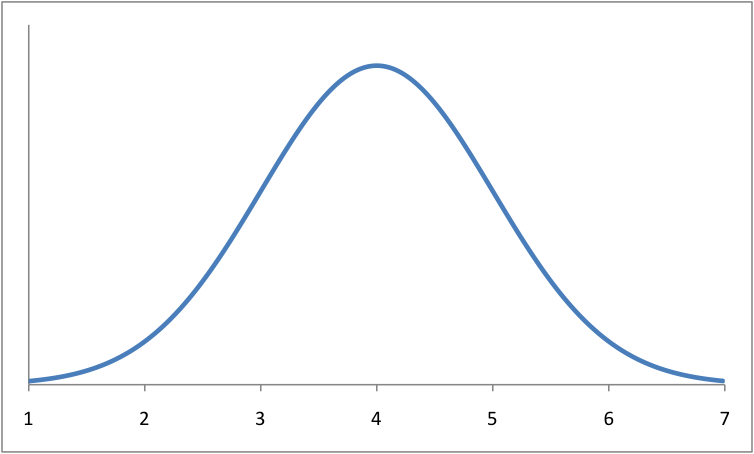
Let us also imagine for a moment that there is something like a “precipice of belief” – a point of confidence beyond which people allow themselves to start asking difficult questions. Arguably, the location of that precipice is entirely dependent on the individual, and there is just as likely to be one for atheism as there is for theism (i.e., it’s theoretically possible for an atheist to begin questioning whether or not there really is a god/gods – in practical terms this is far more rare). But again, looking from the perspective of the general population, there will be an “average” point at which people will start questioning their faith:

It is crucially important at this point to reiterate that I am talking about a population of people rather than any one individual. It is the failure to understand this distinction that is the central flaw of the “Diplomat” position. When an author writes a blog post, or a book, or gives a speech that articulates something from a position of, say, “6”; she/he is speaking to this general audience rather than a particular individual. The goal of the argument is to effect a general shifting of the curve of belief, moving the general population further toward the threshold:

When we consider the new graph, it is immediately clear that while not everyone has crossed the “precipice”, there has been a general shift toward the rightmost edge. But who is it that moved over? It was people who were already teetering on the edge of that precipice, rather than people at the leftmost edge – the “True Believers”, so to speak. True Believers are still believers, but have been subtly moved along in their level of questioning (if it is a particularly effective argument). Even though not a single strong believer has been converted into an atheist, we have accomplished a population-level shift toward atheism, made up of those who were already somewhat predisposed to question.
Doesn’t aggression turn some people off?
The common response to this line of reasoning is to point out that some people will refuse to engage if their feelings are hurt. The general point is that those who are 2s and 3s might move further left, or simply shut their ears, thus blunting the effectiveness of the argument (and further arguments to boot). There are a variety of reasons why I don’t find this line of reasoning compelling, but I am butting up against the word limit of this post, so I will save my response for another post. In general, there are 4 major objections: 1) someone who believes in something because the opponents are mean isn’t rational; 2) there would have to be a lot of people turned off for this to be ‘counterproductive’; 3) minds change over a period of time, not at a single instant; and 4) believers are not the only people in the audience.
To summarize, when we think of belief, we have to recognize that we are dealing with a population that has a continuum of strength of conviction. Not everyone is at the point where they are ready to question their beliefs, but when we address an audience we can expect that some people can be moved towards disbelief, even if we don’t reach everyone.
Like this article? Follow me on Twitter!

 Crommunist