Crommunist
  • Blog
  • Music
    • Video
    • Audio
  • Media
    • Audio
    • Video
  • Events
  • Twitter
  • Ian Cromwell Music
  • Soundcloud

Category: crommunism

8 Health care ‘rationing’: Canada vs. the USA

  • June 6, 2011
  • by Crommunist
  • · blog · Canada · crommunism · health · politics

Once again, and I hope you will forgive the digression, I’d like to talk a bit about something that has absolutely nothing at all to do with the usual topics of this blog. This topic is one that is more in line with my professional interests rather than my personal ones (if those two can be really thought of as distinct – I chose this career for a reason). As I may have intimated previously, I am a passionate believer in public provision of health care services.

While private-sector advocates often point to the increased competition and innovation possible in a for-profit delivery model, they neglect two important factors in their argument. First, health care is consumed almost entirely at a point of crisis. People walking into a hospital are not really in a position to “shop around” – they have an acute need and are therefore far less capable of making a dispassionate consumer choice. Second, the only way a for-profit health care delivery system could work is if it is either stringently regulated (a position that is wildly unpopular) or if we just stopped caring if sick people get gouged by unscrupulous corporate interests. Private delivery has the interest of maximizing profit, and while increasing efficiency is one avenue of doing that, companies have figured out that extra billing and price fixing are much more lucrative ways of turning a profit.

The debate over health care reform in the United States has introduced a new word into the public lexicon: rationing. Basically, rationing refers to the belief that under a publicly-administrated health care system, only a certain level of care would be available, and if you want more than that, it’s tough shit. It is from this idea (and an intentional misrepresentation of ‘end-of-life counselling’) that the now-infamous “death panels” became a talking point. People became outraged at the idea that the government would step in and say “grandma can’t have that hip replacement, because it’s too expensive”.

First, here’s what’s true about that argument: a publicly-provided health care system will introduce rationing. There will be medications, technologies and procedures that people will not have access to because of lines drawn by government about what is acceptable care and what is excessive.

However, there is already rationing in the American system, and it happens all the time. Any health care system will require rationing – the demand for health care services will always exceed the amount of available resources. Our concepts of disease and health are plastic, and shift as new innovations are made and the understanding of the human body increases. In order to understand health care we must first understand that there is no method of delivery that is free of material constraints – the question then becomes “how can we provide the greatest level of health care with what we’ve got?”

Canada’s approach, and indeed that approach of most industrialized nations that have publicly-funded health care delivery, has been twofold. First, a list of services is drawn up. The Canada Health Act allows for all “medically necessary” services – a definition that is intentionally vague. This imprecise wording means that the number of services that are provided can expand and contract based on need and resource availability. If you have a specific medical need that is not listed – for example, you have a rare disease or want a type of drug that is not covered – then you will have to pay out-of-pocket for it. Obviously, this is non-ideal, but by delineating it this way and drawing up the list in such a way that covers the majority of health care needs, the Canadian system can provide some form of care to everyone, even if it is not the absolute best.

Second, the Canadian system rations in terms of accessibility – the notorious waiting lists. Given a finite level of capital resources (and I am putting human resources on this list as well), demand may fluctuate in such a way as to exceed the availability of the system to deliver services immediately to all people. For example – if you have the ability to do 10 bone scans a day and 11 people walk in the door, 1 person is going to have to wait until tomorrow (when, hopefully, only 9 people will come in). These waiting lists can be managed with varying levels of efficacy, and we’ve gained some ground in recent years. The fact remains, however, that people cannot necessarily get immediate care for all health conditions (although acute and emergency needs are always prioritized and get attention reasonably fast).

Rationing in the United States is far less publicized, and far more dangerous. Given the same situation (finite resources, high demand), the USA’s system handles rationing by artificially reducing demand by curtailing access. Whereas there may be the same proportion of people requiring care, the United States simply does not provide care to certain people. By knocking people off the rolls (prohibitively high cost of insurance, de-insuring people for a variety of reasons, making coverage contingent on employment), the system ensures that everyone who can get care gets it quickly and to the extent they want/can pay for.

The reason why I call this type of non-explicit rationing more dangerous than the Canadian solution is because the consequences are far more dire for individuals and the economy. For individuals, because losing health coverage (or never having it in the first place) means that people are unable to get care for anything but emergency conditions. For the economy, because those emergency conditions are far more expensive to treat than they are to prevent, and because medical bankruptcy has a ripple effect through the economy at large. This is to say nothing of the reality that public provision is far cheaper than for-profit schemes (despite what free-market advocates would have us believe).

Conclusion

While “rationing” sounds like a scary word, people need to realize it is the inevitable result of a level of demand that is always greater than available supply. Rationing is no more rare in a for-profit system than it is in a publicly-funded one; the only difference is the method of rationing we choose to use. The Canadian solution is to provide services up to a certain level with some barriers to access (waiting times). The American solution is to curtail the number of people who are able to access any level of care. These solutions have different effects, and for reasons of both utilitarian ethics and personal/economic outcomes, the Canadian approach is superior.

6 Coded racism

  • May 30, 2011
  • by Crommunist
  • · blog · critical thinking · crommunism · racism

Nobody likes to be called a racist. Well, almost nobody, but nobody who wishes to be taken seriously by the general public. We have developed a knee-jerk reaction to racism that has made even the mention of race-sensitive issues abhorrent. This reaction is far from irrational – people have seen how destructive the ideologies of racism are, and how deeply-wounded marginalized communities have become as a result of societal racism. Most people have friends, romantic partners, perhaps even relatives, that are from a different racial group; everyone recognizes that discriminating based on race is a bad thing.

The problem arises when this aversion to racism causes us to become willfully blind to racist practices around us. When confronted with them, we are more likely to explain them away rather than simply admit that we might not be perfect “non-racists”. I’m a particular fan of the way that Stewart Lee characterized it: “…if political correctness has achieved one thing, it’s to make the Conservative party cloak its inherent racism behind more creative language.” Of course we can substitute “Conservative party” with “general public” in most cases. We live in a racist society, and nobody is immune from the subtle voice of cultural indoctrination whispering in our ears.

Given this lack of immunity, the only tools we have to combat the effects of racism are self-awareness and intellectual courage (and surprise…). However, it seems that we prefer instead to use a lexicon that allows us to continue our racist behaviour without seeming racist. This is referred to generally as ‘coded racism’, which I will define as statements of racist ideologies that are carefully designed not to appear racist. I will, for the sake of illustration, give a few examples.

Arizona’s anti-immigration law

Those of you who have been paying attention to the news probably know about Arizona’s new anti-immigration bill, supposedly designed to reduce the amount of illegal immigration to the state. Leaving aside the fact that illegal immigration has absolutely nothing to do with Arizona’s financial woes, the bill reeks of coded racism. The most debated aspect of the bill is the provisions that require police officers to detain anyone that “looks illegal”. No standard has been provided for determining what an illegal immigrant looks like, or how to distinguish someone that “looks illegal” from someone that looks like a legal immigrant. The process is simply left up to a sort of “c’mon… you know what we’re talking about” process.

Defenders of the bill (and there are many) repeatedly affirm that racism and racial profiling are not the purpose of the legislation, stating instead that it is about fighting illegal immigration; and if all the illegals just happen to be brown-skinned people, that’s just an accident of statistics. We are asked to simply ignore the ‘wink-nudge’ aspects of the bill, along with the extreme anti-Hispanic attitudes that accompany it, and pretend that we don’t see how clearly it targets one group of people. Illegal immigration may be a serious issue in Arizona, and if it were, a program that finds a way to minimize the damage would certainly be necessary. However, one that simply gives police discretion to start locking up people based on the way they look is quite clearly racist, even if we don’t want to use those words to describe it.

The “Ground Zero Mosque”

Many of you will likely remember a year ago when a group intended to build an Islamic community centre in Manhattan, a few blocks away from the former site of the World Trade Center. People immediately began frothing at the mouth, calling it the “Ground Zero Mosque” and claiming that it was a plot by terrorists to insult America. Again, leaving aside for a moment that there was already a mosque there, that they weren’t building a mosque, that the construction would have modeled religious tolerance (something that that particular group of terrorists hates), and that Muslims died in the Sept 11th attacks too, the language used was couched in a kind of “this is about terrorists, not Muslims” language that the frothiest of opponents quickly turned to whenever the racist aspects arose.

I will happily concede the point that ‘Muslim’ isn’t a race. That still doesn’t help the argument. The faces of the fight, of the “secret terrorists” was not that of members of the Nation of Islam (with its militant history) or recently-converted white people (converts are among the most zealous); it was Arabs. When a group of protesters mistakenly confronted a construction worker and began screaming at him, it was based on the fact that he was dark-skinned (black, in fact, but he looked Muslim :P). The particularly galling aspect of this particular issue is that these same opponents would like us to give credence to the ‘wink-nudge’ of putting up an Islamic centre at Ground Zero – “c’mon, you know it’s a thinly-veiled insult to those that died”, but then completely reject the “c’mon, you know it’s racist” criticism from the other side.

Birthers

Remember that time that a majority of Americans elected someone with a long history of community service and patriotic dedication, and how his racial identity was the sign of a new, more mature America? Yeah, me either. What I remember is how every excuse was leveled at a black president (“He’s a secret Muslim!”, “He’s a Black Panther!”, “He’s a Kenyan communist sympathizer”) including the accusation that he was foreign-born. This of course despite the fact that he had released his birth certificate during the campaign, that being born in another country doesn’t necessarily preclude you from holding the office of President, and that the guy on the other side of the election actually was born in another country. No, it was pretty clear that the narrative was about Barack Obama being an “other”, and therefore being a bad choice for president.

The Birthers would have us believe that their chief concern is adherence to the Constitution, and certainly not anything that is motivated by racism. I will certainly accede that a lot of their motivation has to do with hating Democrats and liberals rather than simply blind racial hatred. However, their actions and staunch refusal to accept the evidence (even when presented over and over again), coupled with their close ties to the Tea Party, who is making these accusations (how many black, hispanic, or Asian birthers do you think there are?), and the nature of the rhetoric buzzing around Obama that wasn’t there for Clinton, one can’t help but see that race enmity is very much a part of the Birther ideology.

You’ll undoubtedly have noticed that all three of the examples I’ve provided are American. This isn’t in any way to suggest that we here in Canada don’t do the exact same thing, particularly when it comes to talking about First Nations people and their ‘government handouts’. That being said, Canadians are much more stealthy in our use of coded racism, being far more shy about it than our neighbours to the south. These are three dramatic and notorious examples of this process at work.

As I said earlier in this post, it is only by having the courage and integrity to confront our own ideas and motivations that we can identify and eliminate this kind of verbal cloaking. Being able to identify racism and being unafraid to call it out is the first (and second, I guess) step to ameliorating the problem. Failure to do that will only serve to keep us looking the other way, to the detriment of racial minority groups in perpetuity.

TL/DR: As racism has become more unpopular (but no less rare), we have developed a new lexicon to express racist ideas without appearing overtly racist.

Like this article? Follow me on Twitter!

12 Pol Pot, Stalin, Mao… all irrelevant

  • May 23, 2011
  • by Crommunist
  • · blog · critical thinking · crommunism · religion

Anyone who has ever watched a debate between a theist and an atheist has seen this familiar scene: 1) the atheist points out that religion, despite its claims to inform human morality, has been (and continues to be) responsible for many atrocities and moral outrages; 2) the theist counters that the greatest mass murderers in the history of mankind (usually some combination of Hitler, Stalin, Pol Pot, and Mao) were atheists; 3) the theist wins the argument (note: step 3 may or may not be completely made up). Like the sun rising in the morning, the leaves changing colour in autumn, or the Rapture happening two days ago (remember how awesome that was?), this line of argument is so predictable as to be almost laughable.

There are so many flaws with this argument that it makes the head spin, so I am going to try and walk you, the reader, through them sequentially.

Hitler, Stalin, Pol Pot and Mao were atheists

This is debatable. Leaving aside Hitler for a moment (who was baptized Catholic and used Christian religious imagery extensively as the justification for his racist political ideology), there certainly have been leaders that have killed many of their own people, many of whom were openly atheist. However, none of the people that are commonly listed (and some that are less commonly mentioned like Idi Amin, Fidel Castro, and Kim Il-Sung) left religion out of the picture. Instead of worship of a supernatural deity that speaks directly into the ear of the leader, these men simply bypassed the middle man and pronounced themselves akin to the deity.

Without exception, if you look at how these men ruled their countries, they made themselves a figurehead and object of worship. Even today, there are pictures of Castro and Guevera plastered all over Cuba. Idi Amin was Uganda and erected a quasi-religious framework around him; ditto for Stalin (but even more so). Pol Pot and Mao, arguably the closest to being truly atheistic dictators, still installed themselves as nearly-supernatural beings whose word was divine law; in the case of Kim Il-Sung this is quite literally true. Strictly speaking, this doesn’t qualify as atheism. There is a world of difference between saying “there are no gods” and “I am a god”. It exploits the seemingly-innate propensity of human beings to subjugate themselves to something – far closer to the religious position (“I speak for the gods”) than the atheist position.

But, even if that were true…

Let’s pretend for a moment that we can accurately label the above listed dictators as being atheists (in the interest, perhaps, of avoiding being inaccurately accused of using the “No True Scotsman” fallacy). The argument is still invalid because the crimes these men committed were not done in the name of atheism. Whereas theistic murderers often use religious scripture and theological ‘reasoning’ to justify why suchandsuch group of people are deserving of the end of a sword, I know of no examples where someone has said the following:

Because there are no gods, we have the right to murder/oppress this group.

Such a statement would be on par with the justifications that come from religiously-justified crimes against humanity (“God hates fags”, “Unbelievers deserve hell”, “Jews killed Jesus”). And while there have been many atrocities that have happened for non-religious reasons, it is not reasonable or consistent to classify anything that is not pro-theistic as being atheist. The statement “there are no gods” could be twisted to support the murder of people if one was particularly psychopathic, but I don’t think it ever has.

But, even if that were true…

But let’s for a moment imagine that someone unearthed such an example, where the lack of god belief was used as a justification to commit a crime against humanity. Even then, this argument would have no value, since atheism is not a morality claim. The whole purpose of raising the atrocities committed with religious justification is to poke holes in the argument that religious faith is the source of morality, or that adherence to religious codes makes humanity more moral. If this were the case, it would be a rare exception that religious fervor could be twisted to serve a genocidal purpose – people’s faith would steer them away from the clear evil of mass murder.

The fact that even ‘atheistic’ mass murderers used the trappings of religious adherence and unwavering faith to rally people to their clearly immoral cause suggests that, if anything, religion makes people less moral. At least it seems to be useful in getting people to short-circuit their critical thinking faculties and engage in behaviour that, if they were to sit and think rationally about it (or, in hindsight) they would rightly recoil from. Even so, the cup of religion overfloweth with claims of superior morality – claims not supported by the available evidence. Atheism has no such morality claims; it is simply the lack of god-belief. It is entirely incidental (or, more likely, due to a third variable like propensity for independent introspection) that atheists are less likely to murder, rape, etc.

But even if that were true…

Even if we, for the sake of argument, granted all of the above (untrue) assumptions – that atheistic dictators committed their crimes from a position of atheistic moral authority – this argument would still be completely worthless. The issue of whether or not atheism is nice has absolutely no relationship to whether or not atheism is true. Even if we were to grant that atheists are just as shitty are theists, that doesn’t say anything about which of the two positions of correct – all it says is that people suck. Making the assertions that morality comes from the divine assumes the existence of the divine. Failure to demonstrate the existence of the divine (we’re still waiting, by the way) completely invalidates the theistic moral position. Saying that theists are super-nice doesn’t mean that the gods exist any more than saying atheists are shitty people does. Both positions are entirely orthogonal to the central claim of whether or not gods are real.

In summary

I’m honestly not sure why this argument is perceived to carry any weight in a serious debate. Surely respected theists are aware of Godwin’s Law, and while I hold out no expectations for people debating issues on Reddit or on someone’s Facebook wall, I would imagine that enough people have at least thought through their position long enough to realize that such an assertion has no bearing whatsoever on their position. And yet, keep your eyes and ears open for the next big debate between an atheist and a believer – I’ll be willing to bet cookies that the rotting, shuffling corpse of this thoroughly-useless argument will rise again and attempt to devour the brains of the audience.

Remember, aim for the head.

TL/DR: People are often pointing out that some of the greatest mass murderers in history are atheist. Even if they were, they didn’t kill in the name of atheism. Even if they did, atheists don’t make claims of superior morality because of atheism (whereas religion does). Even if they did, that is irrelevant to whether or not atheism is true.

8 Mixed up

  • May 16, 2011
  • by Crommunist
  • · blog · critical thinking · crommunism · race · skepticism

Those of you who have read this blog for a while, or who know me personally, know that I am what is technically known as “mixed race”. Generically, this means that my parents identify as two different ethnic groups. More specifically, my father is black and my mother is white, which according to the racist nomenclature of Jim Crow era America makes me a “mulatto” (a word meaning ‘mule’). At various points in my life, my ‘mixed’ status meant different things to me.

When I was very young, it used to irk me that people in my mostly white home town, who knew I had one white parent, didn’t see me as half-white. After all, technically speaking it was just as true that I was half-white as much as I was half-black. However, nobody else seemed to think along those lines. When I mentioned it to my dad, he imparted to me one of the first lessons I ever had to learn about race: it doesn’t matter what you are, it’s what other people think you are that matters. It affects the way they treat you, the way they think of you, and the way they see you.

I had the opposite experience living in Mississauga, where there were white kids, “really black” kids, and then me. As if I wasn’t enough of an outcast, being a recent transplant to Ontario, not knowing most of the kids I went to school with, and not really having been exposed to other black kids before, I was viewed with deepening suspicion and ultimately kept on the outside. As much as the kids I hung out with (mostly white, as that was who I was used to being around) accepted me, I knew I didn’t fit in. Most of them were Italian, Maltese, or of another Mediterranean extraction.

As a result of my mixed heritage, I never really connected with the black community where I grew up, only able to view it from the outside. Being in a special-ed program that didn’t exactly overflow with black kids didn’t help much either. To this day I wonder whether the system passively discriminated against the black kids – failing to identify them as “gifted” (in the language of the time – who knows what it’s called now?) because of pre-conceived notions of how black kids are supposed to be. I wonder if that’s the case, or if kids that were intelligent enough to qualify weren’t encouraged at home. As for me personally, I had tons of support. That’s neither here nor there, vis a vis this story, I just thought I would big up my home environment.

People of mixed race have been around for as long as there have been distinct racial groups, but as a sociological phenomenon, there has been a marked shift in how kids of my ilk are viewed. First, people no longer call us “half breeds” a term I hated when I was younger – my parents aren’t horses or dogs; they didn’t breed. Furthermore, the idea of someone being “pure” anything is mostly nonsense – everyone is a mutt no matter where they come from. We are called “part _____”, which is a much more flexible descriptor that allows for people who are a mixture of many different things. We’ve gotten over our obsession with fractions.

Secondly, people of mixed heritage are no longer seen as an exotic oddity (at least not to the extent that we were before). Perhaps with the rising prevalence of interethnic marriages, some of the shine is off the penny when it comes to the novelty of identifying with more than one group. Even the census and most other questionnaires that ask about ethnicity use a “check all that apply” rather than forcing people to choose one that applies best.

Last week a white supremacist showed up in the comments section. While I’ve dealt with that type before, there’s always a part of me that gets apprehensive because it raises an old spectre that I don’t like thinking about. That is, if genetics (along racial lines) do influence things like intellect and “personal responsibility”, what does that mean for me? They don’t, of course, but what if they did? Is my interest in science and academic topics the result of my “white” half? Is my love of music and dancing the result of my “black” half? Do traits break down like that? Am I a lucky composite of two complementary characteristics?

I am always able to beat those kinds of introspections back with a little bit of skepticism. Are there not many prominent intelligent black scientists out there? White musicians? Haven’t we learned through history and experience that the reasons that one group does something better than another is simply a product of culture rather than genetics? The stereotypes we paint each other with are just the result of sloppy thinking. Still, it’s always a struggle to have to deal with those fears every day.

Through this blog, I am trying to encourage readers to engage in skeptic thinking when it comes to race. Above and beyond my love of skewering religious topics, if there’s one thing I’d like you to do it’s learn to recognize and challenge the nearly-inaudible voice of cultural indoctrination when it comes to race. We all have embedded assumptions about groups not like our own (or even of those within our own group), and learning how to catch ourselves when we start unconsciously following those assumptions is a useful tool for dealing with each other fairly.

I learned this trick by reflex, living my entire life trying to figure out how I fit in. I don’t have the option to turn it off, nor would I want to if I could. We can find a way to make our unique set of interactions work well if we are just a combination of open-minded, careful and honest. If we can all be “mixed” in this way, we can learn important things about each other, and about ourselves.

Like this article? Follow me on Twitter!

1 Mining a silver lining

  • May 9, 2011
  • by Crommunist
  • · blog · Canada · critical thinking · crommunism · good news · news · politics

First off, I want to apologize for shirking my duties this past week. I squandered my weekend, when I should have been writing the posts for last week, doing other stuff. When Monday came around, I had decided to write a post-mortem on the election after the results were in. However, by the time I got home from working at the polls I was so tired and disgusted with the outcome that I couldn’t really marshal my thoughts enough to write anything that I could feel good about. This is the reason why I usually set up a buffer of posts, so as to avoid this exact type of thing.

Secondly, I find it troubling that the week that I decide not to post, my hit count explodes 😛

Finally, this post is going to be a sort of amalgamation of some thoughts that have been kicking around my head for the past week since the election. I’ve titled this post ‘mining a silver lining’, because while it pretty much goes without saying that I am disappointed and fearful about what it means that the Republican North party has a legislative fiat (both in the Parliament and ostensibly in the Senate), I think there are some real good news stories to come out of the election. The political content of the archives of this blog should be sufficient to explain why a Republican North majority is a bad thing for Canada; I will instead focus on some good news speculation.

ALL THE PROGNOSTICATION MEANS ABSOLUTELY DICK

There will be a lot of political commentators (myself among them) who will make predictions about what will or won’t happen under a Republican North majority. The sheer variety of opinions and predictions ensures, mathematically, that most of them will be wrong. Political decisions are influenced by ideology and promises, but occur on a day-to-day basis and are affected by human events. Nobody can predict exactly what human beings will do, as this world is a chaotic place. Nobody would have expected U.S. foreign policy to make a dramatic series of shifts based on events in the Middle East and Northern Africa. Fewer still would have predicted that Japan’s economy would take a tumble after an earthquake and resultant nuclear accident.

My point here is that no matter who makes the predictions, policy will adapt to the the immediate circumstances around it. Changes in technology, in climate, in foreign politics, in any number of things will have a strong influence on how Stephen Harper’s policy decisions will be made. Trying to predict specific actions over a four-year period is a complete waste of time, and can be enjoyed only as an intellectual masturbatory exercise.

Now I will commence to fapping.

STEPHEN HARPER IS THE LEADER OF A DIVIDED PARTY

The Republic North party is made up of two core constituencies: social conservatives and fiscal conservatives. The perhaps unspoken (or certainly under-spoken) reality that accompanies such a grouping is that while they may claim to be related ideologies, the two are in fact orthogonal. There is nothing in the doctrine of social conservatism that lends itself to fiscal conservatism – in fact the two are often at cross purposes. Libertarians and Classical Liberals believe that the government has no business whatsoever legislating either social issues or economic issues – only in safeguarding individual liberties. The reason the Republican North party was able to pick up so much support is because they catered to the economic centre/right, which is also a part of the Liberal party’s core constituency.

The only way (as far as I can see) that the RNP was able to stitch these two groups together was to simultaneously forge a false equivalence between these two perpendicular political perspectives, and to publicly proclaim disinterest in social policy while quietly whispering assurances to their social base that those issues would come to the fore once a majority was achieved. Now that this is a political reality, Prime Minister Harper will have to ‘pay the piper’, so to speak, by advocating positions that are wildly unpopular among the Canadian majority. If he fails to do this, social conservatives who have long felt ignored by the federal government will abandon the RPN and revive the Reform party. Should he capitulate to their whims, he will alienate the Libertarian/Classical Liberal wing of his party.

This must be a deft balancing act that will take an extraordinary statesman and leader to accomplish. Stephen Harper is neither of these.

JACK LAYTON MAY EXERCISE A GREAT DEAL OF CONTROL

Part of the success of the RPN during their successive minority governments was Stephen Harper’s ability to keep the reins of his party tightly held. Information did occasionally leak, but for the most part the government spoke from one perspective only. Considering the number of wingnuts in the party, keeping that communication clamped down was an extraordinary achievement that served the party’s interests well. Jack Layton may be able to exercise the same kind of party discipline, albeit in a dramatically different way.

Nobody really predicted that the NDP would make the strides they did in this past election (owing largely to Quebec, but also partially due to the implosion of the Liberal party). Jack Layton now finds himself the leader of a party with 102 seats, many held by rookie politicians. The NDP brand has been, since the early 2000s, consistently centred on Jack Layton himself, rather than a particular policy position. The rookie MPs will be looking to Mr. Layton for guidance and instruction, more so than would a team of seasoned veterans. While Jack will have to pull in some of his own wingnuts and handle more than the ordinary number of blunders born of inexperience, he will also have a party that gets virtually all of its cues from him. In this way, the NDP can appear more organized and credible than they legitimately are. This means that progressive decisions and policies can be articulated without seeming like they’re coming from the hippie fringe.

ELIZABETH MAY WAS ELECTED

I am not a Green voter. I did vote Green in 2006, because my riding was a safe bet and I supported electoral reform. I think the Green party can articulate a non-corporate perspective that is sorely and noticeably absent from the other three major parties. Elizabeth May is a gifted speaker and is able to articulate environmental policy issues well. She’s also shown herself to be indomitable and highly resistant to intimidation in the face of overwhelming opposition. While I don’t necessarily agree with her party’s platform on many issues (medicine and health care being chief among those), I am glad to see a more pluralistic Parliament.

Her election also serves the purpose of giving the Green party legitimate political status. Voting Green is now a legitimate alternative, and while the party is still in its infancy in terms of credibility, having elected an MP (over a RPN cabinet minister, no less) certainly vaults it into the standings. After all, they only have 3 fewer seats than the Bloc, who used to be the official opposition 😛

POLARIZATION IS BAD, BUT NOT ALL BAD

One doesn’t have to look much further than the United States (a name that is becoming progressively more ironic) to see how dangerous political polarization can be. Polarization forces people to make choices to support positions they don’t agree with in the name of party affiliation. Having a plurality of perspectives means that government will be more stable, rather than erratically jerking back and forth from right to left. Canada has elected a far-right government with a far-left opposition (although I don’t think either of those descriptions are really fair in the general scheme of things), meaning that for the first time in a long time we see a stark separation between the usually moderate people of this country.

However, there is one upside to polarization that has to do with a necessary consequence of good government. When the government is largely running things behind the scenes and caters to the will of the majority, people become complacent. Why bother getting up in arms about a government whose actions are largely invisible and that I agree with for the most part? Having the debate happen more to the extremes, with policies to match, means that government activity will become increasingly salient to the average Canadian. People will see that their actions (or inactions, as the case may be) can allow dangerous legislation that is contrary to their personal interests to be passed largely without comment. Perhaps having a RPN majority government is what Canada needs as a kick in the pants to spur increased political involvement by its populace.

SUMMARIZING THOUGHTS

As I’ve made clear, I’m not happy about this election. My best-case scenario would have seen a diminishing Harper minority with a strong NDP opposition – allowing the further fragmentation of the right and bringing progressive issues to the fore. What I got instead was a bizarro world in which a 2% increase in political support for the RPN means 30 more seats and the Bloc has all but evaporated. It is an interesting time for Canadian politics, and while there will undoubtedly be some serious damage done in the interim (I’m thinking specifically of crime, climate change and the strength/direction of the Canada Health Act), there may yet be some positive stories to come out of this.

I am back to my regular self, and am recommitting myself to articulating my position. I promise – no more weeks of rage (well… hopefully).

Like this article? Follow me on Twitter!

0 “Natural Law” – When to ignore someone (pt. 4)

  • May 2, 2011
  • by Crommunist
  • · blog · Catholic church · critical thinking · crommunism · religion

Arguments are powerful things in the world of rhetoric. When considering any given topic, familiarity with the cognitive and evidentiary frameworks that pertain to that topic can be of great use both in understanding and defending a position. Some arguments (albeit few) are powerful enough to justify a position all by themselves; most positions require a variety of arguments to be fully persuasive. Conversely, there are some arguments that are so weak that it is reasonable to completely ignore anyone who would try and press them into service.

I have so far dealt with four such arguments: “common sense”, “I’ve done my own research”, any sentence that starts with “I believe that…” and back-filling explanations to satisfy an a priori conclusion. “Common sense” is a poorly-named concept, because it presumes that people perceive and process information in a uniform way. Doing your own research rarely meets the standard of “research” required to be authoritative or replicable. A person’s individual belief in a thing does not grant it legitimacy, regardless of the sincerity of that belief. Finally, reliable information cannot be gained by assuming the truth of the conclusion, then looking for confirmatory evidence.

These are all specious and worthless arguments, and carry with them no persuasive force when the audience is able to think about them critically. To this list, I would like to add any argument that is contingent on the concept of “natural law”. There are a surprising number of thinkers and theorists that use this concept, and a separate definition for each. The particular understanding of the concept that I find to be most vacuous is perhaps best articulated by the Catholic Church:

The natural law expresses the original moral sense which enables man to discern by reason the good and the evil, the truth and the lie: The natural law is written and engraved in the soul of each and every man, because it is human reason ordaining him to do good and forbidding him to sin… But this command of human reason would not have the force of law if it were not the voice and interpreter of a higher reason to which our spirit and our freedom must be submitted.5

The general thrust of this definition is that humans have an innate sense of right and wrong, and that this sense is both reliable and derived through human reason. The weaknesses of the Catholic position (the conjuring of the existence of their specific god and a human soul) aside, the very concept is still meritless, or at least not borne out by evidence. Given the diversity of ways in which people react to similar moral quandaries is evidence that there is not a uniform moral sense. The existence of quandaries – situations in which a reasonable case can be made for or against a given action – is evidence enough that there is nothing “written and engraved in the soul” of anybody.

There are a variety of reasonable ways of arriving at a moral decision – the entire field of ethics attests to this fact. A variety of ethical constructs and theoretical scaffolds have been invented to codify a method of consistently arriving at conclusions that maximize the good and to minimize the negative. However, when a given action may cause both good and evil (e.g., giving a life-saving blood transfusion to a Jehova’s Witness against her/his will), our supposed innate moral sense fails us. One person may choose to ignore her innate moral sense to preserve life in favour of obeying the patient’s wishes, while another may reject the patient’s irrational belief in favour of giving him life-saving treatment. Both of these choices are justifiable (although, for the record, medical ethics fall firmly on the side of patient autonomy). Neither can be said to either violate human reason or some kind of ‘natural law’.

While this argument would be merely annoying if invoked in abstract, it is sometimes assumed to be valid, and then used to justify all manner of harm:

…tradition has always declared that “homosexual acts are intrinsically disordered.” They are contrary to the natural law. They close the sexual act to the gift of life. They do not proceed from a genuine affective and sexual complementarity. Under no circumstances can they be approved.

Divorce is a grave offense against the natural law. It claims to break the contract, to which the spouses freely consented, to live with each other till death. Divorce does injury to the covenant of salvation, of which sacramental marriage is the sign. Contracting a new union, even if it is recognized by civil law, adds to the gravity of the rupture: the remarried spouse is then in a situation of public and permanent adultery:

Basing regulations on the non-existent natural law is dangerous and detrimental to those caught outside the realm of what the authority deems acceptable. Two women that are in love, or a man that wants to leave his abusive wife, are shit out of luck because those things are ‘against natural law’, as though loving who you choose and self-preservation are some kind of irrational goal.

What we see in both the conception and application of ‘natural law’ is simply a collision of ‘common sense’ and back-filling. “I don’t like these things for whatever reason, and so I will look for a justification for my dislike that makes them seem rational.” As an argument, it is the equivalent of throwing up your hands and saying “because I said so, that’s why!” It takes courage and honesty to recognize that things you don’t like may be honestly justifiable to some, based on valid precepts (and no, I don’t count cultural norms or appeals to tradition among the list of valid precepts). Homosexuality seems weird to me, and I may not like it (for the record, I don’t really have strong feelings one way or the other, although I am immensely proud of our society whenever I see a gay couple together openly). I don’t agree with polygamy. I think that religious rules about diet or medical treatment are stupid. My personal discomfiture with a practice is, however, not evidence that said practice is ‘against natural law’. It just means I don’t like it.

Like this article? Follow me on Twitter!

1 One thousand words on objectivism

  • April 25, 2011
  • by Crommunist
  • · blog · critical thinking · crommunism · privilege

Which is, perhaps, one thousand more than it deserves

When I was in high school, a friend loaned me a copy of Ayn Rand’s novel The Fountainhead – a lengthy tome about a superstar architect who defies the forces stacked against him to create the buildings that he wants, not the ones that the mediocratic hordes are creating. I remember being enchanted by the idea that someone could stand up for her/himself and refuse to capitulate to the opinions of popular demand. A major part of my personality has been informed (or perhaps reinforced) by the ideas I read in the book – the part of me that speaks my mind unashamedly and tries to be unfailingly honest in expressing my opinions.

Later, I read the Sword of Truth series by Terry Goodkind. While I enjoyed the series (except the last 2 books, which were steamy piles of word salad), the sixth book – Faith of the Fallen – really spoke to me. Its protagonist fights the good fight against a self-destructive ideology that punishes those that work hard and rewards malingerers and the lazy, by inspiring the people to reject the idea that mankind is inherently flawed and unworthy of dignity. This book, too, resonated with my sense that human beings should work hard to achieve, and that hard work and innovation should be rewarded. I was later to learn that the author was a Rand devotee, penning his own view on objectivism.

As I was completing my graduate studies, I read (well, as an audio-book) Atlas Shrugged, another novel by Ayn Rand. It sucked. It was awful. The writing was as stilted and awkward as the plot was circuitous and interminable. The plot twists were predictable, the ending plodding and unsatisfying, and there was a billion-page monologue from one character that could have been shortened to maybe 5 pages. I got none of the thrill that I had enjoyed from the other two objectivist works I’d read.

Reading Atlas Shrugged (a title which, incidentally, doesn’t make any sense since Atlas held up the sky and not the Earth), I lost any allegiance I had to self-identifying as an objectivist. The entire philosophy seemed to be based on a view of the world that is fundamentally flawed – creating false dichotomies and presenting people as caricatures rather than believable characters. Those who advocate for others are grasping, greedy leeches that feed off the righteous generation of resources that is the result of the hard work of an elect few. Those who produce are virtuous, upright, honest and fair-dealing – the only iniquity is seen by those that would attempt to sponge off the upright by exploiting a sense of “altruism” (which, to Rand, is just the application of guilt). Completely unexamined is the idea of someone producing goods by exploiting and abusing those with less wealth, or the idea of someone being given a leg up and turning that opportunity into a productive life. In Randian terms there are only the good guys (producers) and the bad guys (leeches) – and I suppose the hodge-podge of people who do manual labour and are employed by the good and bad guys alike.

Of course this kind of black-and-white world view appeals a great deal to a large number of people – particularly those that are millionnaires already. I’ve talked about this before, but it can be incredibly difficult to see the number of helping hands you’ve had along the way to success, and it’s very tempting to conclude that your achievements were gained simply by the sweat of your own brow. That’s so rarely the case as to be laughable – everyone has help at various stages, just as everyone has difficulties. Some people are born with innate abilities that make them more likely to be successful, others are born into familial privilege and are able to capitalize on opportunities to which others would not have access. There are many others that are born with one of these things but not the other. As we can infer from the type of nepotism, cronyism and pandering we see in our electorate and in industry, it’s much better to have the second than the first.

So what becomes of those who have no connections or privilege? In an ideal world, those that are born with inherent gifts are able to apply those abilities and achieve some level of success – success that can be passed on to their descendents. Ostensibly, that’s how those that are rich today gained their wealth. Those that cannot achieve greatness can at least work hard and have a decent standard of living, commensurate to their human dignity. That is a true meritocracy – where your level of success is dependent only on your natural abilities and the amount of work you put in.

However, we don’t live in a meritocracy. We live in the world – a world in which political favours are given to corporate entities based on lobbying and favouritism rather than who does the best job, and those at the top achieve greater wealth by defrauding those lower on the rung than they would by producing a superior product or service. Objectivism does not apply to a world like this – it speaks only to a world in which the only barrier between a person and her success is the amount of work she puts into her life. When people do not behave like rational free-market agents, objectivism can make no meaningful predictions about the world.

So is objectivism a complete waste of time? Are there no lessons that can be gleaned from Rand’s works? I don’t think that’s the case. Like the axioms of religion or admonishments of metaphysical philosophy, there can be great subjective value to be gained from reading Rand allegorically. Forgetting for a moment her insistence that her books are meant to portray real life events and people, we can certainly empathize with a person against whom the odds are stacked standing up and refusing to compromise her/his vision, provided we also recognize that when our vision impacts the lives of others, they also have a stake. We can recoil from anyone that insists that we have a moral obligation to give up what we have to those that don’t, provided we simultaneously remember that it is in our best interests as members of a society that people have the opportunities to do for self, and that our participation in that effort may be required. We can recognize that “profit” and “wealth” are not dirty words – rather measures of the success of an idea – provided that we scrutinize the practices of the wealthy to ensure that those without wealth are not being exploited or defrauded.

We can make the world closer to meritocratic, provided that we don’t try and take objectivism literally.

Like this article? Follow me on Twitter!

0 There’s no justice, there’s just us

  • April 11, 2011
  • by Crommunist
  • · blog · critical thinking · crommunism · liberalism · psychology

There is a concept in psychology called the “just world hypothesis”, also known as the “just world fallacy”. In its essence, this concept refers to our tendency to infer that the world operates as it should – goodness is rewarded and iniquity is punished. Where the fallacious component of this phenomenon crops up is when we allow this thought process to operate in reverse – those who are punished or rewarded must have deserved it, because the world just works that way.

This is a particularly attractive heuristic for a number of reasons. First, it is reassuring to think that we live in a universe where things exist in a state of balance – chaos is unsettling and potentially dangerous. Second, and perhaps most compellingly, it gives us a sense of satisfaction to think that the hard work we put in will be rewarded. It gives us even more satisfaction to think that those who do wrong will get their come-uppance in the end, a phenomenon called schadenfreude.

There is no place in which the just world fallacy is more obvious than in theology. Regardless of which deity we are talking about, there is always a balance between the forces of good and the forces of evil, with the good guys eventually winning out in the end. Christianity falls down this path most egregiously, with an accounting of a final battle and judgment that is the stuff of great myth; however, all the great religious traditions put great faith in the idea of ultimate balance. The very concept of an afterlife is an implicit reward for a good life or punishment for a life used for ill.

This fallacy pops up outside the realm of religion, however. It is this fallacy that allows us to look at the horrendous disparity between the living conditions of First Nations people, of women, of people living in starvation in southeast Asia and Africa, and rationalize it. Take a look at the comments section of any news report from that region (particularly about what is currently happening in the Ivory Coast), and you’ll undoubtedly come across someone with a brilliant statement like “well all of those African leaders are corrupt – what do they expect?”

It’s nice to be able to explain away injustice with such a simple wave of the hand. Doing so removes any sense of responsibility you might feel for the way corporations from which we purchase goods exploit and devastate those countries, destabilizing them to a point where corruption becomes de rigeur. It removes any feelings of guilt for the fact that our cities are built on First Nations land, much of which was obtained through dishonest treaty processes. It prevents us from having to feel remorse for propping up a misogynistic system that rewards men for fictitious “superiorities” that we have been told to believe we have. We can then go about our lives without having to constantly examine our every thought and assumption, which is an exhausting process that can prevent anything from actually getting accomplished.

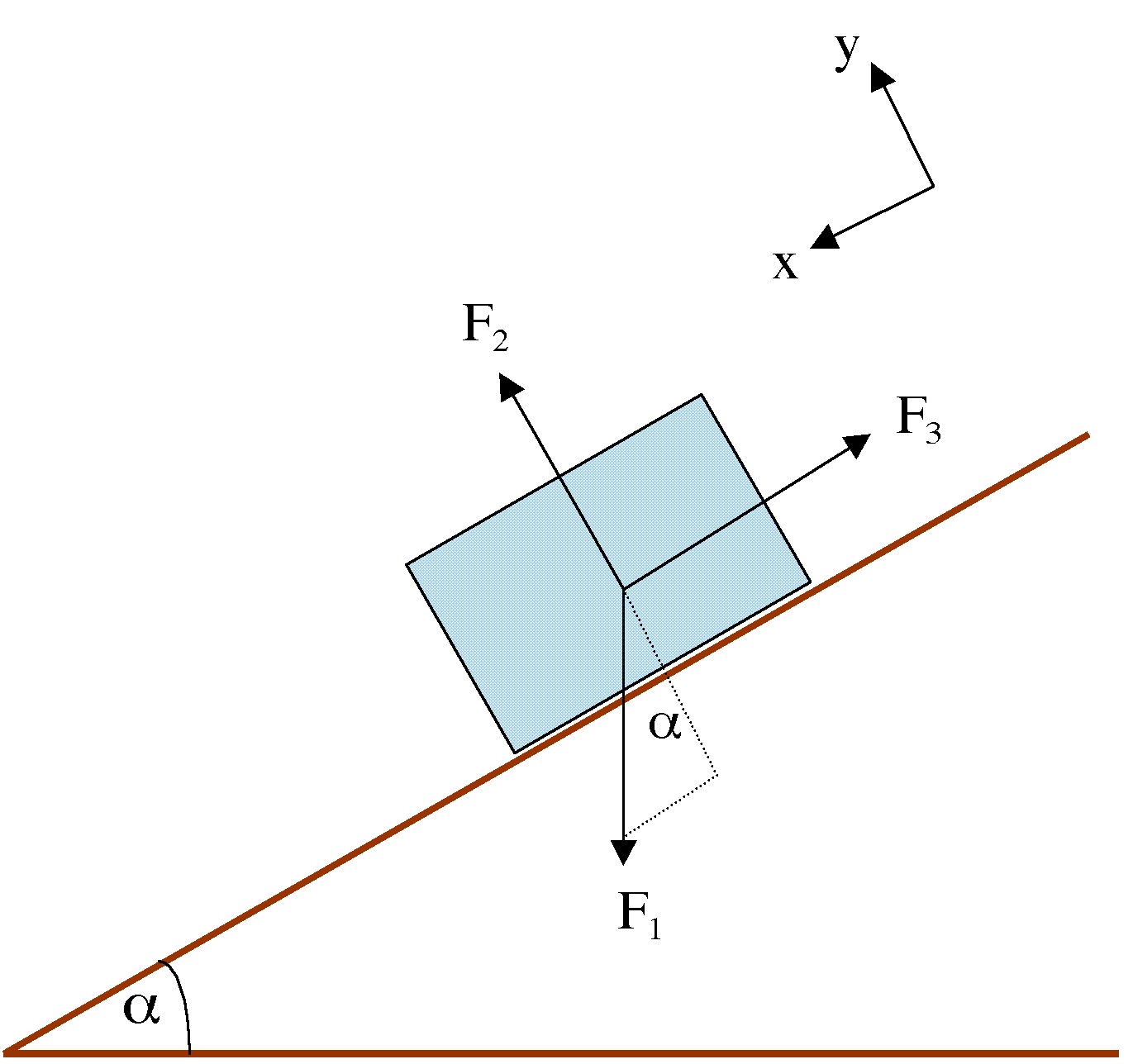
The problem with belief in the just world hypothesis is that it blinds us from seeing the world as it truly is. Consider this figure for a moment:

Anyone who has studied classical mechanics (called ‘physics’ in high school) will immediately recognize this as a free body diagram. The various forces at work on the rectangular object are presented. When we can identify the direction and magnitude of these forces, we can make meaningful predictions about the behaviour of the object. However, if we neglect one of the forces either in how strong it is or where it’s going, our predictions – indeed, our very understanding of the object – are fundamentally flawed (e.g., if we forget about friction, we would expect the block to slide down the ramp – friction may keep it exactly where it is).

Society and the people of which it is comprised can be thought of in much the same way. When we neglect to take into account the forces that are at work on us, our predictions and understanding of the world is meaningfully misconstrued. If we add in other forces that aren’t actually there, then we’re realy in trouble. The just world fallacy is just such an addition – it postulates the existence of an outside influence that inherently balances other forces that may result in unjust disparity. We are then relieved from any sense of responsibility to correct injustices.

The ultimate manifestation of this is the bromide “everything happens for a reason”. Starving kids in Ethiopia? Illegal wars? Abuse and deprivation? Exploitation of vulnerable peoples? Don’t worry, everything happens for a reason. Justice will win out in the end, without any need for action from you, safe behind your wall of fallacy.

It’s not exactly difficult to see why this view of the world is fundamentally dangerous. The world is not a fair place. In fact, “fairness” is an essentially human construction – sometimes animals are predated into extinction, sometimes entire ecosystems are destroyed by natural disasters, it’s entirely possible that entire planetary civilizations were wiped out by a supernova in some far-flung corner of the galaxy. These things are only “unfair” to human eyes – as far as the universe is concerned, them’s the breaks. I suppose there is some truth to the statement that “everything happens for a reason” – it’s just that this reason is that we live in a random, uncaring universe.

If we wish to live in a fair world – and I’d like to hope that we do – then it is incumbent upon us to make it that way. The only force for justice that exists is in the hands of human beings, and the only strength behind that force is the level of responsibility we feel to make it so. It is of no use to cluck our tongues and say “well that’s the way it goes” or “things will work out” – making statements like that is the same as saying “I don’t care about the suffering of those people”. If that’s the case (and oftentimes it is), we should at least be honest with ourselves and say it outright.

It is for this reason that I identify as a liberal – I am not content to let the universe sort things out. The universe doesn’t care, and there’s no reason to believe that the unfairness of random chance will result in justice for those that centuries of neglect have left behind. If we care about justice, then it’s up to us to make it happen.

Like this article? Follow me on Twitter!

TL/DR: The world is not a fair place, although we like to try and convince ourselves that it is. If we want to live in a fair world, then we have to make it that way.

9 The value of the ‘spiritual’

  • April 4, 2011
  • by Crommunist
  • · blog · critical thinking · crommunism

I have a few close friends who describe themselves as ‘spiritual’. In fact, for the intervening period between leaving religious dogma and rejecting god-concepts altogether, I described myself along similar lines. When I said it, and I suppose when my friends say it, it meant that while I did not adhere to a particular religious tradition but still recognized that there was a non-intellectual part of the human experience that made up a non-trivial portion of my life. While my particular ‘spirituality’ did not encompass things like ghosts or angels or other non-corporeal forms of life, it did recognize that there is more in the world than limited human understanding can fully encompass.

In elementary school and throughout my life as a churchie, I was told that in addition to physical, social, emotional and mental health it was important to maintain one’s “spiritual health”. Googling the term gives you a whole flood of holistic sites that make the same claim. The interesting and telling part of both the religious and secular concepts of the spirit is that neither one bothers to actually define it, except in the most vague terms:

Spirituality is having meaning & direction in life. It involves development of positive morals, ethics & values. Being healthy spiritually helps us to demonstrate love, hope & a sense of caring for yourself and others.

The above is the most specific definition I could find, and even it doesn’t really bother to define what the spirit is, merely asserting the effect that having ‘healthy spirituality’ has. Apparently, according to this particular site, morals and values are the domain of the spirit – so much for philosophy and psychology I guess.

The galling part of the ‘spirituality’ issue is that, almost without question, it is describing subjective states of the brain. At least the religious definition posits the existence of a soul, although it is clear from explorations in neuroscience that the ‘soul’ is just another trick of the mind. However, the idea of ‘spirituality’ is inherently flawed in this way – it confuses an illusion with reality, and then back-fills its assumptions to fit the conclusion. First, the ‘spirit’ is created out of thin air; next, characteristics and qualities are ascribed to this figment; finally, a complicated system of diagnostic and treatment techniques are prescribed to maintain the health of the spirit:

  • Create art work and/or writing centered on hope of peace, then have an art show
  • Create cards to send to individuals who are alone, sick or just having a difficult time
  • Draw or write about what you would like to do for a job or career when you get older
  • Participate in mentoring i.e. reading a story to a younger child, either at home or within the school day
  • Participate in random acts of kindness
  • Have a ceremony celebrating Canadian Citizenship (lolwut?)
  • Recognize others special gifts or individuality – e.g. Identify a strength of each person in your class/family
  • Identify/draw a picture of or write about two community resources that help children/youth

It’s not a minor issue – major health care providers offer ‘spiritual health services’, seminars teach courses about how to heal your spirit, books are written that advertise the secrets of ‘boosting your spiritual health’. Millions of dollars are being made every year by people who claim to hold the secret to fixing a part of you that doesn’t exist. What’s more, belief in this non-existent vestigial and ephemeral organ is seen as a virtue – watch as people nod sagely and knowingly as someone repeats the canard “I’m not religious; I’m spiritual.” Contrast that to the reaction to someone who says “I don’t ride horses; I only like unicorns“.

Once we unpack the embedded implication of ‘spirituality’ – that there is something called a ‘spirit’ or a ‘soul’ that exists separately from the body – we are left to explain the pseudo-phenomenon of spirituality. We certainly experience life as though we are a spirit encased in a body, as though there is a living energy (as Orson Scott Card would call it, an aiùa) that comprises our ‘self’, our unique essence. It’s impossible to discuss this phenomenon without leaning heavily on the psycho-babble that makes up the language of spirituality. Anyone who has meditated, been inspired by a beautiful sight or song, felt connected to the planet, or allowed her/his mind to wander cannot deny that there is at least the illusion of a ‘self’ that exists beyond the wet and fleshy bits that make up our body.

What is this a picture of?

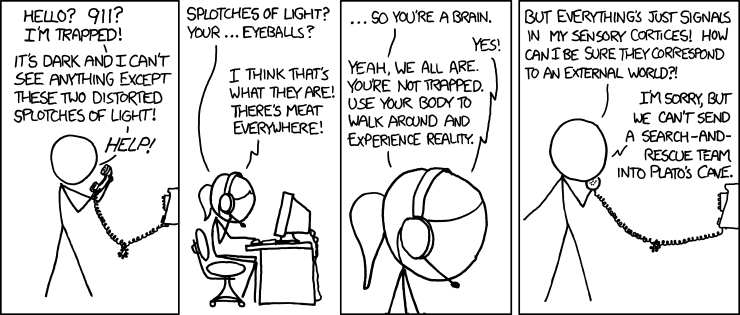
If you said ‘a pretty butterfly’, you’re wrong (if you said anything else, you might have a psychological problem). This is a picture of a bunch of coloured dots, arranged in a pattern that resembles a butterfly. The image of the butterfly is the product of your brain interpreting a number of individual stimuli and synthesizing them into one coherent expression. In the same way, your brain takes a variety of sensory information and builds a subjective experience that creates the illusion of a ‘spirit’ or soul:


All this is in no way meant to diminish the power of subjective experiences. I’ve been sublimely moved by works of music or literature (particularly the latter) that have changed the way I look at the world. I have, while looking at the night sky, felt a super-real connection to the universe. I have, on occasion, been knocked completely sideways by a stray thought that altered my perspective. I have, in years past, felt the Lord Jesus Christ in my heart, and had the Holy Spirit speak through me. These kinds of experiences are part of what defines our human experience. However, it is important to remember that while these things may have deep, powerful personal meaning, they do not correspond in any way to objective reality.

Tl/DR: There can be great value in those things we call ‘spiritual’, but the word itself props up a flawed view of the world.

Like this article? Follow me on Twitter!

0 Movie Friday: Trololololo

  • April 1, 2011
  • by Crommunist
  • · blog · crommunism · funny · movie · religion

It’s April Fool’s Day! This year I am celebrating by trolling the hell out of Canadian Atheist, another site I occasionally blog on.

I am putting this up because I fear that people may not understand that I am joking, and hoping that they click through here for more information.

Here are some other awesome religious troll pranks, in honour of this most foolish of days:

Punk’n the Fundie

Fresh Prince Troll

Miss Cleo Calls a Psychic

The April fool hath said in his heart that this shit ain’t funny.

Like this article? Follow me on Twitter!

Page 15 of 18
  • 1
  • …
  • 13
  • 14
  • 15
  • 16
  • 17
  • 18

  • SoundCloud
  • Twitter
  • Facebook
  • YouTube
  • Subscribe Subscribed
    • Crommunist
    • Join 82 other subscribers
    • Already have a WordPress.com account? Log in now.
    • Crommunist
    • Subscribe Subscribed
    • Sign up
    • Log in
    • Report this content
    • View site in Reader
    • Manage subscriptions
    • Collapse this bar
 

Loading Comments...