This morning I alluded to a fact about the “Occupy Vancouver” movement, indeed the Occupy movement as a whole, that has not yet pierced the popular narrative – the fact that we are choosing to ‘occupy’ land that is already occupied in a very real way. Vancouver, the city I love, is basically existing in a perpetual and overblown state of “squatter’s rights”, wherein the land is governed by people who have no legal claim to it. The irony, therefore, is that the act of standing up for the little guy is happening on land that is owned by the littlest guys in society, by the same people who have a hand in that group’s oppression.
I consider myself a First Nations ally, in the same way that I consider myself a LGBT ally or a women’s rights ally – I am aware that there are serious problems about which I have a superficial understanding. I come to this particular position by recognizing the vast and numerous similarities between Canada’s First Nations and the struggle for mainstream acceptance of black people. My support for the recognition of their rights is, in my mind, no different than my fight for equality for myself. My role as an ally is simple: to advocate when I can, and listen when I am being spoken to. In that vein, I would like to offer this signal boost to what I think is a phenomenal article about some of the ‘forgotten’ issues underlying Occupy Vancouver:
Yesterday there were a bunch of stories that, each on their own, would have made for excellent blog posts. However, in the interest of not deleting them because of insufficient time to address them in depth, I presented them all to you with a brief comment. The week has not gotten any longer, nor my schedule any freer, so I am going to do the same this afternoon, this time about race stuff:
Campus Republicans at the University of California Berkeley have cooked up a storm of controversy with their plans for a bake sale. But it’s not your everyday collegiate fundraiser they’ve got in mind. They’ve developed a sliding scale where the price of the cookie or brownie depends on your gender and the color of your skin. During the sale, scheduled for Tuesday, baked goods will be sold to white men for $2.00, Asian men for $1.50, Latino men for $1.00, black men for $0.75 and Native American men for $0.25. All women will get $0.25 off those prices.
“The pricing structure is there to bring attention, to cause people to get a little upset,” Campus Republican President Shawn Lewis, who planned the event, told CNN-affiliate KGO. “But it’s really there to cause people to think more critically about what this kind of policy would do in university admissions.”
Not being able to do this story full justice pains me, because nobody is more deserving of being torn a new asshole on the internet than Shawn Lewis right now. First of all, this isn’t an original idea – these kinds of bake sales happen all the damn time. But, because people are morons, they don’t bother to adapt their approach or their argument when it has been thoroughly skewered. Many people have been bringing up the idea that people should just round up a bunch of Native American women, take all the baked goods, and then sell them at a profit. That would, perhaps, better approximate the history of racial ‘fairness’ in the United States (albeit in reverse). Stunts like this, which are inaccurately named ‘satire’, serve to illustrate how lopsided the treatment of different racial groups has been throughout the history of the Americas, and how certain people simply refuse to get it.
The NHL called it “stupid and ignorant.” Flyers winger Wayne Simmonds said he was “above this sort of stuff.” A banana came out of the stands in London, Ont., on Thursday night as Simmonds was skating towards Detroit goalie Jordan Pearce in a pre-season shootout. Simmonds is black.
This is the thing about racists: they’re just so funny! Hahaha! A banana! Get it? He’s black! Black people are like apes! Apes like bananas! HAHAHA!
The sigh-inducing aspect of this story is the number of people who took to the internet to defend the guy who threw the banana. “What if he was just planning on eating it, but then got angry and threw it?” Not only would it be a staggering coincidence that someone brought in a whole shit-ton of bananas to a hockey game and just happened to have one left right at the end of the game (through overtime, no less) when the only black person on the ice was taking a solo penalty shot, but who the fuck brings fruit to a hockey game? What is this guy, some kind of health nut with an anger-management problem and an ironic sense of timing?
On a positive note, it is being condemned by pretty much everyone in clear, unequivocal terms, and hasn’t seemed to phasefaze Simmonds much [seriously, Crommunist? What the fuck, dude? – props to Beauxeau]. Also, he scored the goal, and Philadelphia won the game 4-3.
The controversial new executive director of the Africville Heritage Trust is out of the job already. Carole Nixon has stopped working for the organization, but trust chairwoman Daurene Lewis wouldn’t say Wednesday if Nixon had been fired. “She’s no longer with the organization, and this is a personnel matter and any speculation (on that) would have to remain confidential,” Lewis said in an interview.
Regular readers will remember this story from last week. Carole Nixon was appointed the director of the Africville Trust in Halifax. One of the issues swirling around the appointment is that while the story of Africville is essentially the generations-long oppression of a black minority by an unforgiving white majority, Carole Nixon is a white woman. It is an interesting story where compelling arguments can be made on both sides: can an outsider truly represent the values of a community, particularly this one? Is it right to restrict jobs to only those of the ‘correct’ race or nationality?
All that discussion has been rendered hypothetical by this dismissal, which may not be for the reason you suspect:
Newspaper clippings from the St. Catharines Standard in Ontario outlined Nixon’s departure from four jobs, including her firing as executive director of the Burlington (Ont.) Downtown Business Improvement Association in 1989 and the City of Toronto’s employees association in 1995. In 2000, the Standard reported, she abruptly stepped down as executive director of the St. Catharines Downtown Association, and in 2002, she was reportedly fired as development director in Watertown, N.Y.
This one’s going to court, I’d imagine.
If someone wants to pay me to do this full-time, I will be able to devote the requisite amount of attention to each of these stories and more that cross my desktop. Until such time, you’ll just have to make do with these brief summaries and my sincere apologies.
I don’t have a ‘goal’ for this blog per se. Based on feedback I occasionally get from readers I am introducing anti-racist concepts and vernacular to an audience that hadn’t encountered them much before – that’s a bonus for me. I am reasonably sure I haven’t deconverted anyone to atheism… yet. While I am unashamedly putting my ideas out there for public consumption, I don’t hold any pretense of trying to change the world or start a revolution. I’m just a guy with ideas, and some people seem to find them interesting, which makes me happy.
That being said, I am not above occasionally goosing my fellow Canadians and reminding them that while things are undoubtedly bad in other countries, we have our fair share of problems here too.
Some members of Nova Scotia’s black community say they are outraged that a white person has been hired as executive director of the Africville Heritage Trust and are calling for her resignation. “I find it insulting to all black people,” said Burnley (Rocky) Jones, a local lawyer and well-known human rights activist. “Surely we, within our community, have many people fully qualified to do such a job.” (snip) The trust’s board of directors, which includes six representatives of the Africville community, recently hired Carole Nixon, a white Anglican minister, for the position.
I’ll admit that even someone as outspoken and uncompromising as me had a really tough time coming down on one side of this issue. For those of you who weren’t here in February and aren’t familiar with Africville, I wrote about it during my Black History Month review of Canadian Black History. In brief, Africville was an area of Halifax that was systematically underserved and discriminated against by the citizenry of the city at large because it was inhabited primarily by black people. It was eventually bulldozed, leaving its residents largely homeless.
To head up the museum dedicated to the preservation and exploration of the history of this monument to Canadian exploitation and hatred of the white populace against black citizens, the selection committee chose a white woman. Obviously they made their selection based on her qualifications – Ms. Nixon has a certificate in black history from UofT (although I have no idea what that means). At the same time, she is not a member of the community and has no ties to its history. Beyond the simple poor optics of the choice, Ms. Nixon represents, to many of the community members, the same forces that were responsible for the debacle of Africville.
A frosh event at a Montreal university has come under scrutiny after students painted themselves in blackface. Students at the University of Montreal’s business school dressed up as Jamaican sprinters, with black paint covering their skin, for the event Wednesday.
Meh, so what? So a couple of frosh dressed up as Jamaican sprinters, and in order to lend their costumes a bit more realism, they ‘blacked up’ (despite the fact that there are lots of white Jamaicans). Where’s the harm, right?
One witness, who is of Jamaican descent, said he felt uncomfortable and was shocked to hear some students chanting, “Smoke more weed.” “They had reduced all of who I am and the history of Jamaica and culture of Jamaica to these negative connotations of weed smoking, black skin, rastas,” said McGill law student Anthony Morgan, who happened to be on the campus at the time and filmed the group.
Oh. Fuck.
This is something that needs to be repeated regularly, it seems – it is never okay to dress in blackface. Not ever. It doesn’t matter if you think you’re being complimentary or paying homage. It doesn’t matter if you’re spoofing a movie or a television show, or a fictional character. It doesn’t matter if you get assigned “dress like an African” as some kind of bizarre theme exercise. It doesn’t matter how funny or clever you think it is, nor does it matter if you don’t mean it “that way”. The history of blackface, coupled with the way black people are portrayed in contemporary media, means that blackface is just one of those things it’s not okay to do.
It’s certainly not okay when your goal is to mock a culture that you clearly know nothing about as part of a frosh week prank, at a school where black students are underrepresented, in a province that has a major race problem. You would think that this kind of thing wouldn’t need to be explained, but of course that’s the great part about white privilege – you don’t ever have to think before you do stuff like this. All you have to do is claim afterward that you didn’t mean anything by it, and maybe everyone should just lighten up.
Imagine you were inspired and impressed by Canada’s aboriginal history and culture. Imagine you had a world stage with which to express your admiration, and try in your own small way to heal wounds left by generations of exploitation and oppression. Would you do perhaps just a little bit of research to make sure you’re accurately portraying the people whose culture you are paying homage to? Maybe spend some time understanding the history behind the culture, and how it affects aboriginal people today? Would you maybe try to participate in or discuss the cultural practices of the particular band/bands you were emulating?
Or would you just reach for the first handful of cheap stereotypes from a spaghetti western movie that popped into your head?
Yeah... this actually happened
This may not come as a huge shock to you, but if you chose the first option(s) then you can congratulate yourself on being smarter and more insightful than Miss Universe Canada. Well, at least this year’s entrant. Seriously, considering the fact that the way we treat our First Nations people is the great shame of our nation, why on Earth would you think it a good idea to showcase our collective national insensitivity is beyond my limited capacity to understand.
Canada likes to pride itself on being a tolerant country that is open to people of many different ethnicities and walks of life. For the most part, I think we do a good job of that. However, we should never allow ourselves to grow complacent in our quest to model such tolerance. It is far too easy to slip into the easy errors of racism than it is to maintain a constant vigilance; failing to maintain that vigilance will ultimately be our downfall.
I’m not sure how much background everyone reading this has had in the concept of privilege. I recognize that atheists, for example, have been recently introduced to the term as feminist voices within organized atheism have become more vocal. Those of you coming from anti-racist or feminist blogs could probably teach me a thing or two about privilege and how it manifests itself. Those who stumble on this blog from somewhere else may be facing the term for the first time (if that is legitimately the case, you should probably start with this article). Privilege, briefly, describes the set of advantages that one has merely by being a member of a group, operating through how society perceives that group. So if, for example, you are a man who is firmly trying to make a point, you are seen as ‘assertive’; if you’re a woman, you’re ‘bitchy’. Those two evaluations for identical behaviour put one group (men) at a significant advantage compared to those others, due to nothing more than how we stereotype that group.
One of the most insidious aspects of privilege is that, if you have it, it’s practically invisible. Privilege is most often held by the majority group, meaning that it is simply seen as ‘normal’. Whenever you look around, your explanation of the way the world works matches pretty much everyone else’s. It’s what’s in the media, in the classroom, it’s the way your friends and family see things – there’s very rarely any disconfirming evidence. Unless someone takes the time to point it out to you, there’s really no reason to suspect that there’s any other way of looking at the world.
On its own, privilege might not be so bad. Yes, it represents an inaccurate and nuance-free view of the world, but that on its own isn’t necessarily a problem. Where the negative aspect arises is when we use our privileged position to explain the world around us. If we’re trying to construct a narrative about how we came to be where we are, and by extension where we are headed or how we should behave, we need to ensure that we have our facts straight. When all of our facts come from a single perspective that necessarily neglects the number of other valid perspectives in existence, we get an incomplete picture. Thus, any narrative we build is going to neglect big chunks of information.
Even that on its own isn’t that dangerous. Any narrative is going to be missing pieces of information. After all, we can’t possibly know everything. What’s the big deal if we’ve missed a couple of perspectives, so long as we keep our facts straight?
Earlier this year [Michelle Bachmann] told an audience that the United States, at its founding, was a bastion of fairness and opportunity for “different cultures, different backgrounds, different traditions.” She went on to say (in an awkward sort of way) that the U.S. was a “resting point from people groups all across the world. It didn’t matter the color of their skin … [or] language … or economic status.” She was on a roll: “Once you got here, we were all the same.” Even assuming that she was talking only about the men, I still say, uh, no.
It’s easy (and fun!) to pick on Michelle Bachmann, because her relationship with reality is one of those late-night booty call arrangements where they don’t see much of each other, and when they do there’s nobody else around. It’s fairly unnecessary to pick on her specifically, since I’m sure everyone reading this already more or less agrees with my stance on her. What I will do, however, is use her as an illustration of exactly how dangerous it is to be so blissfully unaware of your privilege.
Bachmann’s positions are polluted by ‘research’ from ‘historian’ David Barton, who had an idea fixed in his head and then went out and found evidence to support it. Her approach is the same as his: decide what is true, and then backfill an explanation for how it came to be. Of course, my position on backfilling is pretty clear: if you do it, I stop listening to you. This is something we all do from time to time, out of convenience. After all, we’re not all historians, and we don’t always have all the facts. It’s a useful heuristic when used sparingly and only in cases where the stakes are low. However, when trying to decide national policy that will affect millions of people, it’s probably a good idea to make sure you presuppositions are accurate.
In Bachmann’s case specifically, and in the case of privilege generally, there is the potential to do serious damage when employing this tactic. After all, if Bachmann’s assertion of fundamental equality upon arrival in America is true, then we have to assume that everyone who isn’t successful is that way through their own laziness (which is certainly the way those on the right explain racial disparities). And when you are as ignorant of history as Bachmann is, then you wind up saying really stupid stuff:
Bachmann says that European immigrants “did not come here for the promise of a federal handout … or a welfare payment.” Instead, they came here for the “limitless opportunity” that the “most magnificent country” in history afforded them.
Well, actually, European immigrants did get special federal handouts in the form of white-only citizenship rights: Germans, Greeks, Jews, Irish, Poles and Italians were never barred from the “white only” military, voter rolls, juries or federal jobs, unlike people of color. Keep in mind that citizenship itself was limited to “free white persons.” When more than 90 percent of black people were enslaved in the U.S., the Homestead Act of 1862 gave millions of acres of land to white immigrants. Yep, federal handouts.
The bootstraps myth is a pervasive and powerful one. Its appeal is that it removes the onus of having to do anything to reduce disparities from those who are at the top. Despite their repeated calls for “personal responsibility”, this myth requires everyone else to be “personally responsible”, while allowing the myth-holder to hang on to all the advantages they’ve gained through privilege. It permits us to crane our necks such that we don’t see the scales as tilted in anyone’s favour, despite all the evidence to the contrary.
So we can (and should) deride people like Michelle Bachmann and David Barton for their eager willingness to abdicate any professional responsibility to ensure their depiction of history is based in fact rather than ideology. But we should also use them as an example of what happens when we allow our own privilege to run away unchecked. The picture of the world that remains when we remove the blinders of privilege might be much different from the one we’re used to seeing.
One of the things that blows me away about history and human nature is that there’s really only a handful of stories that get told again and again. While we appear to be facing new challenges all the time, there is so much that even a basic grasp of history and psychology can teach us about just how not-new our problems are.
Pete Townsend certainly seemed to understand this:
This song could have been written yesterday, as far as Egypt and the Middle East are concerned, particularly the seemingly-prescient line “Meet the new boss, same as the old boss.”
Egyptian forces swinging electrified batons and shouting the battle cry “God is great” swiftly chased off dozens of activists Monday who had refused to end four weeks of renewed protests at Cairo’s Tahrir Square. Hundreds of riot police backed by armoured vehicles and soldiers moved in to tear down a camp of dozens of tents after a group of activists — some of them relatives of people killed in the national uprising that toppled ex-president Hosni Mubarak in February — refused commands over loudspeakers to go home. Some in the crowd, whose demonstration aimed to pressure the country’s military rulers, hurled stones at the police.
Just a side note: anyone who isn’t immediately terrified by the prospect of a police officer shouting praises to his god before charging into a crowd of people with the intention of hurting them… there’s something wrong with your head. Of course, many of you who have been reading this blog for a while will remember how much emphasis I put on what is being called the Jasmine Revolution. Anti-government protests started in Tunisia, and rapidly spread throughout the Arabian peninsula. I was admonishing you to pay attention to what was going on, because it will have profound implications on the future of the planet.
While I have stopped talking about the developments there (short attention span? more sexy news items?), my opinion of them hasn’t changed and I have been watching as closely as I can. I hope you have been too, because it hasn’t become less important. The story above, of police tamping down on protesters, should resonate with those of you who’ve been paying attention for two chief reasons. First, because it happened in Tahrir Square, which is the site of the original anti-Mubarak protest that captured the world’s attention back in February. While I don’t really believe in totemistic attachments to geographical locations (I don’t think that places have souls), but the symbolism of police beating protesters in that particular place is powerful.
The second reason has to do with who is behind the attacks. The police now work for the military council that forms the government. If you remember, during the original riots the military refused to take a side in the conflict and protected the protesters from pro-Mubarak gangs. The people of Egypt praised and thanked the military for upholding their sworn duty to the people of Egypt. Things appear to have changed now:
“They beat people with sticks and electrified batons. I don’t see why they had to use excessive force like this,” she said. State radio reported later that 270 people were arrested, describing them as thugs and criminals.
Also interesting is the fact that protesters are now being described on state radio as “thugs and criminals” – precisely the same language that Mubarak’s government-controlled state radio used to describe protesters in February. It attempted to delegitimize the protests by claiming that they were simply a handful of malcontents who were only there to cause trouble. Of course that wasn’t the case at all – they had real concerns about government conduct and human rights abuses. The same is the case now:
Many activists are skeptical that a military council headed by Mubarak’s longtime defence minister can deliver on promises of democratic reforms before returning the country to civilian rule. They also accuse it of dragging its feet with prosecutions of regime figures and say it has so far failed to weed out Mubarak loyalists from the judiciary, police and civil service.
What I find fascinating is the level of hypocrisy and myopia we see in human beings when they (we) gain power. Now that the military is running the show, they are adopting the exact same pattern of behaviour as those they helped to oust. They are using force to quell political protest – in direct violation of the stance they took less than a year ago. They are lying about the motivation of dissenters – which they must know doesn’t work because they were there on the streets the first time it failed. And perhaps most chilling of all, they are doing it with the name of their god on their lips – not a good sign in what is trying to become a secular democratic state.
There are two potential explanations I can conjure for this phenomenon. The first is cynical – the military had been looking for an opportunity to supplant Mubarak’s rule but for some reason couldn’t until there was public hatred for him. Now that he (Mubarak) is out, the army can take over permanently, and was just using its temporary political powers as a ruse for long-term despotism. The second is perhaps a bit more optimistic – that human beings in power will inevitably become corrupted by that same power. When someone sees themselves as representing the ideals of a nation, then any personal opposition to them is tantamount to treason. In such a scenario how could you see legitimate criticism as anything other than sedition?
While that doesn’t sound terribly optimistic, it does tell us what we have to do as a society to ensure that our political organizations are stable and sustainable – we cannot allow power to become consolidated in the hands of a few individuals. Power must rest with the people, and the governmental organizations must be responsive to the people’s needs. Without that kind of underlying philosophy, even those that we once thought of as heroes will quickly turn villain.
Regular readers here will remember my frustration and anger toward a Dutch group representing ancestors of former slaves, who threatened to burn a book by one of my favourite authors, Lawrence Hill. Not only are book burnings stupid and counterproductive (since they elevate the profile of the idea you’re attempting to destroy), but they are barbaric and violent. Burning a book is an implicit threat to the author of that book, not simply a rejection of an idea.
The second part of my frustration was the fact that it was clear that the people involved had not bothered to even read coverage of the book. They let their single-minded focus on the issue of the title completely blind them to the fact that the book is about slavery and its related horrors. Not only that, but the title of the book (the source of their objection) is based on an actual existing document – it is a reference to a real thing. If they had stopped for 5 seconds before getting their backs up, they would have easily understood the significance.
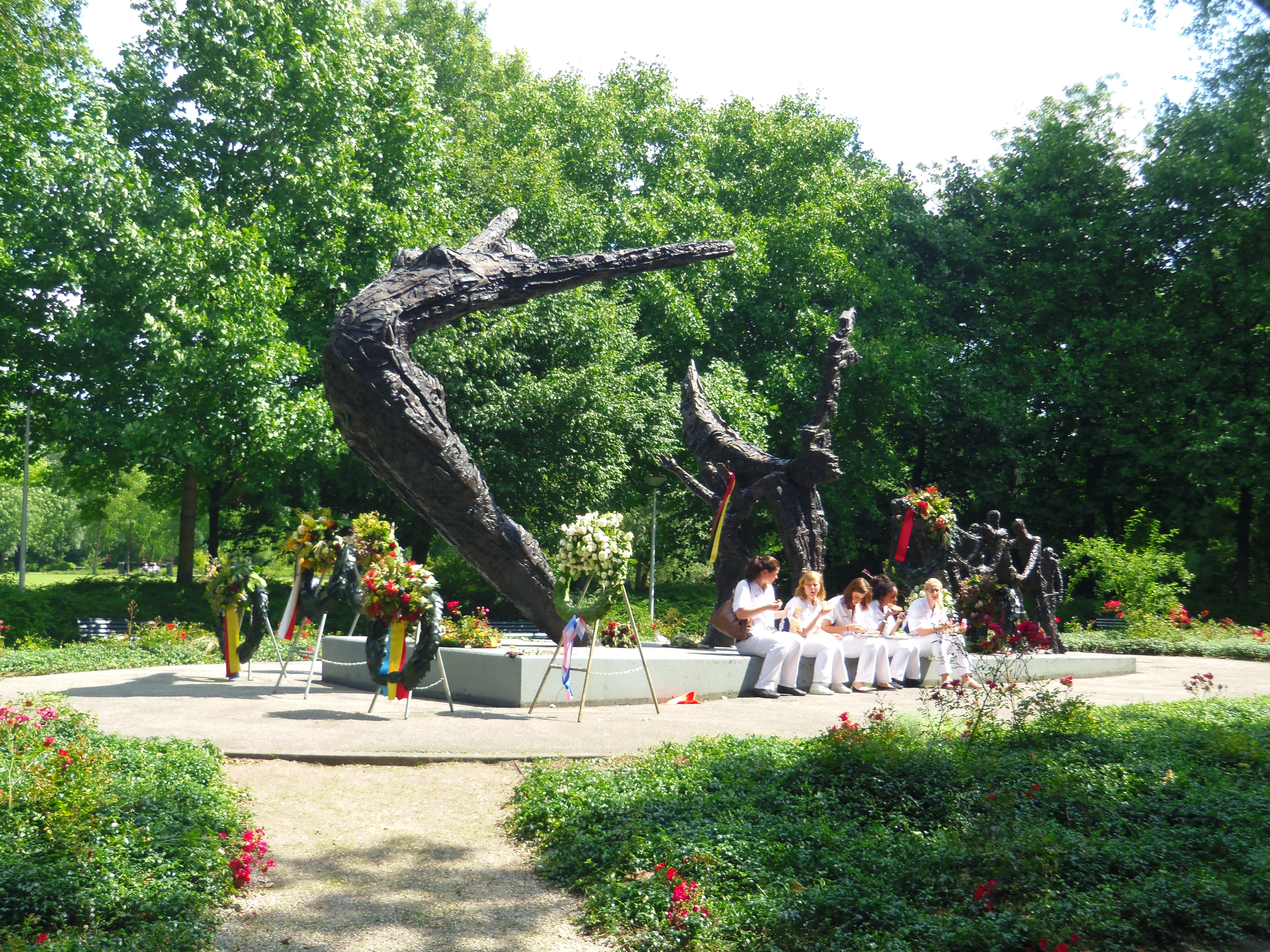
However, they chose to ignore the lessons of history and just good sense, and staged the burning anyway. They did it at the slavery memorial in Osterpark in Amsterdam. As you know, I was in Amsterdam recently, and I visited Osterpark.
Mr. Hill, these photos are for you:
Something's missing...Much better
We shouldn’t burn books. We certainly shouldn’t burn great books. We should learn from them, and if we disagree we should exercise our rights to free speech to do so. Those same free speech rights protect things we like and dislike, and threatening those rights with fire is threatening our entire civilization.
Hey everyone, so as I mentioned, I was out of town this past week. I am in fact still out of town, but at least I am back in the country. Where was I, you ask? Well, as the title probably tipped you to, I was in Amsterdam, Netherlands. I had two poster presentations accepted at the IASLC’s World Conference on Lung Cancer. This is kind of a big deal, career-wise, since it’s a high-profile venue for me to showcase not only my work, but myself as a researcher.
While I was there for work, I did manage to find time to explore the city and see some things that I think you might find interesting. I’m going to try and summarize as much as I can in one post, but it’s probably going to be a long one.
The City of Amsterdam
Amsterdam is the capital city of the Netherlands, and has a long history that relates predominantly to two things: land reclamation and banking. See, the Netherlands used to be largely under water, so the Dutch used windmills to pump water away from the land, creating a harbour. They dug canals that surround the city, allowing buildings to be constructed. They used materials exploited from colonial territory to establish Europe’s first stable banking system. It’s not really an exaggeration to say that Europe would not exist in the absence of the financial stability that was afforded by Dutch banking institutions.
Of course, one has to remember that when we say “the Dutch” dug canals and “the Dutch” exploited resources, we are referring predominantly to Dutch slave owners. The labour responsible for the human-made miracle that is Amsterdam was stolen from Africans, Indonesians, and Caribbean aboriginals. It is certainly no exaggeration to say that Europe was built on the backs of slaves. This is me at a monument to those slaves in Oosterpark on the east side of the city:
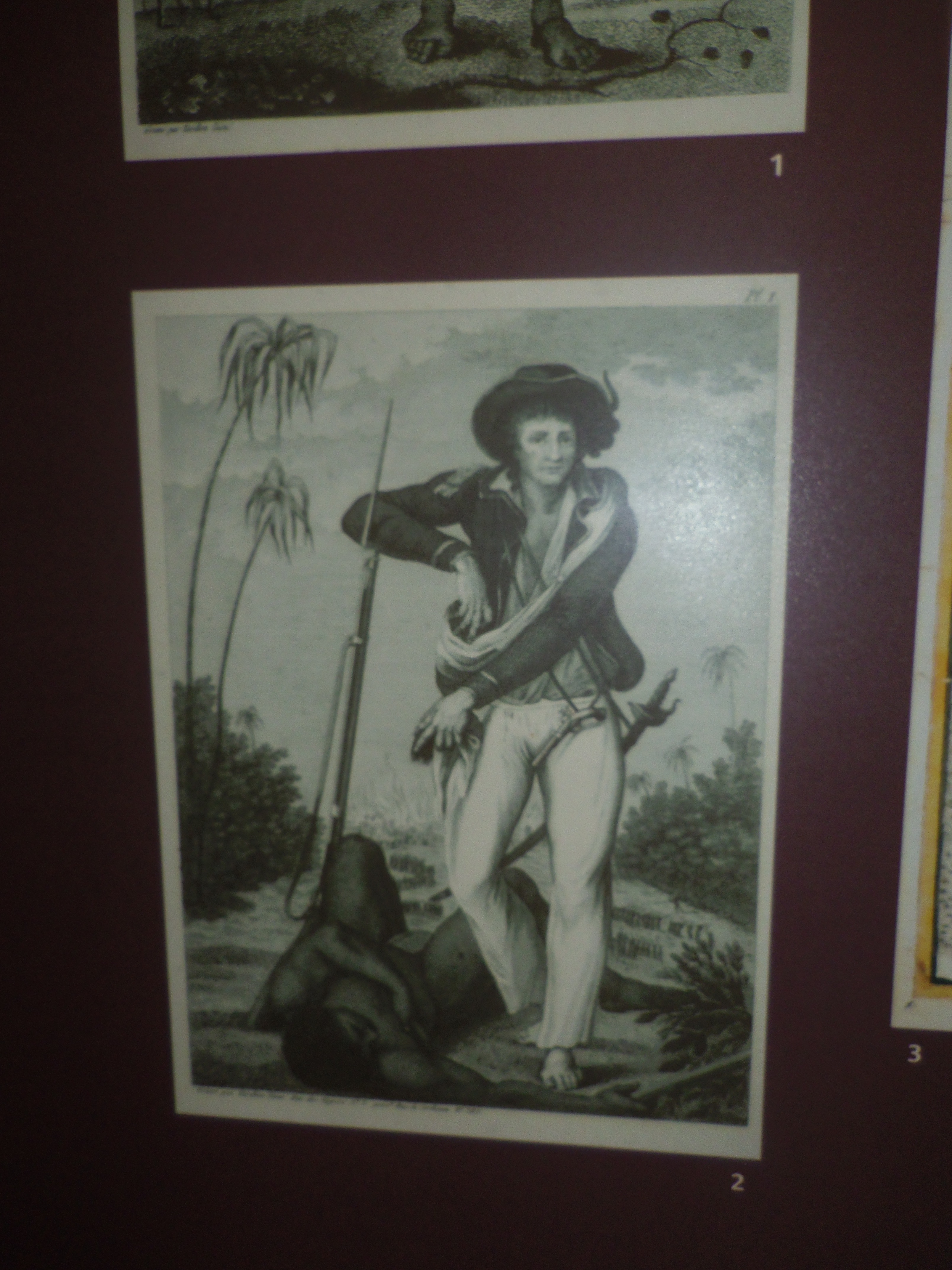
There is a nearby museum devoted to exploring and discussing the slave trade. Of course I couldn’t pass up the opportunity, and I went. Unfortunately (for me, anyway), the entire exhibit was in Dutch. Dutch is actually a remarkably easy language to learn, provided you speak English and have even just a little German. So, while I missed some of the meaning, I did manage to catch most of the general idea of the displays:
Want to be flip about this, but can't
The people of Amsterdam
I have never been to Europe before, so I wasn’t sure what to expect. One of the first things I noticed about people in Amsterdam is that they’re all really good-looking. There were stunningly gorgeous women everywhere I went – riding bicycles, running, working, pushing strollers with good-looking kids in them. It was like walking through some kind of eugenicist’s wet dream.
The next thing I noticed was the sheer amount of race mixing happening. In addition to the fact that there was a large proportion of black people in the populace, I noticed that there wasn’t any kind of “sticking with our own” going on, at least not along race lines. Groups of teenagers, kids, adults, rich, poor, young and old – all sprinkled with people from around the globe. It was pretty amazing to see, especially coming from a place where despite our vaunted tolerance we don’t see a great deal of heterogeneity in peer groups.
There were also a number of interracial couples and people who were clearly (like me) the product of those couplings. I was expecting that everyone was going to confuse me for American because of my skin colour. That definitely wasn’t the case – they took me as Dutch until I began speaking. Then it was my accent rather than my appearance that got them to make that conclusion. Everyone was still very friendly though – maybe the stereotype about the way Europeans treat Americans is a bit out of date.
Life in Amsterdam
I was told by people who have been before that the way to get around Amsterdam is by bicycle. Everyone bikes here. All of the streets have separate lanes for bikes, and bike traffic has right of way. Since it’s a small city and parking is a motherfucker, biking is definitely the most convenient way to get from A to B. While the conference provided me with a transit pass, I only used it once.
Of course Amsterdam is famous for its Red Light District, where prostitution is legalized. I checked it out while I was there (of course) – it was pretty exciting and definitely worth seeing, but I’m not much of a sex tourist. Most of the stuff there is only appealing in the sense that you’ll have a great story to tell afterward. Plus, being there on my own meant that if I wanted to check out some of the more exciting shops, I’d have to go in on my own. That crosses a line in my mind from ‘hilarious curiosity’ to ‘full perv’. Wasn’t ready to make that jump yet.
The other thing that is legal in Amsterdam is marijuana. I live in Vancouver, where we have a sort of “hear no evil, smoke no evil” policy. I wasn’t altogether that fired up to smoke pot, since the novelty is blunted by how readily available it already is. I did, however, try some space cake:
I definitely recommend trying it if you haven’t before, but I also definitely recommend only eating half! That’s all I think I’m comfortable saying about the whole experience.
Concluding thoughts
I really enjoyed being in Amsterdam, and would definitely go back again. The city seems to be inhabited exclusively by happy people, who are also really attractive. Despite the rich heritage and beautiful scenery, it’s important not to forget the country’s history with slavery. Understanding that history is key to understanding the contemporary situation, just as it is here in Canada.
A row with uncomfortable echoes of the past is gripping the world of Germany’s student duelling societies after a club admitted a non-European member. Duellers in Munich objected to the fact a Mannheim club had allowed a member with an Asian background to join, despite his service in the German army.
Yep… that’s happening. Apparently the member in question is German enough to serve Germany in the armed forces, but not German enough to dress up in a silly costume and wave a sword around. The reaction of the club? Well I think we could all have predicted this one:
The clubs’ national association insisted they were not racist.
“We’re not racist, honest! We just don’t like darkies being in our clubs!” The story reads like the plot of a bad Disney movie (Erinner Das Titan maybe?), and just gets more ridiculous the further in you go:
Such societies are usually male and involve dressing up in traditional 19th Century outfits, as well as drinking and fighting with swords. Real swords are used and the men who join often sport a scar on their cheeks to show they have fought a real duel.
There was a feeling from the more conservative elements in Bavaria that, according to internal documents, members with “non-European facial and bodily characteristics” did not qualify as Germans and so could not join what the objectors see as a bastion of true German identity, our correspondent says.
It’s funny, many of the rampant anti-immigrant sentiment currently running through Europe hinges around the idea that immigrants won’t “assimilate”. That people whose ancestry hails from another part of the world (by the way, Germany – your ancestry is from Africa, so maybe you should put down the swords and pick up a drum) will refuse to adopt the customs and mores of the majority group. Since immigrants won’t take on native ideas, we should keep them out! Except here’s a guy who is trying to do just that – take part in a custom that is about as German as it gets, and he’s being forced out by the same majority group.
These kinds of attitudes come from a mindset in which culture is a static thing that cannot and should not change. This is a faulty view of the world – all currently-existing cultures are departures from ones that came before. Those elements of cultures that are valuable are retained (co-operation, family cohesion, respect for individual rights), and those that are not necessary for survival can be sloughed off (exclusion of outsiders, absolute power of the patriarch, tyranny of the majority). There can be debate over the merit of the individual component values, but it is ludicrous to suggest that any change to traditions is a destruction of those values.
The fact that this kind of story merits any discussion at all, let alone the tide of public opinion against the egregious racism on display by these clubs (or at least their conservative elements), is evidence of the fact of this cultural evolution. Time was, not long ago, it was considered entirely reasonable to exclude members of certain racial groups from “private clubs”. This practice still occurs, mind you, but only in those places where the light of modernity hasn’t quite penetrated the curtain of stupidity.
As with the story this morning, these kinds of attitudes will be consigned to the dustbin of history, and be seen as simply an odd curiosity of our ancestry.
Long-time readers of this blog (at least, those that memorize everything I say) may remember two salient details. The first is that I am a big fan of Canadian author Lawrence Hill. His books explore race and racial issues through a Canadian and mixed-race lens, so it’s perhaps no surprise that I am such a fan. The other thing that you might remember is that I think book burnings/bans are possibly the dumbest thing of all time – not only because they don’t work, but because they usually accomplish the exact opposite of their intent, and make more people likely to read the book.
A Dutch group is threatening to burn Lawrence Hill’s award-winning novel The Book of Negroes, because they oppose the use of the word “negro” in the title. The Canadian writer’s novel, which traces the life of a slave girl, was recently published in the Netherlands, where a group that represents slavery victims has threatened to burn the book if its title isn’t changed.
This week, Hill received a letter from Roy Groenberg, the leader of Dutch group Foundation Honor and Restore Victims of Slavery in Suriname. “We, descendants of enslaved in the former Dutch colony Suriname, want let you know that we do not accept a book with the title The Book of Negroes,” he said in the letter.
For those of you that haven’t read this book, you should. Hill is a master of the written word, and his skill is on full display in this particular book (which is hailed as his magnum opus, but I think he’s capable of better), in which he takes the narrator’s chair for the coming-of-age tale of a young African slave girl. I can’t imagine how difficult it must have been to speak from a complete lack of personal experience (when’s the last time Hill experienced menarche?), but he pulls it off convincingly.
Besides the fact that the book is well-written, it’s also historically relevant. It chronicles the nascent and developing abolition movement in Canada, the United States, and England. It documents (fictionally) the foundation of the country of Sierra Leone, thought of as a refuge for freed slaves. It puts context around a period of history that has many myths built around it.
And these idiots want to ban the book because they don’t like the title:
“We struggle for a long time to let the word ‘nigger’ disappear from Dutch language and now you set up your Book of Negroes! A real shame!” Groenberg’s group plans to burn the book on June 22 just over a week before July 1 — which marks the abolition of slavery in the Netherlands.
This is the same mindset of people who would ban the book ‘Moby Dick’ because children would see a naughty word. First off, The Book of Negroes is an actual physical document, from which the novel gets its name. The title is not incidental – it references both the historical document and the people who are the focus of the story. Slavery abolition is the entire purpose of the novel, and to have an anti-slavery body object based on something like a naughty word in the title, one has to wonder whether they’ve actually read the damn book.
But of course, banning a book doesn’t prevent people from reading it. Especially in this day of instantaneous transfer of information, burning a book is simply raising a flag that says “We are ignorant” and “We are out of touch with reality” at the same time. If people in the Netherlands wanted to find a copy of TBoN, they could simply go to Amazon or any number of other online bookstores. Banning the book is therefore futile. Burning the book may have some kind of psychological satisfaction for the protesting group, but it is an outmoded and meaningless gesture.
Book bans also draw attention to the work in question. In this particular case, I have to confess I’m sort of glad for that. People should read this book, if for no other reason than the fact that it’s excellent. And while I can sympathize with those who don’t want to see racism spread through their country, objections to racist language should be based on fact and reason, not knee-jerk reactions based on poor understanding of language.
Last Friday, a great American poet and musician died. Gil Scott Heron was a significant mouthpiece for the black community in the United States, exposing black and white audiences alike to the social and political issues happening with urban black people in the 1960s and 1970s. Part of a great tradition of blues musicians, Scott Heron blended their ability to evoke the pain and suffering of the working-class and poor black man and woman with the emerging scene of spoken-word poetry to pioneer a contemporary method of articulating the struggles of his own community.
Scott Heron’s musical style laid the foundation for the next generation of musicians and artists to perform the same function – funk and soul in the 1970s, followed by hip-hop in the 1980s and 1990s. While he is often credited with the appellation, Scott Heron eschewed being thought of as the forefather of hip-hop music:
Shame on every writer who reported Gil Scott-Heron’s death with the blurb, “Godfather of Rap,” writers who have—per Angela Davis’ observations—totally missed the point of the man’s career. It was a term that Gil Scott-Heron was not ambivalent about: “There seems to be a need within our community to have what the griot provided supplied in terms of chronology; a way to identify and classify events in black culture that were both historically influential and still relevant (Now and Then: The Poems of Gil Scott Hereon, xiv).
This is less Scott-Heron distancing himself from Hip-hop (though he would do so from time to time), but more a recognition that what he did, sat at the feet of traditions that came before him. He writes, “there were poets before me who had great influence on the language and the way it was performed and recorded: Oscar Brown, Jr., Melvin Van Peebles, and Amiri Baraka were all published and well respected for their poetry, plays, songs and range of other artistic achievements when the only thing I was taping were my ankles before basketball practice.” (xiv)
Scott was perhaps best known for his immortal work The Revolution Will Not Be Televised
The revolution will not be right back after a message about a white tornado, white lightning, or white people.
You will not have to worry about a dove in your bedroom, a tiger in your tank, or the giant in your toilet bowl.
The revolution will not go better with Coke.
The revolution will not fight the germs that may cause bad breath.
The revolution will put you in the driver’s seat.
But I think my favourite work of his is a poem called simply Brother:
We deal in too many externals, brother
Always afros, handshakes and dashikis
Never can a man build a working structure for black capitalism
Always does the man read Mao or Fanon
I think I know you would-be black revolutionaries too well
Standing on a box on the corner,
Talking about blowing the white man away
That’s now where it’s at yet, brother
Calling this man an Uncle Tom and telling this woman to get an afro
But you won’t speak to her if she looks like hell, now will you brother
Some of us been checking your act out kinda close
And by now its looking kinda shaky the way you been rushin’ people with your super black bag
Jumping down on some black men with both feet cause they’re after their BA
But you’re never around when your BA is in danger…I mean your black ass
I think it was a little too easy for you to forget that you were a negro before Malcolm
You drove your white girl through the village every Friday night while the grassroots stared in envy and drank wine,
Do you remember?
You need to get your memory banks organized brother.
Show that man you call an Uncle Tom just where he’s wrong
Show that woman that you’re a sincere black man
All we need to do is see you shut up and be black
Help that woman
Help that man
That’s what brothers are for, brother
As a musician, I recognize the importance of history. We all build our lives on the shoulders of those that have come before us, and we hope to add a little piece to their legacy. If we can’t do that, we can at least try and bring the work of those others to a new audience. What we cannot do, what we must not do, is pass off the works of others as original material, and divorce it from its origins. To sever that link to history is to lose all meaning, all context, all life from art, rendering it meaningless.
We’re used to having white people try to rob us
Ain’t no new thing, we have dug his game
Charlie Parker will live on
John Coltrane will live on
Eric Dolphy will live on
Billie Holiday will live on
Jimi Hendrix and Clifford Brown and Lee Morgan will live on
And on in the sunshine of their accomplishments The glory of the dimensions that they added to our lives [emphasis mine]
Gil Scott Heron is dead. A tireless voice for the American black community has fallen silent, but has left a long legacy that lives on in those that carry that voice forward to a new generation.




 Crommunist